Parametrized spaces model locally constant homotopy sheaves
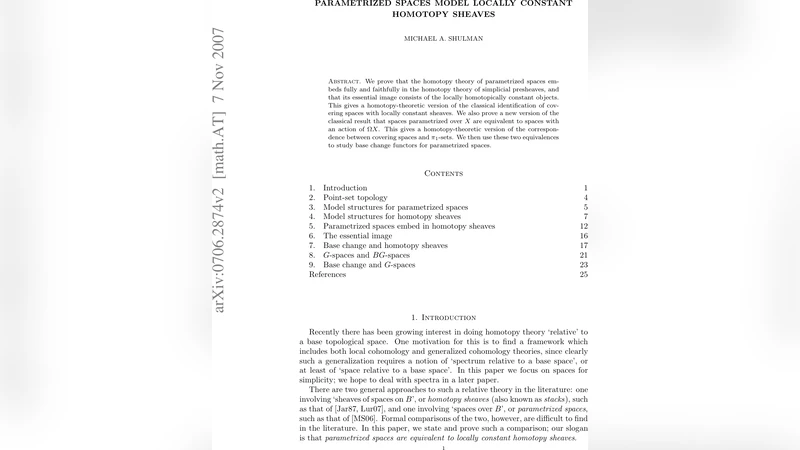
We prove that the homotopy theory of parametrized spaces embeds fully and faithfully in the homotopy theory of simplicial presheaves, and that its essential image consists of the locally homotopically constant objects. This gives a homotopy-theoretic version of the classical identification of covering spaces with locally constant sheaves. We also prove a new version of the classical result that spaces parametrized over X are equivalent to spaces with an action of the loop space of X. This gives a homotopy-theoretic version of the correspondence between covering spaces over X and sets with an action of the fundamental group of X. We then use these two equivalences to study base change functors for parametrized spaces.
💡 Research Summary
The paper establishes two fundamental equivalences that place the homotopy theory of parametrized spaces firmly within the modern framework of simplicial presheaves and loop‑space actions.
First, the authors construct a functor F from the category of parametrized spaces over a fixed base X—objects are continuous maps p : E → X—to the category of simplicial presheaves on X. For each open set U ⊂ X, F(p)(U) is defined as the mapping space Map_X(U,E), i.e. the space of sections of p over U. By endowing the presheaf category with the Joyal‑Jardine model structure and choosing a compatible model structure on parametrized spaces (the “parametrized” or “over‑category” model structure), they prove that F is a Quillen functor which is fully faithful on the homotopy category. Moreover, the essential image of F consists precisely of those presheaves that are locally homotopically constant: for every point x ∈ X there exists a neighbourhood U such that the restriction F(p)|_U is equivalent to a constant presheaf, and these local equivalences glue together homotopically on overlaps. This condition is the homotopical analogue of the classical notion of a locally constant sheaf, and the result can be read as a homotopy‑theoretic version of the correspondence between covering spaces and locally constant sheaves.
Second, the paper proves a new Quillen equivalence between parametrized spaces over X and spaces equipped with an action of the loop space ΩX. Classical covering‑space theory identifies covering spaces of X with sets carrying an action of the fundamental group π₁(X). Here the authors replace the discrete group by the topological monoid ΩX and replace sets by genuine topological spaces, thereby capturing higher homotopical information. They define a functor Φ that sends a parametrized space p : E → X to the total space E equipped with the natural ΩX‑action obtained by concatenating loops in X with paths in the fibres. Conversely, a functor Ψ builds a parametrized space from an ΩX‑space by forming the homotopy quotient E ×_{ΩX} P X, where P X is the path space of X. The pair (Φ, Ψ) forms a Quillen adjunction which is shown to be a Quillen equivalence. Consequently, parametrized homotopy types are exactly the homotopy types of ΩX‑modules, extending the classical π₁‑action picture to all higher homotopy groups.
Having these two equivalences at hand, the authors turn to base‑change functors. For a continuous map f : X → Y, the usual pull‑back f^* and push‑forward f_! on parametrized spaces correspond under F to the restriction and left Kan extension of simplicial presheaves, respectively. Under the loop‑space picture, the same base‑change functors are realized as induction and co‑induction along the induced map of loop spaces Ωf : ΩX → ΩY. The paper proves that these descriptions are compatible: the diagram of homotopy categories involving parametrized spaces, locally constant presheaves, and Ω‑modules commutes up to natural equivalence. This compatibility yields clean formulas for how homotopy‑sheaves and loop‑space actions transform under base change, and it clarifies when base change preserves local homotopy constancy (e.g., for covering maps or fibrations with contractible fibres).
The final sections illustrate the theory with examples. When X is simply connected, ΩX is contractible, so every parametrized space is already locally constant and the base‑change functors reduce to ordinary restriction and extension of sheaves. When X has non‑trivial higher homotopy, the Ω‑action encodes monodromy data not captured by π₁ alone, and the locally constant condition forces the parametrized space to be a homotopy‑coherent system of fibres with compatible ΩX‑action.
In summary, the paper provides a robust homotopy‑theoretic framework that unifies three perspectives: (1) parametrized spaces as objects over a base, (2) locally homotopically constant simplicial presheaves (homotopy sheaves), and (3) spaces with a continuous action of the loop space. By establishing full and faithful embeddings and Quillen equivalences, it extends classical covering‑space theory to the realm of higher homotopy, and it supplies a clear description of base‑change phenomena across all three models. This work opens the door to further applications in parametrized spectra, higher stacks, and equivariant homotopy theory, where the interplay between base‑space topology, sheaf‑theoretic locality, and loop‑space symmetry is essential.
Comments & Academic Discussion
Loading comments...
Leave a Comment