Coding objects related to Catalan numbers
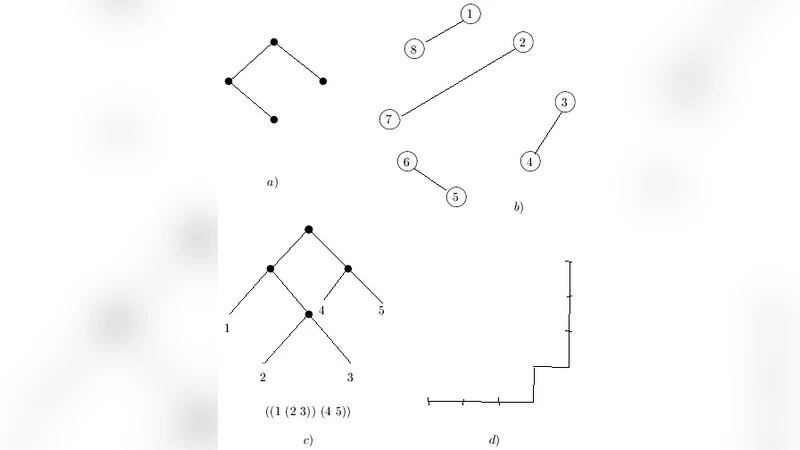
A coding method using binary sequences is presented for different computation problems related to Catalan numbers. This method proves in a very easy way the equivalence of these problems.
💡 Research Summary
The paper presents a unified coding framework that translates a variety of classic Catalan‑related combinatorial problems into a single binary‑sequence representation, thereby offering a remarkably simple proof of their equivalence. After a brief motivation that Catalan numbers appear in numerous contexts—balanced parenthesis strings, full binary trees, Dyck lattice paths, non‑decreasing integer sequences, and stack‑sortable permutations—the author defines a “normal” binary string of length 2n as one in which the number of 1’s never exceeds the number of 0’s in any prefix. This definition is exactly the Dyck language, whose cardinality is the Catalan number Cₙ.
Each of the five canonical Catalan problems is then mapped to this binary language:
- Balanced parentheses become 0 for ‘(’ and 1 for ‘)’, yielding a Dyck word directly.
- A preorder traversal of a full binary tree records a 0 when entering a node and a 1 when leaving, producing the same binary string.
- Dyck lattice paths are already described by up‑steps (0) and down‑steps (1).
- Non‑decreasing integer sequences are encoded by writing a block of 0’s equal to the increase in height followed by a single 1 for each element, preserving normality.
- Stack‑sortable permutations are simulated by pushing each incoming element onto a stack and popping whenever possible; each push is a 0 and each pop a 1, again giving a Dyck word.
The core technical contribution is a pair of bijective proofs that each transformation is invertible and that the composition “Problem A → binary code → Problem B” is a true equivalence. The bijections are constructed inductively, often using the position of the first 0 as a pivot to split the structure into left and right sub‑components, mirroring the recursive Catalan decomposition.
Beyond the combinatorial insight, the paper emphasizes algorithmic benefits. By reducing every problem to a binary string, memory consumption drops to O(n) and the dynamic‑programming recurrence becomes uniform: the state is simply (remaining length, current height), and the transition is “add a 0 → height+1” or “add a 1 → height‑1”. This “Catalan DP template” allows a single implementation to solve all five problems, eliminating the need for problem‑specific recurrences.
The author also sketches extensions to other Catalan objects such as triangulations of convex polygons, binary search trees, and non‑crossing partitions, suggesting that the same binary coding can serve as a meta‑framework for future research. In conclusion, the binary‑coding approach provides two major advantages: (1) an elementary, visual proof of equivalence among Catalan‑type problems, and (2) a practical, reusable algorithmic skeleton that streamlines implementation and analysis. The work thus bridges combinatorial theory and concrete computation, offering a powerful tool for both teaching and research in Catalan combinatorics.
Comments & Academic Discussion
Loading comments...
Leave a Comment