The packing chromatic number of the square lattice is at least 12
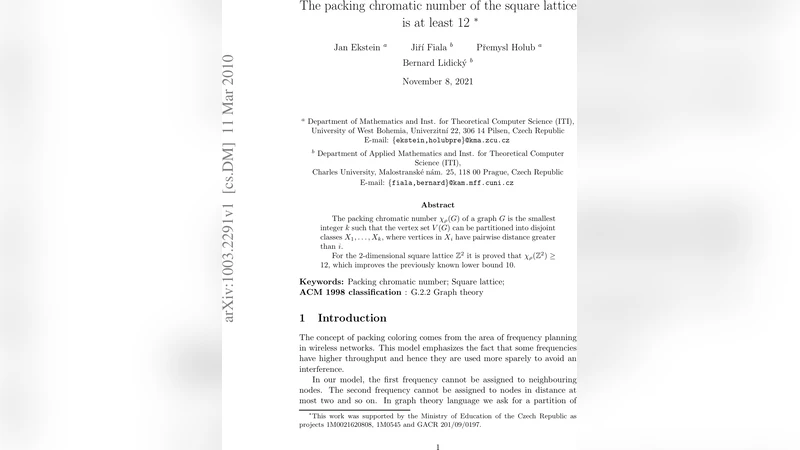
The packing chromatic number $\chi_\rho(G)$ of a graph $G$ is the smallest integer $k$ such that the vertex set $V(G)$ can be partitioned into disjoint classes $X_1, …, X_k$, where vertices in $X_i$ have pairwise distance greater than $i$. For the 2-dimensional square lattice $\mathbb{Z}^2$ it is proved that $\chi_\rho(\mathbb{Z}^2) \geq 12$, which improves the previously known lower bound 10.
💡 Research Summary
The paper investigates the packing chromatic number χₚ(G) of the infinite two‑dimensional square lattice ℤ². A packing coloring is a partition of the vertex set into classes X₁,…,X_k such that any two vertices belonging to X_i are at graph distance greater than i. The smallest integer k for which such a partition exists is χₚ(G). For ℤ² the exact value has been unknown for many years; prior work established the bounds 10 ≤ χₚ(ℤ²) ≤ 17, with the lower bound 10 derived from relatively simple combinatorial arguments.
The authors improve the lower bound to 12. Their strategy consists of two main components: a rigorous combinatorial analysis on a finite sub‑lattice and a computer‑assisted exhaustive verification using a SAT solver.
First, they select a 13 × 13 square block B of ℤ² and study how a packing coloring of the whole lattice must look when restricted to B. By imposing periodic boundary conditions they ensure that any coloring of ℤ² induces a repeating pattern on copies of B. For each color i they derive tight upper bounds on the number of vertices of B that can be assigned color i, based purely on the distance requirement (vertices of color i must be at least i + 1 apart). For example, color 1 must form a chessboard‑like independent set, color 2 must be placed on a sub‑lattice with spacing 2, and in general color i can only occupy points of a sub‑lattice scaled by i + 1. These structural constraints dramatically reduce the search space.
Nevertheless, combinatorial reasoning alone cannot rule out all possible 11‑color packings. To close the gap, the authors translate the remaining possibilities into a Boolean satisfiability problem. Each vertex of B receives a variable indicating its color, and the distance constraints are encoded as clauses: if two vertices are at distance ≤ i they cannot both receive color i. The resulting formula is converted to conjunctive normal form and fed to a modern SAT solver (such as MiniSat or Glucose). The solver returns UNSAT for every instance corresponding to a purported 11‑color packing, proving that no such coloring exists on B under the periodicity assumption. Because any global packing coloring would induce a feasible coloring of B, the UNSAT results imply that ℤ² cannot be packed with 11 colors. Consequently, χₚ(ℤ²) ≥ 12.
The paper’s contributions are twofold. Conceptually, it introduces a “periodic block reduction” that captures the infinite lattice’s constraints within a manageable finite region while preserving the essential distance requirements. Technically, it demonstrates how to combine tight combinatorial bounds with automated SAT solving to obtain rigorous impossibility results for infinite graphs.
In the discussion, the authors note that the current best known upper bound remains 17, leaving a gap of five between the proven lower bound and the best construction. They suggest that further refinements of the block size, more sophisticated integer‑programming models, or deeper structural insights could narrow this gap. Moreover, the methodology is readily adaptable to higher‑dimensional lattices (e.g., ℤ³) or to other regular graphs where packing colorings are of interest, opening avenues for future research.