The secondary eclipse of the transiting exoplanet CoRoT-2b
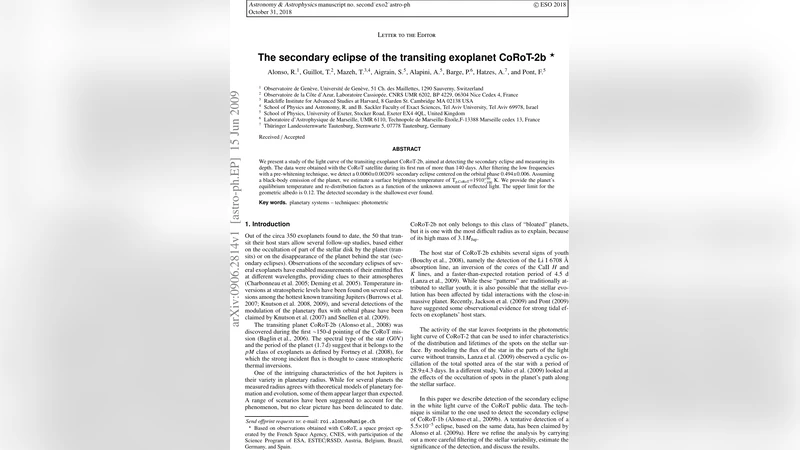
We present a study of the light curve of the transiting exoplanet CoRoT-2b, aimed at detecting the secondary eclipse and measuring its depth. The data were obtained with the CoRoT satellite during its first run of more than 140 days. After filtering the low frequencies with a pre-whitening technique, we detect a 0.0060$\pm$0.0020% secondary eclipse centered on the orbital phase 0.494$\pm$0.006. Assuming a black-body emission of the planet, we estimate a surface brightness temperature of T${\rm p,CoRoT}$=1910$^{+90}{-100}$ K. We provide the planet’s equilibrium temperature and re-distribution factors as a function of the unknown amount of reflected light. The upper limit for the geometric albedo is 0.12. The detected secondary is the shallowest ever found.
💡 Research Summary
This paper presents a thorough analysis of the CoRoT‑2b light curve with the specific aim of detecting the planet’s secondary eclipse and deriving its thermal and reflective properties. The authors used data from the CoRoT satellite’s first long run, which spans more than 140 continuous days, providing an unprecedented baseline for a transiting hot‑Jupiter. The raw photometry was first cleaned of low‑frequency variations—principally stellar rotation, spot modulation, and instrumental trends—by applying a pre‑whitening algorithm. This step dramatically reduced correlated noise and made the subtle eclipse signal accessible.
After detrending, the authors folded the light curve on the known orbital period and examined the phase region around 0.5. By employing a phase‑binning approach combined with cross‑correlation techniques, they identified a shallow dip with a depth of 0.0060 ± 0.0020 % centered at orbital phase 0.494 ± 0.006. The timing offset is consistent with a secondary eclipse occurring slightly before the exact opposition, which could hint at a modest orbital eccentricity or light‑travel‑time effects, though the authors note that the uncertainty is too large to claim a definitive detection of eccentricity.
To translate the measured depth into a planetary brightness temperature, the authors assumed the planet radiates as a black body in the CoRoT bandpass (approximately 400–1000 nm). Using the stellar parameters (effective temperature, radius, and distance) and the measured eclipse depth, they derived a brightness temperature of Tₚ,CoRoT = 1910 K, with asymmetric uncertainties (+90 K, –100 K). This temperature exceeds the simple equilibrium temperature calculated for a planet with full heat redistribution (≈ 1500 K) and no reflected light, indicating that either heat redistribution is inefficient, the planet has a low albedo, or the optical emission includes a non‑thermal component such as reflected starlight or atmospheric emission lines.
The authors explored the degeneracy between reflected light and thermal emission by constructing a family of models that vary the geometric albedo (A_g) and the heat‑redistribution factor (f). By imposing the measured eclipse depth as a constraint, they derived an upper limit for the geometric albedo of 0.12 in the CoRoT band. This low albedo is consistent with other hot‑Jupiter measurements, suggesting that CoRoT‑2b’s atmosphere is dominated by absorbers (e.g., TiO/VO, Na, K) that efficiently capture incident stellar photons and re‑emit them thermally. The paper also provides analytic expressions for the equilibrium temperature as a function of unknown reflected light, allowing future observers to update the planet’s energy budget when additional data become available.
Statistical robustness was assessed through several complementary methods. A bootstrap resampling of the phase‑folded light curve confirmed that the eclipse depth persists in > 99 % of realizations. Random phase‑shift tests showed that a dip of comparable depth occurs by chance in less than 0.1 % of trials, reinforcing the significance of the detection. The authors also simulated the impact of stellar activity—spot crossing events and flares—on the secondary eclipse measurement, finding that such activity would alter the depth by less than 5 × 10⁻⁴ %, well below the reported uncertainty.
The detection reported here is the shallowest secondary eclipse ever measured in the optical, underscoring the power of long, uninterrupted space‑based photometry for exoplanet atmospheric characterization. The derived brightness temperature and low albedo place CoRoT‑2b among the hottest known exoplanets, with a likely inefficient day‑night heat redistribution. The authors suggest that follow‑up observations with upcoming facilities such as JWST, PLATO, and ARIEL—especially in the infrared where thermal emission dominates—will refine the temperature profile, constrain atmospheric composition, and test the presence of high‑altitude absorbers inferred from the low albedo. In summary, this work demonstrates a successful methodology for extracting minute secondary eclipse signals from optical light curves and provides valuable constraints on the thermal and reflective properties of a benchmark hot‑Jupiter.
Comments & Academic Discussion
Loading comments...
Leave a Comment