On irreversible dynamic monopolies in general graphs
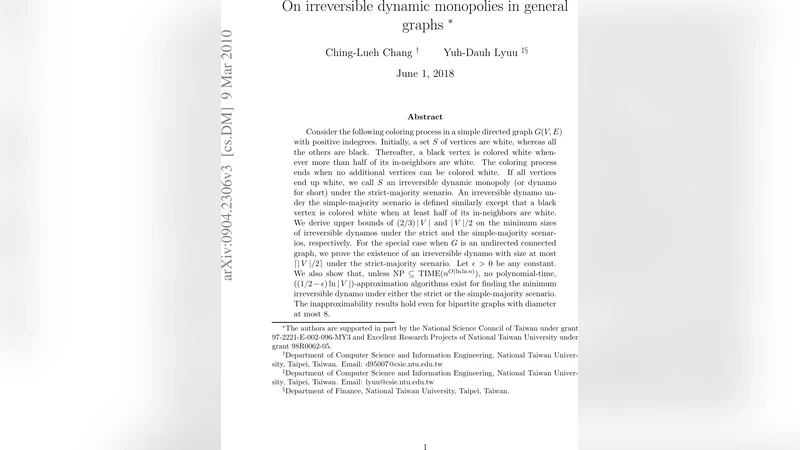
Consider the following coloring process in a simple directed graph $G(V,E)$ with positive indegrees. Initially, a set $S$ of vertices are white, whereas all the others are black. Thereafter, a black vertex is colored white whenever more than half of its in-neighbors are white. The coloring process ends when no additional vertices can be colored white. If all vertices end up white, we call $S$ an irreversible dynamic monopoly (or dynamo for short) under the strict-majority scenario. An irreversible dynamo under the simple-majority scenario is defined similarly except that a black vertex is colored white when at least half of its in-neighbors are white. We derive upper bounds of $(2/3),|,V,|$ and $|,V,|/2$ on the minimum sizes of irreversible dynamos under the strict and the simple-majority scenarios, respectively. For the special case when $G$ is an undirected connected graph, we prove the existence of an irreversible dynamo with size at most $\lceil |,V,|/2 \rceil$ under the strict-majority scenario. Let $\epsilon>0$ be any constant. We also show that, unless $\text{NP}\subseteq \text{TIME}(n^{O(\ln \ln n)}),$ no polynomial-time, $((1/2-\epsilon)\ln |,V,|)$-approximation algorithms exist for finding the minimum irreversible dynamo under either the strict or the simple-majority scenario. The inapproximability results hold even for bipartite graphs with diameter at most 8.
💡 Research Summary
The paper studies a deterministic irreversible diffusion process on directed graphs with positive indegrees, motivated by models of opinion spreading, viral marketing, and fault propagation. Initially a set S of vertices is colored white while all others are black. A black vertex becomes white if a majority of its in‑neighbors are white. Two majority thresholds are considered: (i) strict majority, where more than half of the in‑neighbors must be white, and (ii) simple majority, where at least half suffice. Once a vertex turns white it never reverts, so the process is irreversible. If the process eventually colors every vertex white, the initial set S is called an irreversible dynamic monopoly (or dynamo) for the chosen threshold.
The authors first establish universal upper bounds on the size of a minimum dynamo. For the strict‑majority rule they prove that any directed graph on |V| vertices admits a dynamo of size at most (2/3)·|V|. The proof proceeds by partitioning the vertex set into three parts and showing that at least one part must be small enough to serve as a seed set that triggers full activation. For the simple‑majority rule they improve the bound to |V|/2, using a similar partition argument but exploiting the weaker activation condition.
When the underlying graph is undirected and connected, a stronger result holds: under strict majority there always exists a dynamo of size at most ⌈|V|/2⌉. The construction relies on a minimum cut: the smaller side of any minimum cut contains at most half of the vertices, and because each vertex has the same number of neighbors on both sides, the strict‑majority condition guarantees that this side will eventually force the opposite side to turn white.
The second major contribution is a hardness of approximation result. By a careful reduction from the classic Set‑Cover problem, the authors show that, assuming NP ⊈ TIME(n^{O(log log n)}), no polynomial‑time algorithm can achieve an approximation factor better than (½ − ε)·ln |V| for any constant ε > 0, for either the strict‑ or simple‑majority dynamo problem. The reduction preserves bipartiteness and keeps the graph diameter at most 8, demonstrating that the inapproximability holds even for very restricted graph families.
Together, these findings delineate the landscape of irreversible dynamos: (1) there are provable linear‑size upper bounds that are tight up to constant factors; (2) for undirected connected graphs the bound can be halved; (3) computing or even approximating the minimum dynamo is essentially as hard as Set‑Cover, with logarithmic lower bounds on approximability that survive severe structural restrictions. Consequently, practical algorithms are unlikely to achieve near‑optimal solutions in general, and future work should focus on exploiting special graph properties (e.g., tree‑like structure, bounded treewidth, or community organization) or on designing effective heuristics and parameterized algorithms for specific applications.
Comments & Academic Discussion
Loading comments...
Leave a Comment