Automated Proofs in Geometry : Computing Upper Bounds for the Heilbronn Problem for Triangles
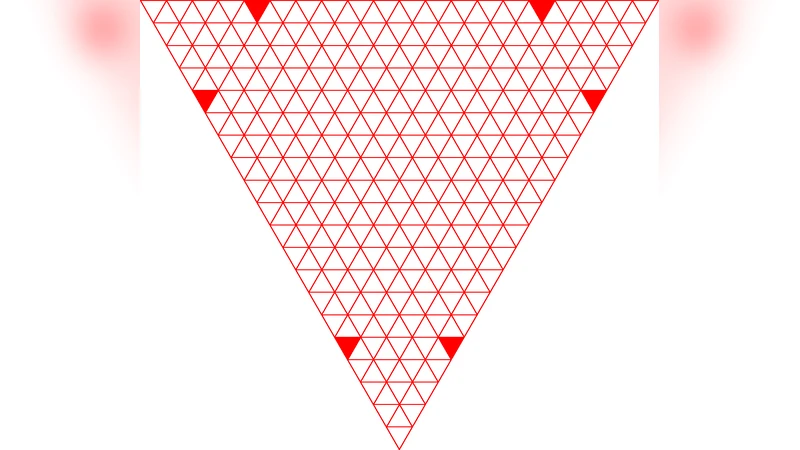
We propose a method for computing upper bounds for the Heilbronn problem for triangles.
💡 Research Summary
The paper addresses the classic Heilbronn triangle problem, which asks: given N points placed inside a triangle of unit area, what is the smallest possible maximal area of a triangle formed by any three of those points? In other words, one seeks the minimal σ such that among any N points in a unit‑area triangle there always exists a triple whose convex hull has area ≤ σ. While exact optimal configurations are known for N = 3 and 4 (trivial) and have been proved for N = 5 and 6 by earlier works, the situation for larger N remains largely unresolved, with only lower bounds known for N ≥ 7.
The authors propose a systematic, computer‑assisted method to obtain rigorous upper bounds for σ for any N, and they implement it for N = 5, 6, 7. Their approach is inspired by a 2008 paper of Matthew Kahle, but it replaces Kahle’s heuristic reasoning with exhaustive enumeration and integer arithmetic, thereby turning the computation into a form of automated theorem proving.
The core of the method is a discretization of the unit triangle T. The triangle is subdivided into a regular grid of P × P congruent elementary triangles by drawing lines parallel to each side. Each elementary triangle is taken as a possible “cell” that may contain one of the N points. For a given N‑tuple of cells (e.g., a 5‑tuple when N = 5) the algorithm examines every choice of three distinct cells within that tuple. For each such triple, it enumerates the 27 possible triangles whose vertices lie at the three vertices of the three cells (each cell contributes three vertices, and a triangle is formed by picking one vertex from each cell). The area of each of these 27 candidate triangles is computed, and the maximum among them is recorded as the worst‑case area for that particular triple of cells.
For a fixed N‑tuple, the algorithm then takes the minimum over all triples of cells of the worst‑case area; this value, denoted σ(N) for that tuple, is an upper bound on the true σ for any configuration that places one point inside each of the N cells. Finally, the algorithm scans all possible N‑tuples of cells in the P × P grid and records the largest σ(N) encountered. This final number is a rigorous upper bound for the Heilbrinson problem with N points, because any placement of N points can be “rounded” to a placement where each point lies in a distinct cell, and the rounding can only increase the maximal triangle area.
A crucial technical refinement is the use of integer coordinates. By choosing T to be an isosceles right triangle whose legs have length P, every vertex of every elementary triangle has integer coordinates, and the area of any triangle formed by three such vertices is a rational number with denominator 2P². Consequently, all calculations can be performed exactly with integers, eliminating any floating‑point rounding error. The authors stress that this guarantees that the computed σ(N) values are true mathematical upper bounds, not merely numerical approximations.
The experimental results are reported for several values of P. For N = 5 they obtain:
- P = 10 → σ(5) ≤ 0.21 (slightly better than Kahle’s 0.24).
- P = 15 → σ(5) ≈ 0.2044.
- P = 20 → σ(5) ≈ 0.1975.
- P = 25 → σ(5) = 121/625 ≈ 0.1936.
Thus, as the grid is refined, the bound decreases and appears to converge near 0.19. The authors also explore a restricted scenario where the optimal five points are assumed to lie on the boundary of T. Under this assumption and with a much finer grid (P = 150) they obtain a stronger bound σ(5) ≤ 87/500 ≈ 0.174, suggesting that the true optimum may indeed be attained on the perimeter.
For N = 6 and N = 7 the same pipeline yields:
- σ(6) ≤ 3/20 = 0.15, based on a specific configuration illustrated in the paper (Figure 7).
- σ(7) ≤ 23/200 = 0.115, again tied to an explicit construction (Figure 8).
These bounds are higher than the conjectured optimal values (σ(6) = 1/8 = 0.125 and σ(7) ≈ 0.0922) but are nevertheless rigorous, as they arise from exhaustive enumeration.
The paper’s contributions can be summarized as follows:
- Methodological Innovation – It demonstrates how automated theorem proving techniques can be harnessed for a classic extremal geometry problem, turning a combinatorial search into a provably correct algorithm.
- Exact Integer Arithmetic – By mapping the problem onto an integer lattice, the authors avoid any numerical uncertainty, ensuring that the reported bounds are mathematically sound.
- Improved Upper Bounds – For N = 5 the bound 0.1936 improves on previous results; for N = 6 and 7 the paper provides the first computer‑verified upper bounds, albeit not yet optimal.
- Scalability Discussion – Although the exhaustive search grows combinatorially with P and N, the authors note that parallelization and smarter pruning could extend the approach to larger N.
In conclusion, the work offers a concrete, reproducible framework for obtaining rigorous upper bounds on the Heilbronn triangle problem. It bridges the gap between heuristic geometric arguments and formal verification, and it opens the door to future investigations that could combine more sophisticated combinatorial pruning, parallel computation, and perhaps even machine‑learning‑guided search to push the bounds closer to the true optimum for larger N.
Comments & Academic Discussion
Loading comments...
Leave a Comment