On the action of the group of isometries on a locally compact metric space
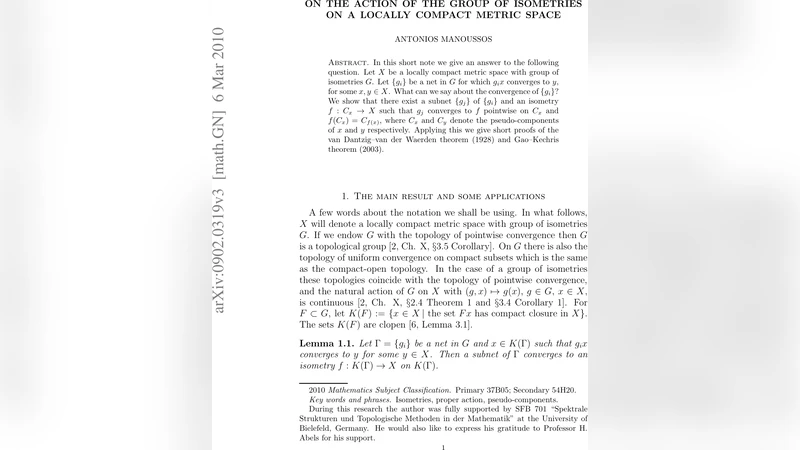
In this short note we give an answer to the following question. Let $X$ be a locally compact metric space with group of isometries $G$. Let ${g_i}$ be a net in $G$ for which $g_ix$ converges to $y$, for some $x,y\in X$. What can we say about the convergence of ${g_i}$? We show that there exist a subnet ${g_j}$ of ${g_i}$ and an isometry $f:C_x\to X$ such that $g_{j}$ converges to $f$ pointwise on $C_x$ and $f(C_x)=C_{f(x)}$, where $C_x$ and $C_y$ denote the pseudo-components of $x$ and $y$ respectively. Applying this we give short proofs of the van Dantzig–van der Waerden theorem (1928) and Gao–Kechris theorem (2003).
💡 Research Summary
The paper addresses a natural but subtle question about the convergence behavior of sequences (more generally nets) in the isometry group G of a locally compact metric space X. Suppose we are given a net {g_i}⊂G such that for some points x, y∈X the orbit points g_i x converge to y. One might hope that the whole net {g_i} converges in some sense inside G, but the usual topologies on transformation groups (e.g., the compact‑open topology) do not guarantee convergence from a single orbit convergence. The authors resolve this by introducing the notion of a pseudo‑component C_x of a point x. A pseudo‑component is the maximal subset of X in which any two points can be joined by a finite chain of arbitrarily small jumps; equivalently, for every ε>0 there exists a finite ε‑chain connecting the points. In a locally compact metric space each pseudo‑component is open, and, crucially, it inherits completeness from X.
The main theorem states: if a net {g_i} in G satisfies g_i x→y, then there exists a subnet {g_j} and an isometry f defined on the pseudo‑component C_x such that for every z∈C_x we have g_j z→f(z). Moreover, f maps C_x onto the pseudo‑component of its image point, i.e. f(C_x)=C_{f(x)}. The proof proceeds in two stages. First, using local compactness, the authors show that for any neighbourhood U of y there is an index i_0 such that for i≥i_0 the images g_i(U_x) are contained in U, where U_x is a small neighbourhood of x. This yields pointwise convergence on a neighbourhood of x. Second, for an arbitrary z∈C_x, one chooses an ε‑chain x=z_0, z_1,…,z_n=z. Applying the pointwise convergence to each link of the chain and using the triangle inequality, one proves that the sequence {g_i z} is Cauchy; completeness gives a limit f(z). The map f is shown to preserve distances by a direct computation, hence is an isometry on C_x. To prove that f is onto C_{f(x)} one repeats the argument with the inverse net {g_i^{-1}} and obtains an inverse isometry, establishing that f is a bijective isometry between the two pseudo‑components.
Having this precise description of convergence, the authors give streamlined proofs of two classical results. The van Dantzig–van der Waerden theorem (1928) asserts that the isometry group of a locally compact metric space is itself locally compact and acts properly. The theorem above shows that any net with a convergent orbit admits a subnet converging to an actual isometry on a neighbourhood, which implies that the compact‑open topology on G coincides with the topology of pointwise convergence on compact sets. This coincidence yields local compactness of G and the properness of the action without invoking heavy machinery. The second application is to the Gao–Kechris theorem (2003), which states that the isometry group of a complete separable metric space (a Polish space) is a Polish group and its natural action is Borel‑regular. The authors observe that the limit map f constructed in the main theorem is Borel measurable, and because the construction works on the whole pseudo‑component (which is Borel), the action of G on X is Borel‑regular. Thus the theorem follows directly from the convergence result.
Beyond these applications, the paper highlights a methodological contribution: by focusing on the local structure given by pseudo‑components, one can extract global convergence information about transformation groups from merely a single convergent orbit. This approach bypasses the need for global compactness assumptions on the whole space and suggests possible extensions to settings where the space is not locally compact or where the acting group consists of more general homeomorphisms rather than isometries. The authors conclude that the pseudo‑component technique provides a versatile tool for studying the topology and dynamics of isometry groups, with potential implications for descriptive set theory, geometric group theory, and the analysis of metric‑space automorphisms.
Comments & Academic Discussion
Loading comments...
Leave a Comment