Hybrid approach for Image Encryption Using SCAN Patterns and Carrier Images
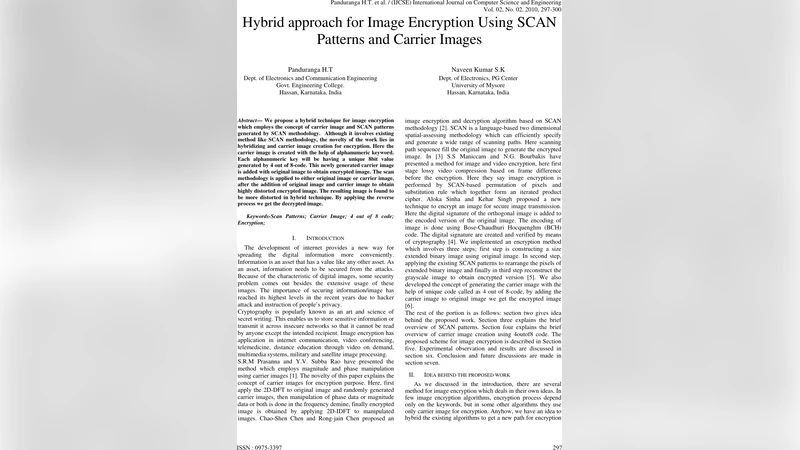
We propose a hybrid technique for image encryption which employs the concept of carrier image and SCAN patterns generated by SCAN methodology. Although it involves existing method like SCAN methodology, the novelty of the work lies in hybridizing and carrier image creation for encryption. Here the carrier image is created with the help of alphanumeric keyword. Each alphanumeric key will be having a unique 8bit value generated by 4 out of 8-code. This newly generated carrier image is added with original image to obtain encrypted image. The scan methodology is applied to either original image or carrier image, after the addition of original image and carrier image to obtain highly distorted encrypted image. The resulting image is found to be more distorted in hybrid technique. By applying the reverse process we get the decrypted image.
💡 Research Summary
The paper presents a hybrid image encryption scheme that combines two previously independent techniques: carrier‑image based encryption and SCAN‑methodology based pixel permutation. A carrier image is generated from an alphanumeric keyword by mapping each character to a unique 8‑bit pattern drawn from a 4‑out‑of‑8 code set (36 possible codes, each containing exactly four ‘1’s and four ‘0’s, with each nibble balanced). The keyword is repeated or tiled to match the dimensions of the original image, and the lookup table is used to replace each character with its corresponding 8‑bit value, producing a carrier image of the same size as the plaintext.
The encryption process consists of three main steps: (1) creation of the carrier image from the keyword, (2) pixel‑wise addition of the carrier image to the original image (implicitly modulo‑256), and (3) application of a SCAN pattern to the resulting image. SCAN is a formal language for describing two‑dimensional traversal paths; the authors employ its four basic patterns—continuous raster (C), continuous diagonal (D), continuous orthogonal (O), and spiral (S)—each with eight possible transformations (rotations and reversals). The SCAN transformation acts as a permutation of pixel positions, and its inverse can be used for decryption.
The authors illustrate several configurations: (a) applying only a SCAN permutation to the original image, (b) adding only the carrier image, (c) adding the carrier image first and then applying a SCAN permutation, and (d) applying a SCAN permutation to the carrier image before adding it to the original. Experiments are performed on the standard “Lena” bitmap, using three different keywords (“Iwant2EncryptThisImage”, “HybridApproch128z”, and “UniversityOfMysore”). Visual results show that the hybrid configurations (c) and (d) produce far more distorted ciphertext images than the single‑method cases, supporting the claim that combining the two techniques increases apparent security.
The paper’s contribution lies mainly in the integration of the two methods and the demonstration that the combined approach yields higher visual distortion. However, the work lacks a rigorous security analysis: no quantitative metrics such as NPCR, UACI, entropy, or key‑space size are reported; the carrier‑image generation relies on a fixed 36‑entry lookup table, limiting key entropy; and the SCAN permutations are linear and potentially vulnerable to known‑plaintext attacks. The authors acknowledge these limitations and suggest future extensions, including the use of more complex SCAN patterns, richer carrier‑image generation (e.g., random or chaotic codes), and additional bit‑level manipulations to increase non‑linearity.
In summary, the proposed hybrid scheme demonstrates that a simple combination of carrier‑image addition and SCAN‑based pixel rearrangement can produce ciphertext images with higher visual distortion, but further work is required to substantiate its cryptographic strength through formal analysis and expanded key space.
Comments & Academic Discussion
Loading comments...
Leave a Comment