One of my recent papers transforms an NP-Complete problem into the question of whether or not a feasible real solution exists to some Linear Program. The unique feature of this Linear Program is that though there is no explicit bound on the minimum required number of linear inequalities, which is most probably exponential to the size of the NP-Complete problem, the Linear Program can still be described efficiently. The reason for this efficient description is that coefficients keep repeating in some pattern, even as the number of inequalities is conveniently assumed to tend to Infinity. I discuss why this convenient assumption does not change the feasibility result of the Linear Program. I conclude with two Conjectures, which might help to make an efficient decision on the feasibility of this Linear Program.
Deep Dive into Repeating Patterns in Linear Programs that express NP-Complete Problems.
One of my recent papers transforms an NP-Complete problem into the question of whether or not a feasible real solution exists to some Linear Program. The unique feature of this Linear Program is that though there is no explicit bound on the minimum required number of linear inequalities, which is most probably exponential to the size of the NP-Complete problem, the Linear Program can still be described efficiently. The reason for this efficient description is that coefficients keep repeating in some pattern, even as the number of inequalities is conveniently assumed to tend to Infinity. I discuss why this convenient assumption does not change the feasibility result of the Linear Program. I conclude with two Conjectures, which might help to make an efficient decision on the feasibility of this Linear Program.
Given a univariate integer Polynomial Q(x) of degree d, it has been proved [1] that Q(x) does not have a positive real root, if and only if, Q(x) can be multiplied by some Polynomial P(x) with positive coefficients, so as to produce a resultant Polynomial with positive coefficients. Here we assume that both the coefficients of 1 and of x d in Q(x) are positive, and if not, then we assume without loss of generality that Q(x) is simply replaced with Q 2 (x). The minimum required degree of P(x), has been shown to be bounded by some function of the smallest non-zero imaginary roots of Q(x) [1]. If we denote P(x) = p 0 + p 1 x + p 2 x 2 + ... + p N x N , we can obtain a set of Linear Inequalities by stating that there exist non-negative real coefficients
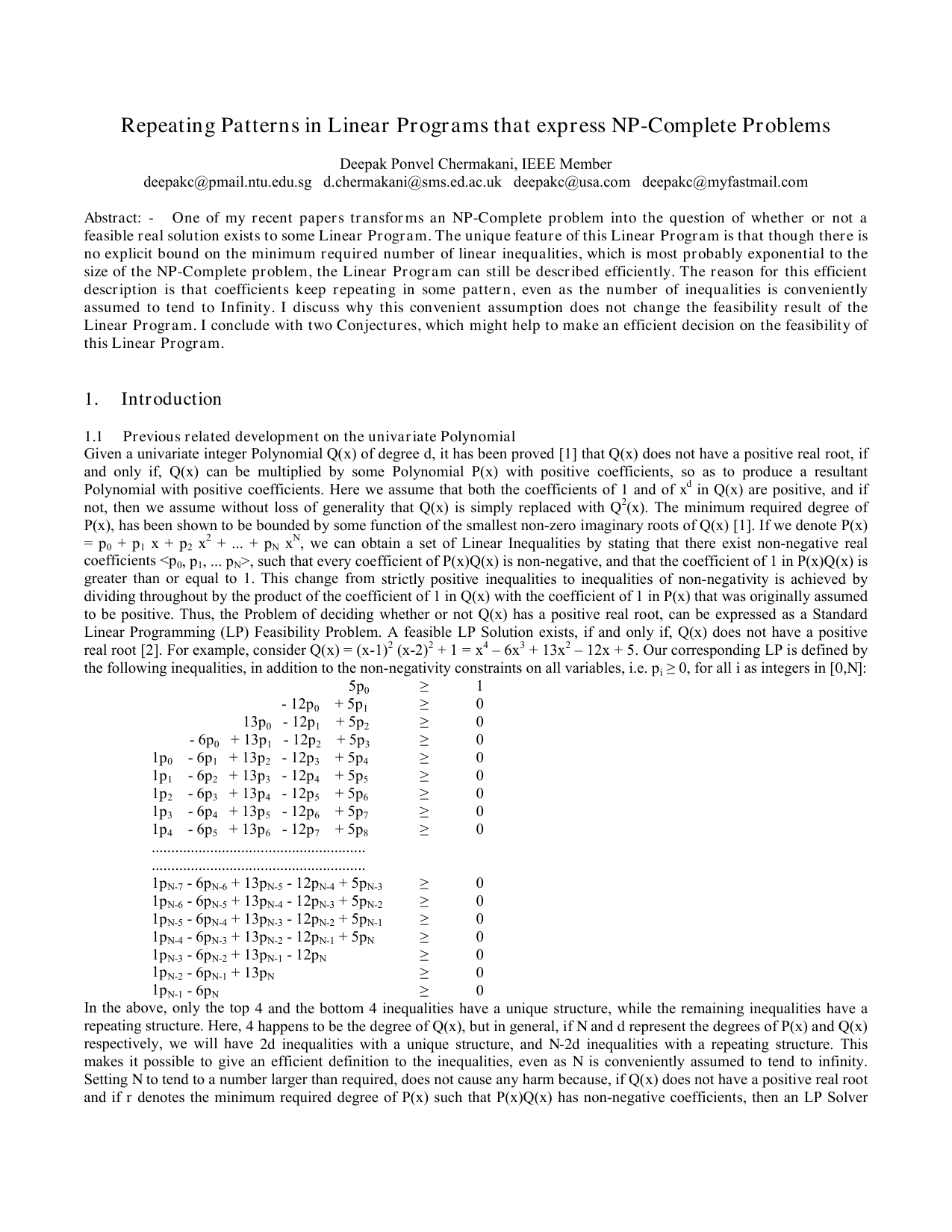
, such that every coefficient of P(x)Q(x) is non-negative, and that the coefficient of 1 in P(x)Q(x) is greater than or equal to 1. This change from strictly positive inequalities to inequalities of non-negativity is achieved by dividing throughout by the product of the coefficient of 1 in Q(x) with the coefficient of 1 in P(x) that was originally assumed to be positive. Thus, the Problem of deciding whether or not Q(x) has a positive real root, can be expressed as a Standard Linear Programming (LP) Feasibility Problem. A feasible LP Solution exists, if and only if, Q(x) does not have a positive real root [2]. For example, consider Q(x) = (x-1) 2 (x-2) 2 + 1 = x 4 -6x 3 + 13x 2 -12x + 5. Our corresponding LP is defined by the following inequalities, in addition to the non-negativity constraints on all variables, i.e. p i ≥ 0, for all i as integers in [0,N]:
In the above, only the top 4 and the bottom 4 inequalities have a unique structure, while the remaining inequalities have a repeating structure. Here, 4 happens to be the degree of Q(x), but in general, if N and d represent the degrees of P(x) and Q(x) respectively, we will have 2d inequalities with a unique structure, and N-2d inequalities with a repeating structure. This makes it possible to give an efficient definition to the inequalities, even as N is conveniently assumed to tend to infinity. Setting N to tend to a number larger than required, does not cause any harm because, if Q(x) does not have a positive real root and if r denotes the minimum required degree of P(x) such that P(x)Q(x) has non-negative coefficients, then an LP Solver can choose p i = 0 for all i as integers in [r+1, N]. Also, if Q(x) has a positive real root, then by Descartes Rule of Signs, there cannot exist a real Polynomial P(x), such that P(x)Q(x) has non-negative coefficients. The figure below plots feasibility (‘1’ means that a feasible LP solution exists, while ‘0’ means that there is no feasible LP solution) versus the degree of P(x).
3-SAT is a well-known NP-Complete Problem that aims to decide on whether or not a Boolean expression is satisfiable, with a maximum of 3 literals per clause. Let us denote a 3-SAT instance to have k clauses and u binary variables.
3-SAT has been transformed into the problem of deciding real root existence for a univariate Polynomial Q(x) [4]. So going by the logic mentioned in the Section 1.1, we can obtain the corresponding LP expressing the 3-SAT instance. However, it is difficult to study this LP because of the following three properties of Q(x) obtained from the 3-SAT instance:
- the degree of Q(x) is exponential to k and u 2) Q(x) is usually not sparse, though it can be efficiently expressed as a Straight Line Program (A Straight Line Program is a set of instructions to describe a Polynomial) 3) the coefficients of Q(x) are exponential to k and u
Given a u-variate (u > 1) integer Polynomial Q, it has been shown that not all instances of Q (without a real root) can be multiplied by another Polynomial, to give a resultant Polynomial with positive coefficients [3]. The same author also described a transformation that maps every instance of Q without a real root, in the standard Simplex and the standard Hypercube, onto some Polynomial with positive coefficients [3]. However, it is to be noted that there also exist Polynomials with real roots that can be mapped onto Polynomials with positive coefficients, by this transformation.
To the best of my knowledge, Theorem-7 of my paper [2] is the first robust theoretical development for a u-variate (u > 1) integer Polynomial Q, where Q is constrained to either have integer roots in a bounded region, or not have a real root. It can be inferred that Theorem-7 can be generalized over a finite set of positive real numbers as follows.
Let N be a finite Set of positive Real numbers, i.e. N = {n 1 , n 2 , … n M }. Let a multivariate Polynomial Q defined in u-variables x 1 , x 2 , … x i ,…x u , be such that exactly one of the following two statements, is true: 1) “Q = 0” implies that x i ∈ N, for all integers i in [1,u] 2) Q does not have a real root Next, define constant Polynomials P 1 , P 2 , … P i ,…P u , where P i =
…(Full text truncated)…
This content is AI-processed based on ArXiv data.