Markov Logic Networks in the Analysis of Genetic Data
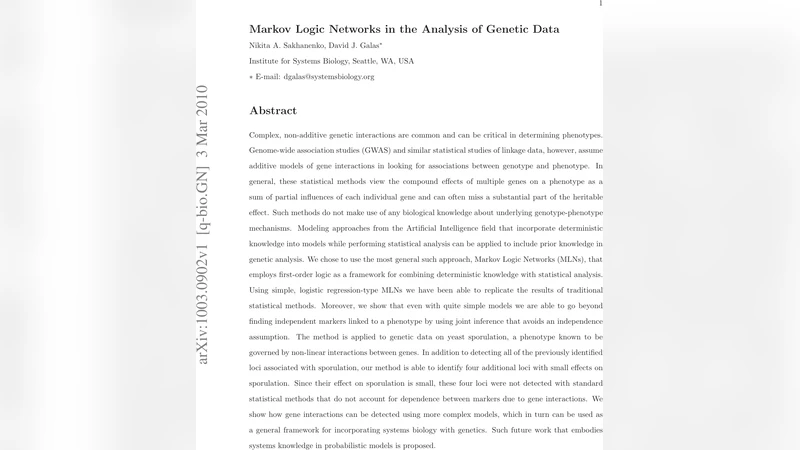
Complex, non-additive genetic interactions are common and can be critical in determining phenotypes. Genome-wide association studies (GWAS) and similar statistical studies of linkage data, however, assume additive models of gene interactions in looking for genotype-phenotype associations. These statistical methods view the compound effects of multiple genes on a phenotype as a sum of partial influences of each individual gene and can often miss a substantial part of the heritable effect. Such methods do not use any biological knowledge about underlying genotype-phenotype mechanisms. Modeling approaches from the AI field that incorporate deterministic knowledge into models to perform statistical analysis can be applied to include prior knowledge in genetic analysis. We chose to use the most general such approach, Markov Logic Networks (MLNs), as a framework for combining deterministic knowledge with statistical analysis. Using simple, logistic regression-type MLNs we have been able to replicate the results of traditional statistical methods. Moreover, we show that even with simple models we are able to go beyond finding independent markers linked to a phenotype by using joint inference that avoids an independence assumption. The method is applied to genetic data on yeast sporulation, a phenotype governed by non-linear gene interactions. In addition to detecting all of the previously identified loci associated with sporulation, our method is able to identify four loci with small effects. Since their effect on sporulation is small, these four loci were not detected with methods that do not account for dependence between markers due to gene interactions. We show how gene interactions can be detected using more complex models, which can be used as a general framework for incorporating systems biology with genetics.
💡 Research Summary
The paper presents a novel application of Markov Logic Networks (MLNs) to the analysis of genetic data, addressing two major shortcomings of conventional genome‑wide association studies (GWAS): the reliance on additive (linear) models that ignore epistatic (non‑additive) gene‑gene interactions, and the inability to incorporate prior biological knowledge into statistical inference. MLNs combine Markov Random Fields (MRFs) with first‑order logic (FOL), allowing logical formulas to be weighted probabilistically. This framework permits the inclusion of deterministic biological constraints while still handling noisy, uncertain data, because formulas need not be satisfied absolutely; instead, their weighted violations contribute to the overall probability of a configuration.
The authors construct a simple logistic‑regression‑style MLN where each SNP‑phenotype relationship is encoded as a first‑order clause with an associated weight. They train the weights using maximum‑likelihood‑type learning (gradient‑based optimization) on a yeast dataset that measures sporulation efficiency in progeny derived from a cross of two fully sequenced strains. Importantly, inference is performed jointly over all markers, rather than testing each marker independently as in standard GWAS. This joint inference captures dependencies among markers, effectively modeling epistasis without explicitly enumerating interaction terms.
Results show that the MLN reproduces all previously reported quantitative trait loci (QTL) for yeast sporulation (12 loci). Moreover, the joint inference discovers four additional loci whose individual effects are too small to reach significance in traditional GWAS but become detectable when the dependence structure among markers is taken into account. By extending the MLN to include higher‑order cliques (size 3‑4) and more complex logical templates, the authors also demonstrate the ability to infer specific gene‑gene interaction patterns, something that standard additive models cannot achieve.
The paper’s contributions are threefold: (1) it introduces MLNs as a flexible, probabilistic‑logic framework for genetic association analysis; (2) it shows that incorporating biological knowledge via logical formulas can improve power to detect subtle genetic effects; and (3) it provides a proof‑of‑concept that joint probabilistic inference can uncover epistatic relationships without pre‑specifying interaction terms. Limitations include computational scalability—current implementations handle a modest number of markers and samples, which may be insufficient for human GWAS with millions of SNPs—and interpretability of learned weights, which require domain expertise to translate into biological insight.
Future work suggested by the authors involves developing more efficient, possibly distributed learning algorithms for large‑scale data, integrating continuous phenotypes and multi‑omics layers (transcriptomics, metabolomics) into the MLN, and constructing richer knowledge bases that encode known pathways, regulatory networks, and temporal dynamics. Such extensions would move the field toward a true systems‑biology approach to genetics, where statistical inference is guided by, and in turn refines, mechanistic biological models.
Comments & Academic Discussion
Loading comments...
Leave a Comment