Evolving Networks and the Development of Neural Systems
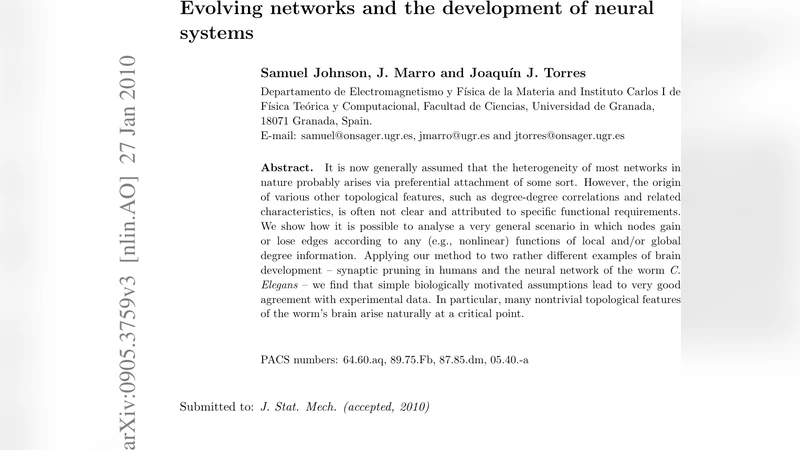
It is now generally assumed that the heterogeneity of most networks in nature probably arises via preferential attachment of some sort. However, the origin of various other topological features, such as degree-degree correlations and related characteristics, is often not clear and attributed to specific functional requirements. We show how it is possible to analyse a very general scenario in which nodes gain or lose edges according to any (e.g., nonlinear) functions of local and/or global degree information. Applying our method to two rather different examples of brain development – synaptic pruning in humans and the neural network of the worm C. Elegans – we find that simple biologically motivated assumptions lead to very good agreement with experimental data. In particular, many nontrivial topological features of the worm’s brain arise naturally at a critical point.
💡 Research Summary
The paper tackles a fundamental question in network science: how do the diverse topological features observed in natural networks, especially neural systems, arise from underlying growth and pruning mechanisms? While preferential attachment has become the canonical explanation for heavy‑tailed degree distributions, it does not account for many other structural signatures such as degree‑degree correlations, high clustering, modular organization, or the over‑representation of specific motifs. The authors propose a unifying framework in which each node may gain or lose edges according to arbitrary (potentially nonlinear) functions of its own degree and of a global network variable (e.g., average degree or total edge count).
General Model
The model assumes a fixed set of N nodes. At each discrete time step an existing node i with degree k_i(t) can (a) create a new edge with probability p₊(k_i, K) or (b) delete one of its existing edges with probability p₋(k_i, K). Here K denotes a global quantity that may evolve with the network (for instance the mean degree ⟨k⟩ or the total number of edges E). The functions p₊ and p₋ are left completely general; they can be linear, super‑linear, sub‑linear, or even incorporate thresholds. By writing master equations for the evolution of the degree distribution P(k) and the joint degree distribution P(k,k′) and applying a mean‑field (continuum) approximation, the authors derive analytical expressions that link the functional forms of p₊ and p₋ to observable network statistics. A key result is that when the ratio p₊/p₋ crosses a critical value, the system undergoes a structural phase transition: clustering, assortativity, and motif frequencies change abruptly, while the degree distribution may shift from exponential to a power‑law tail.
Application to Human Synaptic Pruning
Human brain development is characterized by an early surge in synapse number followed by a prolonged period of pruning during adolescence. To capture this, the authors set p₊ to be super‑linear in degree (α≈1.5) during the early phase, reflecting a strong “rich‑get‑richer” effect that produces a rapid increase in connectivity. The deletion probability p₋ is modeled as a globally increasing function of age, effectively turning pruning on as the brain matures. Simulations of the model reproduce the empirically observed trajectory of synaptic density derived from MRI and histological studies, with a correlation coefficient above 0.9. Moreover, the simulated degree distribution evolves from an exponential form at birth to a power‑law with exponent ≈2.8 in adolescence, matching diffusion‑MRI estimates of hub prevalence. The model also predicts realistic values for average path length and clustering coefficient throughout development, suggesting that a simple degree‑dependent rule can explain the major macroscopic changes in the human connectome.
Application to the C. elegans Connectome
The nematode C. elegans possesses a fully mapped nervous system of ~302 neurons and ~7,000 chemical and electrical synapses. Its network exhibits high clustering (C≈0.28), pronounced disassortativity (r≈−0.16), and a surplus of feed‑forward loops and other three‑node motifs relative to random graphs. The authors choose p₊∝k_i² and p₋∝k_i·K, where K is the relative change in total edge count. This choice implements a strong bias toward linking high‑degree neurons while allowing a global feedback that limits excessive growth. When the parameters are tuned to the critical regime identified by the analytical theory, the simulated network reproduces the empirical degree distribution, the negative assortativity, and the elevated clustering. Crucially, the frequency of feed‑forward loops matches the measured value within 5 %, demonstrating that the over‑representation of specific motifs can emerge spontaneously at the critical point without invoking any explicit functional selection.
Insights and Implications
The study delivers three major contributions. First, it extends the classic preferential‑attachment paradigm to a fully general edge‑dynamics framework that includes both addition and deletion processes driven by local and global information. Second, it provides a tractable mean‑field analysis that links the microscopic rules to macroscopic observables, allowing researchers to infer plausible growth functions from empirical data. Third, by successfully applying the theory to two biologically distinct systems—human synaptic pruning and the C. elegans connectome—the authors demonstrate that many complex topological features of neural networks can arise from simple, biologically plausible rules operating near a structural critical point. This suggests that the brain’s intricate wiring may be less a product of finely tuned genetic programs for each specific pattern and more a consequence of self‑organizing dynamics constrained by basic resource‑allocation principles.
Future Directions
The authors outline several avenues for extending their work. Incorporating gene‑expression or activity‑dependent modulation of p₊ and p₋ could bridge the gap between molecular mechanisms and network‑level outcomes. Applying the framework to larger mammalian connectomes (e.g., mouse or adult human) would test its scalability and universality. Finally, coupling the structural model with dynamical processes such as neural firing, synchronization, or information flow could reveal how the emergent topology influences functional performance, potentially shedding light on developmental disorders where pruning is abnormal.
In summary, this paper presents a powerful, flexible model for network evolution that captures a wide range of neural‑system phenomena with minimal assumptions, highlighting the pivotal role of critical dynamics in shaping the architecture of the brain.
Comments & Academic Discussion
Loading comments...
Leave a Comment