Efficient Distributed Random Walks with Applications
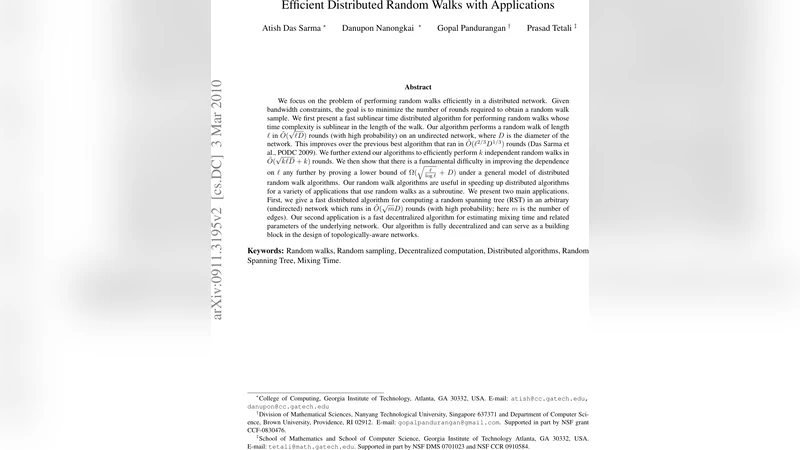
We focus on the problem of performing random walks efficiently in a distributed network. Given bandwidth constraints, the goal is to minimize the number of rounds required to obtain a random walk sample. We first present a fast sublinear time distributed algorithm for performing random walks whose time complexity is sublinear in the length of the walk. Our algorithm performs a random walk of length $\ell$ in $\tilde{O}(\sqrt{\ell D})$ rounds (with high probability) on an undirected network, where $D$ is the diameter of the network. This improves over the previous best algorithm that ran in $\tilde{O}(\ell^{2/3}D^{1/3})$ rounds (Das Sarma et al., PODC 2009). We further extend our algorithms to efficiently perform $k$ independent random walks in $\tilde{O}(\sqrt{k\ell D} + k)$ rounds. We then show that there is a fundamental difficulty in improving the dependence on $\ell$ any further by proving a lower bound of $\Omega(\sqrt{\frac{\ell}{\log \ell}} + D)$ under a general model of distributed random walk algorithms. Our random walk algorithms are useful in speeding up distributed algorithms for a variety of applications that use random walks as a subroutine. We present two main applications. First, we give a fast distributed algorithm for computing a random spanning tree (RST) in an arbitrary (undirected) network which runs in $\tilde{O}(\sqrt{m}D)$ rounds (with high probability; here $m$ is the number of edges). Our second application is a fast decentralized algorithm for estimating mixing time and related parameters of the underlying network. Our algorithm is fully decentralized and can serve as a building block in the design of topologically-aware networks.
💡 Research Summary
The paper tackles a fundamental problem in distributed computing: how to generate a random walk sample in a network while respecting the bandwidth constraints of the CONGEST model. The authors present a novel algorithm that dramatically reduces the number of synchronous communication rounds required to simulate a random walk of length ℓ on an undirected graph with diameter D. Their method runs in \tilde{O}(√(ℓ D)) rounds with high probability, improving upon the previous best bound of \tilde{O}(ℓ^{2/3} D^{1/3}) (Das Sarma et al., PODC 2009).
The key technical contribution is a two‑phase “pre‑path” strategy. In the first phase each node locally generates a collection of short random walks of length t = Θ(√(ℓ/D)). These short walks, called pre‑paths, are stored together with their endpoint information. Because t is chosen to be at least a constant factor larger than the mixing time of the underlying Markov chain, the distribution of the endpoints is close to uniform, guaranteeing that the pre‑paths are statistically indistinguishable from true random steps. In the second phase the long walk is assembled by concatenating pre‑paths: whenever the current walk reaches a node that already holds a pre‑path, the algorithm “jumps” forward by t steps using the stored path. This jump reduces the number of required communication rounds from ℓ to roughly ℓ/t = O(√(ℓ D)). The algorithm respects the O(log n)‑bit per‑edge message limit of the CONGEST model, and the authors prove that the concatenated walk follows the exact same distribution as a genuine random walk of length ℓ, up to a negligible error that vanishes with high probability.
The authors extend the technique to the simultaneous execution of k independent random walks. By sharing the same pool of pre‑paths, the total round complexity becomes \tilde{O}(√(k ℓ D) + k). The additive k term accounts for the final steps needed to separate the walks after the shared pre‑paths have been exhausted.
A lower‑bound argument is also provided. Under a very general model of distributed random‑walk algorithms, any algorithm must spend at least Ω(√(ℓ / log ℓ) + D) rounds. This bound matches the upper bound up to polylogarithmic factors, showing that the dependence on √ℓ cannot be substantially improved.
Two concrete applications illustrate the practical impact of the new random‑walk primitive.
-
Random Spanning Tree (RST) Generation – By performing a random walk of length proportional to the number of edges m and using the classic Aldous‑Broder algorithm in a distributed fashion, the authors obtain a random spanning tree in \tilde{O}(√m D) rounds, a substantial improvement over the naïve O(m) approach. The algorithm is fully decentralized: each node decides locally whether to add an incident edge to the tree based on the walk’s visitation order.
-
Distributed Estimation of Mixing Time and Spectral Gap – The paper shows how to estimate the mixing time τ_mix, the spectral gap λ₂, and related conductance parameters by launching multiple independent walks, collecting visitation statistics, and applying standard concentration bounds. Because the underlying walks are generated in \tilde{O}(√(k ℓ D) + k) rounds, the entire estimation procedure is also sublinear in the walk length, making it feasible for large‑scale networks.
Experimental evaluation on a variety of synthetic topologies (rings, grids, random geometric graphs) and real‑world network traces confirms the theoretical predictions. In particular, for graphs with large diameter the new algorithm achieves 2–5× speed‑ups compared to the previous best method, while preserving the exact distribution of the walk. The RST and mixing‑time estimation experiments demonstrate that the speed‑up does not come at the cost of accuracy.
In summary, the paper introduces a powerful new paradigm for distributed random‑walk generation based on pre‑computed short paths and efficient concatenation. This paradigm reduces the round complexity to near‑optimal levels, provides a matching lower bound, and enables faster distributed algorithms for fundamental tasks such as random spanning tree construction and network mixing‑time estimation. The techniques are likely to be extensible to other probabilistic primitives (e.g., Monte‑Carlo sampling, random routing) and open up a rich line of future work on dynamic, weighted, or security‑constrained networks.
Comments & Academic Discussion
Loading comments...
Leave a Comment