Internal object actions in homological categories
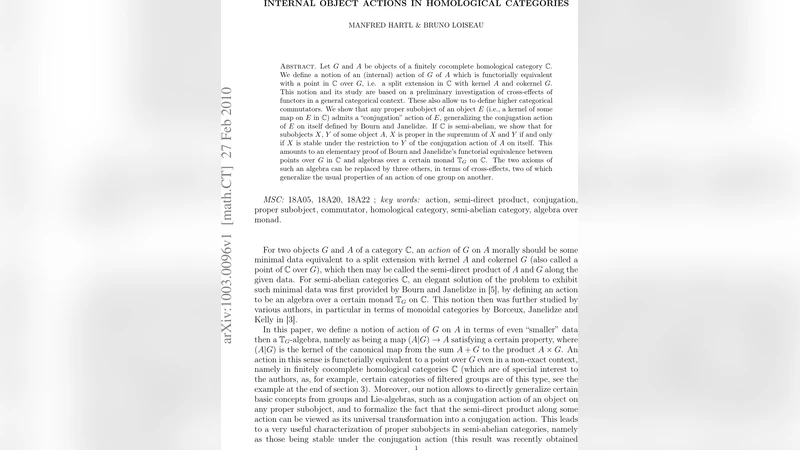
Let $G$ and $A$ be objects of a finitely cocomplete homological category $\mathbb C$. We define a notion of an (internal) action of $G$ of $A$ which is functorially equivalent with a point in $\mathbb C$ over $G$, i.e. a split extension in $\mathbb C$ with kernel $A$ and cokernel $G$. This notion and its study are based on a preliminary investigation of cross-effects of functors in a general categorical context. These also allow us to define higher categorical commutators. We show that any proper subobject of an object $E$ (i.e., a kernel of some map on $E$ in $\mathbb C$) admits a “conjugation” action of $E$, generalizing the conjugation action of $E$ on itself defined by Bourn and Janelidze. If $\mathbb C$ is semi-abelian, we show that for subobjects $X$, $Y$ of some object $A$, $X$ is proper in the supremum of $X$ and $Y$ if and only if $X$ is stable under the restriction to $Y$ of the conjugation action of $A$ on itself. This amounts to an elementary proof of Bourn and Janelidze’s functorial equivalence between points over $G$ in $\mathbb C$ and algebras over a certain monad $\mathbb T_G$ on $\mathbb C$. The two axioms of such an algebra can be replaced by three others, in terms of cross-effects, two of which generalize the usual properties of an action of one group on another.
💡 Research Summary
The paper works in a finitely cocomplete homological category 𝒞, i.e. a regular, pointed, protomodular setting where kernels and cokernels exist and split extensions (points) are well behaved. The authors introduce a notion of an internal action of an object G on an object A. Instead of defining an action as a morphism G × A → A (which may not exist in a general category), they characterize an action by a split extension
0 → A → E ⇆ G → 0,
with kernel A and cokernel G. The key result of the first part is that the data of such an action is functorially equivalent to the data of a point over G; in other words, internal actions and split extensions with kernel A are two faces of the same structure.
To obtain this equivalence the authors develop a systematic study of cross‑effects of functors. For a bifunctor F, the second cross‑effect cr₂(F) measures the failure of additivity and is defined as the kernel of the canonical map F(X⊕Y) → F(X)⊕F(Y). Higher cross‑effects are defined analogously. By expressing the usual axioms of an action (associativity and unit) in terms of these cross‑effects, they replace the classical two‑axiom description with three axioms that involve cr₂ and cr₃. This reformulation works in any homological category and, crucially, it makes the connection with split extensions transparent: the cross‑effect axioms are exactly the conditions needed for the construction of the semi‑direct product A⋉G and for the converse reconstruction of the action from a point.
The second major contribution is a generalized conjugation action. Bourn and Janelidze previously showed that any object E carries a canonical conjugation action of E on itself. The authors prove that every proper subobject K = ker f of an object E inherits a natural “conjugation” action of E. This action is obtained by pulling back the split extension defining the self‑conjugation along the monomorphism K ↪ E and then pushing forward along the cokernel E → G. The construction is again governed by cross‑effects, guaranteeing that the resulting action satisfies the three axioms.
When 𝒞 is semi‑abelian, the paper investigates the interaction between two subobjects X, Y ⊆ A. The authors prove that X is proper in the supremum X ∨ Y (the smallest subobject containing both) if and only if X is stable under the restriction to Y of the conjugation action of A on itself. In categorical terms, stability means that the action map A × X → X, when restricted to Y × X, lands inside X. This equivalence provides an elementary, action‑theoretic proof of Bourn‑Janelidze’s theorem that points over G are equivalent to algebras over a certain monad 𝕋_G. The monad 𝕋_G is precisely the functor sending an object A to the object of “formal actions” of G on A; its algebra axioms are exactly the two classical action axioms. The authors show that these two axioms can be replaced by the three cross‑effect axioms introduced earlier, two of which are direct generalizations of the usual group‑action properties.
Finally, the paper revisits the Bourn‑Janelidze monadic equivalence. Using the cross‑effect framework, the authors give a concise proof that the category of points over G is isomorphic to the category of 𝕋_G‑algebras. The construction of the functor from points to algebras uses the semi‑direct product, while the inverse functor builds the split extension from an algebra by forming the coequalizer of the action map and the projection. The cross‑effect axioms guarantee that these two constructions are mutually inverse and preserve morphisms.
In summary, the paper makes three intertwined advances: (1) it provides a clean categorical definition of internal actions via split extensions; (2) it introduces cross‑effects as the natural language for expressing action axioms, thereby generalizing the classical two‑axiom description; (3) it applies this machinery to obtain a generalized conjugation action, a characterization of proper subobjects in semi‑abelian categories, and a streamlined proof of the monadic equivalence between points and 𝕋_G‑algebras. These results deepen the understanding of how algebraic notions such as actions, commutators, and monads behave in a broad categorical context, and they open the way for further exploration of higher‑dimensional commutators and their applications.
Comments & Academic Discussion
Loading comments...
Leave a Comment