A New Understanding of Prediction Markets Via No-Regret Learning
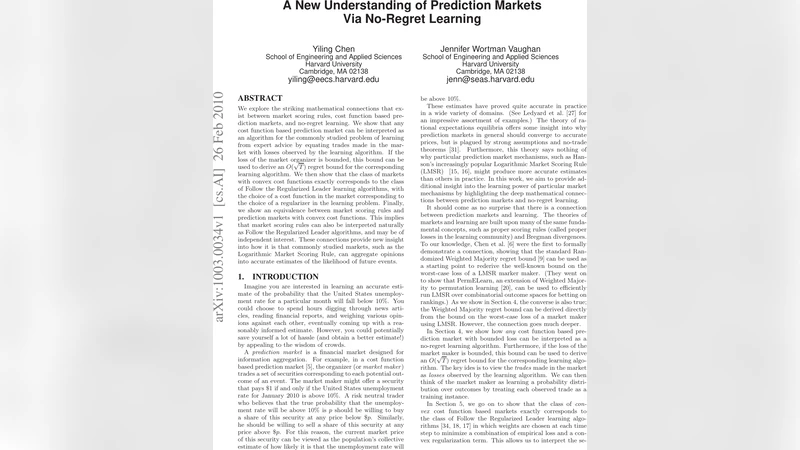
We explore the striking mathematical connections that exist between market scoring rules, cost function based prediction markets, and no-regret learning. We show that any cost function based prediction market can be interpreted as an algorithm for the commonly studied problem of learning from expert advice by equating trades made in the market with losses observed by the learning algorithm. If the loss of the market organizer is bounded, this bound can be used to derive an O(sqrt(T)) regret bound for the corresponding learning algorithm. We then show that the class of markets with convex cost functions exactly corresponds to the class of Follow the Regularized Leader learning algorithms, with the choice of a cost function in the market corresponding to the choice of a regularizer in the learning problem. Finally, we show an equivalence between market scoring rules and prediction markets with convex cost functions. This implies that market scoring rules can also be interpreted naturally as Follow the Regularized Leader algorithms, and may be of independent interest. These connections provide new insight into how it is that commonly studied markets, such as the Logarithmic Market Scoring Rule, can aggregate opinions into accurate estimates of the likelihood of future events.
💡 Research Summary
The paper establishes a rigorous bridge between two major strands of prediction‑market design—market‑scoring‑rule (MSR) mechanisms and cost‑function‑based markets (CFM)—and the well‑studied problem of learning from expert advice under a no‑regret framework. The authors begin by interpreting each trade in a prediction market as an observation of loss for a learning algorithm. In this mapping, the market organizer’s cumulative loss corresponds to the algorithm’s total loss, while the loss of the best fixed expert corresponds to the profit that could have been achieved by a perfectly informed market maker. Assuming the organizer’s loss is bounded, the standard analysis of no‑regret learning yields an O(√T) regret bound for the market, directly linking market efficiency to the classic √T‑rate of regret minimization.
The central technical contribution is the identification of convex cost functions with the regularizer in Follow‑the‑Regularized‑Leader (FTRL) algorithms. A convex cost function φ(p) that maps a price vector p to a monetary cost can be written as φ(p)=R(p)+const, where R is the regularization term used in FTRL. Consequently, the price update rule in a CFM—obtained by taking the gradient of φ after each trade—is mathematically identical to the FTRL update that minimizes the sum of observed losses plus the regularizer. This equivalence shows that every convex‑cost market implements an FTRL algorithm, and conversely any FTRL algorithm can be realized as a market with an appropriately chosen cost function.
The paper further proves that MSR mechanisms are a special case of convex‑cost markets. By expressing the scoring‑rule update as the gradient of a specific convex function, the authors demonstrate that the logarithmic market scoring rule (LMSR) corresponds to an entropy regularizer, while other scoring rules map to other convex regularizers. Hence MSR and CFM are not merely analogous; they are mathematically interchangeable representations of the same underlying learning process.
These connections have several important implications. First, the O(√T) regret bound guarantees that, over a long horizon, market prices converge to the true posterior probabilities of the events being forecast, provided the organizer’s loss remains bounded. Second, the choice of cost function (or equivalently, regularizer) directly controls the trade‑off between market liquidity (low transaction costs) and resistance to manipulation (strong regularization yields tighter regret bounds). Third, the unified view allows researchers to import tools from online learning—such as potential functions, adaptive learning rates, and variance‑based analyses—into the study of prediction markets, opening new avenues for both theoretical refinement and practical market design.
In summary, the authors provide a comprehensive theoretical framework that unifies prediction‑market mechanisms with no‑regret learning. By showing that convex cost functions correspond exactly to FTRL regularizers and that market‑scoring rules are equivalent to convex‑cost markets, they give a clear, mathematically grounded explanation for why popular markets like LMSR aggregate information efficiently. This work not only deepens our understanding of existing market designs but also offers a principled methodology for constructing new markets with desired performance guarantees.
Comments & Academic Discussion
Loading comments...
Leave a Comment