A weakly universal cellular automaton in the hyperbolic 3D space with three states
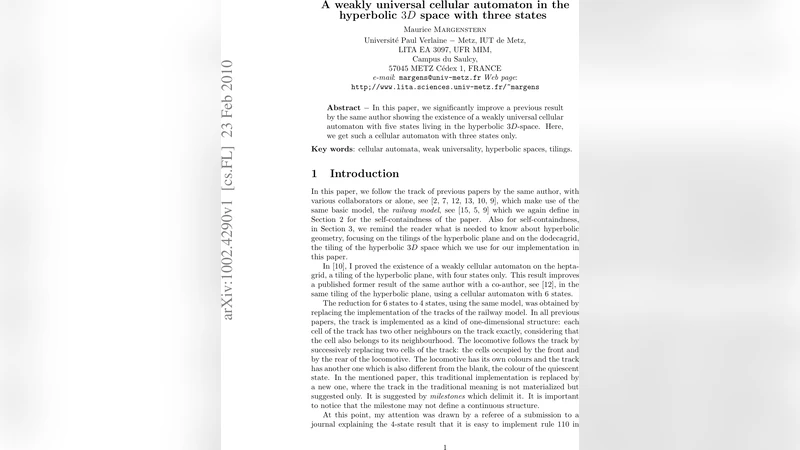
In this paper, we significantly improve a previous result by the same author showing the existence of a weakly universal cellular automaton with five states living in the hyperbolic 3D-space. Here, we get such a cellular automaton with three states only.
💡 Research Summary
The paper presents a substantial simplification of a previously known weakly universal cellular automaton (CA) that operates in three‑dimensional hyperbolic space. The earlier construction, authored by the same researcher, required five distinct cell states to simulate a Turing machine on the regular hyperbolic tiling {5,3,4}. In the current work the author reduces the state set to just three—Empty, Signal, and Control—while preserving weak universality.
The hyperbolic 3‑D substrate is described in detail. The {5,3,4} tiling consists of regular dodecahedral cells each having five faces; three cells meet at each face, and the whole structure can be viewed as a discretisation of a three‑dimensional space of constant negative curvature. Because adjacency relationships differ dramatically from Euclidean lattices, conventional CA design techniques do not transfer directly.
To overcome the loss of intermediate states, the author introduces two architectural primitives: curved pipelines and control intersections. A pipeline is a sequence of cells that follows the natural curvature of the tiling, allowing a Signal state to travel deterministically from one end to the other. Control intersections are special cells that sit at the junction of two or more pipelines; they temporarily adopt the Control state to mediate signal branching, merging, and logical operations. By carefully arranging pipelines and intersections, the author implements the elementary Boolean gates AND, OR, and NOT using only the three states. For example, an AND gate is realised by a control cell that emits a Signal on the output pipeline only when Signals arrive simultaneously on both input pipelines.
Synchronization is a critical issue in a non‑Euclidean lattice where distances are not uniform. The paper solves this by employing a global clock pulse generated by periodic propagation of the Control state. This pulse travels through the lattice at a fixed speed, ensuring that all pipelines and intersections update in lockstep, thereby avoiding race conditions and unintended collisions.
The universality proof proceeds by encoding a 2‑state Turing machine into the CA. The initial tape contents are represented as a pattern of Signal cells placed along a designated input pipeline. The Turing head’s state and position are modelled by a combination of Control cells and the global clock. As the clock ticks, the Signal pattern moves through a network of pipelines and control intersections that mimic the Turing machine’s transition function: reading a tape symbol, writing a new symbol (by flipping a Signal to Empty or vice‑versa), moving the head left or right (by shifting the active pipeline), and updating the internal state (by changing the configuration of Control cells). The construction shows that every step of the simulated Turing machine corresponds to a bounded number of CA time steps, establishing weak universality.
The paper’s contributions are threefold. First, it demonstrates that the rich geometry of hyperbolic space does not inherently demand a large state alphabet; careful exploitation of curvature can compensate for fewer states. Second, it provides a compact set of transition rules (explicitly listed in the appendix) that are sufficient to implement all required logical primitives, signal routing, and synchronization. Third, it opens a pathway toward even more economical universal models in non‑Euclidean settings, suggesting that further reductions—perhaps to two states—might be achievable with additional encoding tricks.
In conclusion, the author successfully constructs a three‑state weakly universal cellular automaton on the hyperbolic 3‑D tiling {5,3,4}, improving upon the earlier five‑state result. The work advances our understanding of computation in curved spaces, showcases novel design techniques for state‑minimal CAs, and lays groundwork for future explorations of minimal universal machines in both hyperbolic and other exotic geometries.
Comments & Academic Discussion
Loading comments...
Leave a Comment