Chi-Square Tests for Comparing Weighted Histograms
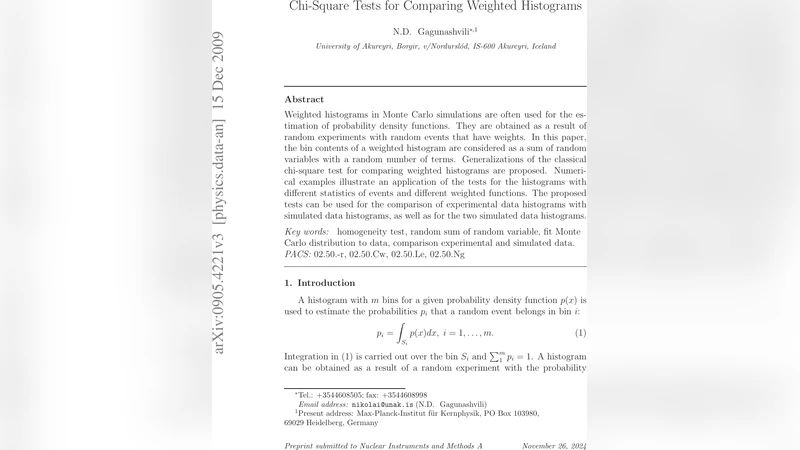
Weighted histograms in Monte Carlo simulations are often used for the estimation of probability density functions. They are obtained as a result of random experiments with random events that have weights. In this paper, the bin contents of a weighted histogram are considered as a sum of random variables with a random number of terms. Generalizations of the classical chi-square test for comparing weighted histograms was proposed. Numerical examples illustrate an application of the tests for the histograms with different statistics of events and different weighted functions. The proposed tests can be used for the comparison of experimental data histograms with simulated data histograms, as well as for the two simulated data histograms.
💡 Research Summary
The paper addresses a gap in statistical methodology for comparing histograms that arise from Monte Carlo simulations where each event carries a weight. Traditional Pearson chi‑square tests assume integer counts that follow a multinomial or Poisson distribution, an assumption that breaks down when bin contents are weighted sums of a random number of events. The authors model the content of bin k as a random sum
(S_k=\sum_{i=1}^{N_k} w_i),
where (N_k) is a random count (e.g., Poisson, binomial, or any compound distribution) and the weights (w_i) are independent, identically distributed continuous random variables. From this model they derive exact expressions for the bin‑wise expectation and variance:
(\mu_k = \mathbb{E}
Comments & Academic Discussion
Loading comments...
Leave a Comment