Metric Dichotomies
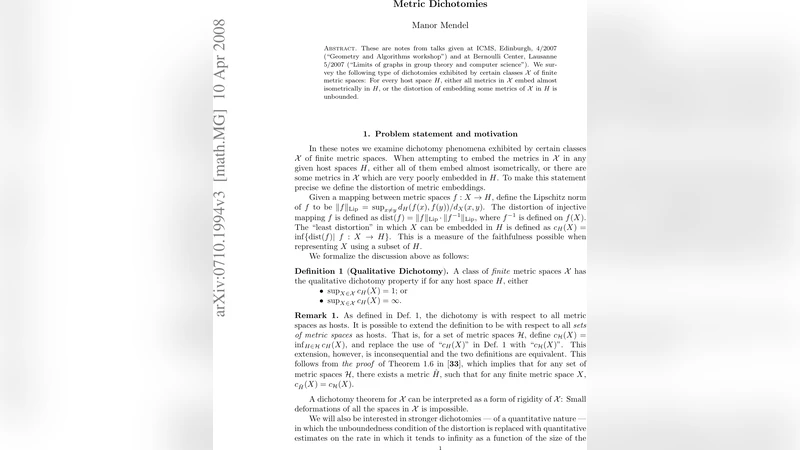
These are notes from talks given at ICMS, Edinburgh, 4/2007 (“Geometry and Algorithms workshop”) and at Bernoulli Center, Lausanne 5/2007 (“Limits of graphs in group theory and computer science”). We survey the following type of dichotomies exhibited by certain classes X of finite metric spaces: For every host space H, either all metrics in X embed almost isometrically in H, or the distortion of embedding some metrics of X in H is unbounded.
💡 Research Summary
The paper “Metric Dichotomies” surveys a striking phenomenon that occurs when one tries to embed finite metric spaces from a given class X into an arbitrary host space H. The central claim, phrased as a dichotomy theorem, is that for any host space H exactly one of the following two alternatives holds: either every metric in X can be embedded into H with distortion arbitrarily close to 1 (i.e., almost isometrically), or there exists at least one metric in X whose distortion when embedded into H is unbounded. In other words, the distortion function c_H restricted to X is either uniformly bounded or it blows up to infinity.
The authors begin by fixing the basic terminology. A finite metric space (M,d) is a finite set equipped with a distance function d. An embedding f : M → H is measured by its Lipschitz constant ‖f‖_Lip and the Lipschitz constant of its inverse on the image, ‖f⁻¹‖_Lip. Their product defines the distortion c_H(M). “Almost isometric” means c_H(M) ≤ 1 + ε for arbitrarily small ε. The host space H may be a Banach space (ℓ_p, Hilbert space), a non‑linear metric such as an ultrametric, or any other metric space of interest.
A key technical tool is the notion of metric cotype, originally introduced in Banach space theory. A space H has cotype q (typically q ≥ 2) if it controls certain higher‑order averages of vectors. This property translates into powerful concentration and Markov‑type inequalities (the latter due to Mendel and Naor) that bound how much a random walk can contract under an embedding. When H possesses a suitable cotype, the authors show that any class X with “moderate complexity” (e.g., bounded doubling dimension, tree‑like structure) embeds with O(1) distortion. Conversely, if H lacks the appropriate cotype, the same techniques—particularly the “metric Ramsey” or “Lafforgue‑Naor partition” arguments—produce a family of metrics in X whose distortion grows without bound.
The paper illustrates the dichotomy with several concrete families:
-
Tree metrics. Every finite tree metric embeds into Hilbert space with distortion O(√log n) (the classic Bourgain–Rabinovich–Talwar bound). However, when the host is ℓ₁, certain deep trees require distortion Ω(log n). This demonstrates that the host’s geometry (Hilbert vs. ℓ₁) determines which side of the dichotomy applies.
-
Expanders. High‑girth, constant‑degree expander graphs have spectral gaps that force any embedding into ℓ₂ to incur distortion at least Ω(log n). The proof uses the Markov‑type inequality for spaces of cotype 2, showing that the random walk on an expander cannot be contracted too much without violating concentration bounds.
-
ℓ₁ versus ℓ_p (p > 1). While ℓ₁ itself has cotype 1, it does not embed into ℓ_p with bounded distortion for p > 1. The authors invoke a “snowflake” argument and the failure of uniform convexity in ℓ₁ to illustrate the unbounded side of the dichotomy.
-
Finite‑dimensional Hilbert spaces and ultrametrics. When the host is a fixed‑dimensional Hilbert space, certain high‑dimensional metrics (e.g., hypercubes) incur distortion Ω(√d). In contrast, ultrametrics admit hierarchical partitions that guarantee low‑distortion embeddings into many host spaces, placing them on the bounded side.
A central methodological contribution is the extension of the Lafforgue‑Naor partition theorem. The authors prove that if a class X admits embeddings with uniformly bounded distortion into H, then every metric in X can be decomposed into clusters of bounded diameter (a “ball‑partition”). Conversely, the impossibility of such a partition yields a lower bound on distortion, establishing the dichotomy in a constructive way.
Beyond the pure mathematics, the paper discusses algorithmic implications. Low‑distortion embeddings are the backbone of many approximation algorithms (e.g., for nearest‑neighbor search, sparsest cut, and metric labeling). The dichotomy tells us that for certain host spaces, one cannot hope to design universally good embeddings for all metrics in a complex class such as expanders; any algorithm relying on such embeddings must either restrict its input or accept large approximation factors. In group theory, the authors note that the dichotomy mirrors the relationship between growth rates of Cayley graphs and the Banach space geometry of their word metrics, offering a new lens on rigidity phenomena.
In summary, “Metric Dichotomies” provides a unified framework that connects the geometry of the host space (through cotype, uniform convexity, and partitionability) with the combinatorial complexity of metric families (trees, expanders, ℓ₁‑type metrics). The dichotomy theorem—either uniformly bounded distortion or unbounded distortion—holds across a wide spectrum of examples and is proved using a blend of probabilistic, functional‑analytic, and combinatorial techniques. This synthesis not only clarifies the landscape of metric embeddings but also points to concrete limitations and opportunities in algorithm design, network theory, and geometric group theory.
Comments & Academic Discussion
Loading comments...
Leave a Comment