The thermal emission detected from the millisecond pulsar J0437-4715 is not explained by standard cooling models of neutron stars without a heating mechanism. We investigated three heating mechanisms controlled by the rotational braking of the pulsar: breaking of the solid crust, superfluid vortex creep, and non-equilibrium reactions ('rotochemical heating'). We find that the crust cracking mechanism does not produce detectable heating. Given the dependence of the heating mechanisms on spin-down parameters, which leads to different temperatures for different pulsars, we study the thermal evolution for two types of pulsars: young, slowly rotating 'classical' pulsars and old, fast rotating millisecond pulsars (MSPs). We find that the rotochemical heating and vortex creep mechanism can be important both for classical pulsars and MSPs.
Deep Dive into Internal Heating of Old Neutron Stars: Contrasting Different Mechanisms.
The thermal emission detected from the millisecond pulsar J0437-4715 is not explained by standard cooling models of neutron stars without a heating mechanism. We investigated three heating mechanisms controlled by the rotational braking of the pulsar: breaking of the solid crust, superfluid vortex creep, and non-equilibrium reactions (‘rotochemical heating’). We find that the crust cracking mechanism does not produce detectable heating. Given the dependence of the heating mechanisms on spin-down parameters, which leads to different temperatures for different pulsars, we study the thermal evolution for two types of pulsars: young, slowly rotating ‘classical’ pulsars and old, fast rotating millisecond pulsars (MSPs). We find that the rotochemical heating and vortex creep mechanism can be important both for classical pulsars and MSPs.
For all standard cooling models [13], neutron stars (NSs) cool down to surface temperatures T s < 10 4 K within less than 10 7 yr. However, the observation of ultraviolet thermal emission from millisecond pulsar J0437-4715 [8], whose spin-down age is τ sd ∼ 7 × 10 9 yr [5], suggests a surface temperature ∼ 10 5 K for this pulsar. Thus, a heating mechanism has to be added to the thermal evolution models in order to obtain agreement between theory and observation.
The goal of this work is to provide a comparative analysis of the thermal evolution including three internal heating mechanisms that are driven by the rotational evolution: crust cracking [2,3], vortex creep [1,12,9], and rotochemical heating [11]. The first operates in the nuclear lattice that composes the crust of the star; the second, in the inner crust, where superfluid neutrons coexist with the nuclear lattice; and the last one, mainly in the core of the star. Due to the dependence of heating mechanisms on spindown parameters, we study separately the thermal evolution for two types of pulsars: “classical” pulsars, characterized by strong magnetic fields and relatively slow rotation, and MSPs with low surface magnetic fields and fast rotation.
Typically, NSs are born with temperatures ∼ 10 11 K. The subsequent cooling is caused by neutrino emission from the interior and photon emission from the surface of the star. The evolution of the internal temperature is given by the thermal balance equation
where C is the total heat capacity of the star, L γ is the photon luminosity, L ν is the neutrino luminosity, and L H is the power generated by internal heating mechanisms, of which we consider the following three: Crust Cracking: The rotational braking causes a gradual change in the shape of the star from an ellipsoidal to a spherical form, which increases the stress in the crust. When it reaches a critical deformation, it breaks, and part of the accumulated strain energy is released. The energy loss rate by this mechanism, based on the formalism of Baym & Pines [2], is L cc = 5bIθ c Ω Ω, where b is the rigidity parameter of the crust, I is the moment of inertia of the star, θ c is the maximum strain angle, and Ω is the angular velocity of the NS. With b ∼ 10 -7 [4] and θ c ∼ 10 -1 [7], we find L cc ∼ 10 26 erg s -1 for typical MSPs, too low to produce detectable heating.
Vortex Creep: When a superfluid is forced to rotate, this generates vortex lines whose distribution and dynamics are determined by the rotation rate. In a rotating NS containing a neutron superfluid, the vortices interact with the nuclei of the inner crust and are dragged through the nuclear lattice due to the spin-down of the star. The pinning and unpinning of the vortex lines with respect to the nuclei of the crystal lattice releases energy that heats the star. The energy dissipation rate by this mechanism is given by L vc = J Ω [1], where the parameter J contains all the (highly uncertain) information about the vortex-nuclei interaction. Rotochemical Heating: In chemical equilibrium, in a NS composed of neutrons (n), protons (p), and leptons (l: electrons and muons), the chemical potentials µ i satisfy η npl ≡ µ n -µ p -µ l = 0. However, if the rotation of the star is slowing down, the cen- trifugal force is reduced, the central density of the star increases, and the chemical potentials are imbalanced, η npl = 0. As the equilibrium composition is altered, the NS will tend to relax to the new chemical equilibrium (via beta and inverse beta decays), releasing energy as neutrinos, antineutrinos, and thermal photons. The evolution of the chemical imbalance is of the form ηnpl = -A(η npl , T ) -R npl Ω Ω [6], where the function A quantifies the effect of reactions toward restoring chemical equilibrium, and the constant R npl quantifies the departure from equilibrium due to the change in the angular velocity Ω of the star. Reisenegger [11] found that, if the angular velocity Ω varies slowly over the times required to cool the star and achieve chemical equilibrium, the star reaches a quasi-steady state, with heating and cooling balancing each other. Fernández & Reisenegger [6] calculated the simultaneous solution of Ṫ = ηnpl = 0 for a typical range of equations of state and found that, in a NS with a non-superfluid core, the photon luminosity in the quasi-steady state depends only on the period and period derivative of the star, L st γ ≃ (10 30 -10 31 )( Ṗ-20 /P 3 ms ) 8/7 erg s -1 . Here, Ṗ-20 is the period derivative measured in units of 10 -20 and P ms is the period in milliseconds.
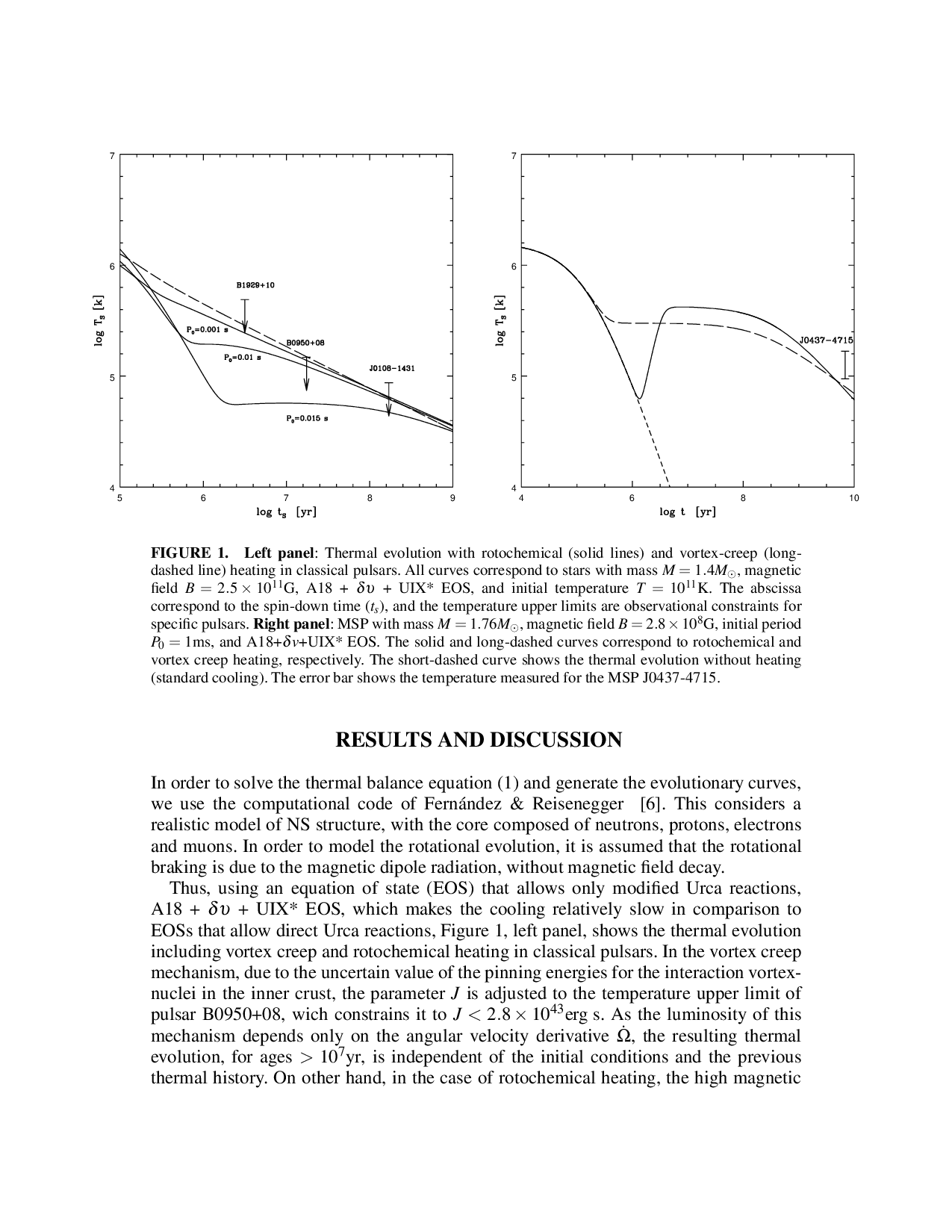
In order to solve the thermal balance equation ( 1) and generate the evolutionary curves, we use the computational code of Fernández & Reisenegger [6]. This considers a realistic model of NS structure, with the core composed of neutrons, protons, electrons and muons. In order to model the rotational evolution, it is assumed that the rotational braking is due to the magnetic dipole radiation, without ma
…(Full text truncated)…
This content is AI-processed based on ArXiv data.