We consider two-component integrable generalizations of the dispersionless 2DTL hierarchy connected with non-Hamiltonian vector fields, similar to the Manakov-Santini hierarchy generalizing the dKP hierarchy. They form a one-parametric family connected by hodograph type transformations. Generating equations and Lax-Sato equations are introduced, a dressing scheme based on the vector nonlinear Riemann problem is formulated. The simplest two-component generalization of the dispersionless 2DTL equation is derived, its differential reduction analogous to the Dunajski interpolating system is presented. A symmetric two-component generalization of the dispersionless elliptic 2DTL equation is also constructed.
Deep Dive into Non-Hamiltonian generalizations of the dispersionless 2DTL hierarchy.
We consider two-component integrable generalizations of the dispersionless 2DTL hierarchy connected with non-Hamiltonian vector fields, similar to the Manakov-Santini hierarchy generalizing the dKP hierarchy. They form a one-parametric family connected by hodograph type transformations. Generating equations and Lax-Sato equations are introduced, a dressing scheme based on the vector nonlinear Riemann problem is formulated. The simplest two-component generalization of the dispersionless 2DTL equation is derived, its differential reduction analogous to the Dunajski interpolating system is presented. A symmetric two-component generalization of the dispersionless elliptic 2DTL equation is also constructed.
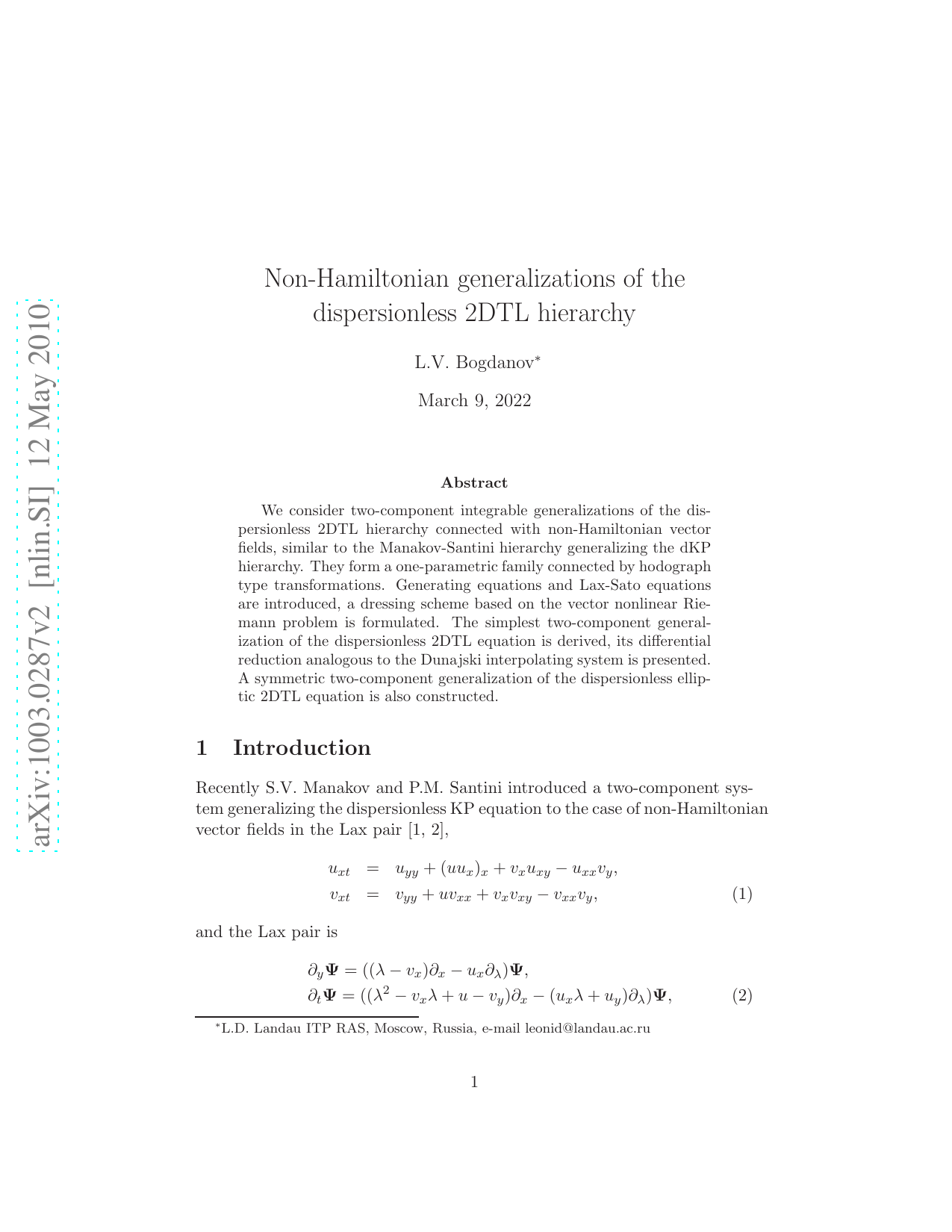
Recently S.V. Manakov and P.M. Santini introduced a two-component system generalizing the dispersionless KP equation to the case of non-Hamiltonian vector fields in the Lax pair [1,2],
and the Lax pair is
where u, v are functions of x, y, t, and λ plays a role of a spectral variable. For v = 0 the system (1) reduces to the dKP (Khohlov-Zabolotskaya) equation
Respectively, the reduction u = 0 gives an equation [3]
The hierarchy related to this system was studied in [4,5]. It was demonstrated that the Manakov-Santini hierarchy represents a case N=1 of a general (N+1)-component hierarchy. This general hierarchy is connected with commutativity of (N+1)-dimensional vector vields containing a derivative with respect to the spectral variable, with the coefficients of vector fields meromorphic in the complex plane of the spectral variable and having a pole only at one point (e.g., infinity, compare the Lax pair ( 2)). In this sense the Manakov-Santini hierarchy is a two-component one-point hierarchy, and generalizations of the dispersionless 2DTL hierarchy we are going to consider in this paper represent a two-component two-point case, when vector fields have poles at two points (say, zero and infinity). Our starting point is the formalism of the works [6,4,5], which we transfer to the two-point case having in mind the representation of the dispersionless 2DTL hierarchy given in [7,8] and the results of the recent work [9], in which the dressing, the Cauchy problem and the behavior of solutions of the dispersionless 2D Toda equation were studied. We introduce generating equations and Lax-Sato equations and develop a dressing scheme based on vector nonlinear Riemann problem. We discover one-parametric freedom in generalizing the dispersionless 2DTL hierarchy, and describe hodograph type transformations connecting different generalizations.
The simplest two-component generalization of the dispersionless 2DTL equation reads
and the Lax pair is
(the derivation is given below). For m = t the system (5) reduces to the dispersionless 2DTL equation
Respectively, the reduction φ = 0 gives an equation [3] m tt = m ty m xm xy m t .
System (5) doesn’t preserve the symmetry of the dispersionless 2DTL equation with respect to x, y variables, however, we also introduce a symmetric generalization of the d2DTL equation.
We generalize a picture of the dispersionless 2DTL hierarchy given by Takasaki and Takebe [7,8], taking into account the results of the recent work [9], to the case of non-Hamiltonian vector fields, similar to the Manakov-Santini hierarchy, which generalizes the dispersionless KP hierarchy [1,2,4,5]. We consider formal series
where λ is a spectral variable. Usually we suggest that ‘out’ and ‘in’ components of the series define the functions outside and inside the unit circle in the complex plane of the variable λ respectively, with Λ in -ln λ, M in -M in 0 analytic in the unit disc, and Λ out -ln λ, M out -M out 0 analytic outside the unit disc and decreasing at infinity. For a function on the complex plane, having a discontinuity on the unit circle, by ‘in’ and ‘out’ components we mean the function inside and outside the unit disc. For two-component series we observe a natural convention (AB) in = A in B in , (AB) out = A out B out , which corresponds to multiplication of respective functions on the complex plane. The coefficients of the series φ, m 0 , l ± k , m ± k are functions of times t, x n , y n . Usually for simplicity we suggest that only finite number of x k , y k are not equal to zero. Generalized dispersionless 2DTL hierarchy is defined by the generating relation
which may be considered as a continuity condition on the unit circle for the differential two-form (or just in terms of formal series), where J 0 is a determinant of Jacobi type matrix J,
, and we suggest that J 0 = 0; the differential d is given by
As a result of a continuity condition, the coefficients of the differential twoform in the generating relation (10) are meromorphic. First we will give a direct derivation of the Lax-Sato equations of generalized two-component d2DTL hierarchy from the generating relation (10). It is also possible to give a derivation based on an intermediate general statement about linear operators of the hierarchy, similar to the works [6], [4], but here we prefer to demonstrate a more straightforward way of exploiting the generating relation (10).
Taking a term of the generating relation containing dλ ∧ dx n , we get
where we introduce a notation
Thus, taking into account (8), (9), we come to the conclusion that the functions
are polynomials, and they can be expressed by the formula
where the subscripts + , -denote projection operators, (
In a similar way, taking a term of the generating relation containing dt∧dx n , we conclude that the functions
are also polynomials, and they can be expressed by the formula
Resolving ( 12), ( 14) as linear equations with respect to ∂ + n Λ, ∂ + n M , we obt
…(Full text truncated)…
This content is AI-processed based on ArXiv data.