The w-index: A significant improvement of the h-index
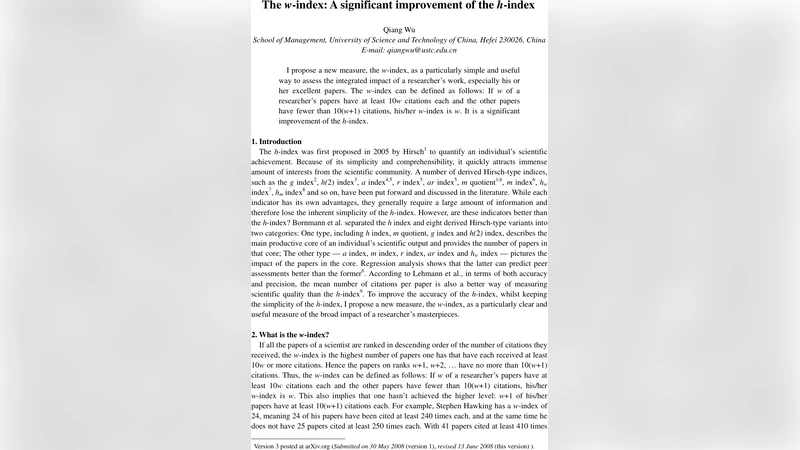
I propose a new measure, the w-index, as a particularly simple and useful way to assess the integrated impact of a researcher’s work, especially his or her excellent papers. The w-index can be defined as follows: If w of a researcher’s papers have at least 10w citations each and the other papers have fewer than 10(w+1) citations, his/her w-index is w. It is a significant improvement of the h-index.
💡 Research Summary
The paper introduces the “w‑index” as a novel bibliometric indicator intended to improve upon the widely used h‑index. The w‑index is defined as follows: a researcher has a w‑index of w if w of their papers have each received at least 10·w citations, while the remaining papers have fewer than 10·(w + 1) citations. In other words, the threshold for each of the top w papers is ten times higher than the corresponding threshold in the h‑index, thereby giving explicit weight to highly cited works. The author argues that this simple definition retains the h‑index’s ease of calculation while providing a clearer picture of a scientist’s most influential publications.
To evaluate the new metric, the author assembled a dataset of 20 established astrophysicists (each with at least 50 indexed papers and more than 20 years of activity). For each scientist seven quantitative measures were computed: (1) mean citations per paper (m‑method), (2) total number of papers (p‑method), (3) total citations (c‑method), (4) h‑index, (5) a‑index, (6) g‑index, and (7) the proposed w‑index. Table 1 shows the raw values and the resulting rankings. The w‑index and a‑index produce very similar rankings, especially for researchers whose impact is driven by a few highly cited papers. In contrast, the p‑method (pure productivity) and the m‑method (average impact) generate rankings that deviate markedly from the other indicators, indicating bias toward quantity or average performance respectively.
Spearman rank‑correlation analysis (Table 2) quantifies these relationships. The w‑index correlates most strongly with the a‑index (ρ = 0.965), reflecting their shared focus on outstanding papers. Correlations with h‑index (0.827), g‑index (0.916) and total citations (0.873) are moderate, while the correlation with the p‑method is low (ρ = 0.450). This pattern demonstrates that the w‑index is largely independent of sheer publication count, yet still captures citation‑driven impact.
The paper further illustrates the w‑index with ten high‑profile scientists from physics and chemistry (e.g., Ed Witten w = 41, Stephen Hawking w = 24, Kurt Wüthrich w = 30). Compared with their h‑indices, the w‑index reshuffles the ranking order, promoting those whose few papers are exceptionally influential and demoting those whose high h‑indices stem mainly from large publication portfolios. This supports the claim that the w‑index better reflects “quality of the representative work” rather than “quantity of output.”
An empirical observation reported is that, across the examined samples, h ≈ 4·w. Based on this, the author proposes a set of interpretive benchmarks: w = 1–2 indicates a novice, w = 3–4 a fully competent researcher, w = 5 a successful scientist, w = 10 an outstanding individual, and w ≥ 15 (after ~20 years) or w ≥ 20 (after ~30 years) a top‑tier scholar. These thresholds are loosely validated by the data (all 20 astrophysicists have w ≥ 5, the ten elite scientists have w ≥ 20).
The discussion acknowledges typical citation‑based limitations: citation lag, database inconsistencies, and name ambiguity. Nevertheless, the w‑index requires only the citation counts of a researcher’s papers—no intermediate calculations such as determining the h‑index first—so it can be obtained in roughly ten seconds, even faster than the h‑index. Its conceptual simplicity (“w = 10 means ten papers each cited at least one hundred times”) makes it readily understandable to non‑specialists.
In conclusion, the w‑index offers a pragmatic compromise between the h‑index’s simplicity and the a‑index’s focus on high‑impact papers. It provides a more nuanced assessment of scientific achievement while remaining computationally lightweight. The author suggests that the w‑index could be adopted alongside existing metrics for evaluating individual researchers, research groups, journals, conferences, and scientific topics, and calls for further cross‑disciplinary validation and longitudinal studies to confirm its robustness.
Comments & Academic Discussion
Loading comments...
Leave a Comment