When a rotating neutron star loses angular momentum, the reduction in the centrifugal force makes it contract. This perturbs each fluid element, raising the local pressure and originating deviations from beta equilibrium that enhance the neutrino emissivity and produce thermal energy. This mechanism is named rotochemical heating and has previously been studied for neutron stars of non-superfluid matter, finding that they reach a quasi-steady state in which the rate that the spin-down modifies the equilibrium concentrations is the same to that of the neutrino reactions restoring the equilibrium. On the other hand, the neutron star interior is believed to contain superfluid nucleons, which affect the thermal evolution of the star by suppressing the neutrino reactions and the specific heat, and opening new Cooper pairing reactions. In this work we describe the thermal effects of Cooper pairing with spatially uniform energy gaps of neutrons and protons on rotochemical heating in millisecond pulsars (MSPs) when only modified Urca reactions are allowed. We find that the chemical imbalances grow up to a value close to the energy gaps, which is higher than the one of the nonsuperfluid case. Therefore, the surface temperatures predicted with Cooper pairing are higher and explain the recent measurement of MSP J0437-4715.
Deep Dive into Rotochemical heating in millisecond pulsars with Cooper pairing.
When a rotating neutron star loses angular momentum, the reduction in the centrifugal force makes it contract. This perturbs each fluid element, raising the local pressure and originating deviations from beta equilibrium that enhance the neutrino emissivity and produce thermal energy. This mechanism is named rotochemical heating and has previously been studied for neutron stars of non-superfluid matter, finding that they reach a quasi-steady state in which the rate that the spin-down modifies the equilibrium concentrations is the same to that of the neutrino reactions restoring the equilibrium. On the other hand, the neutron star interior is believed to contain superfluid nucleons, which affect the thermal evolution of the star by suppressing the neutrino reactions and the specific heat, and opening new Cooper pairing reactions. In this work we describe the thermal effects of Cooper pairing with spatially uniform energy gaps of neutrons and protons on rotochemical heating in millisec
The main motivation to study the thermal evolution of neutron stars is that contrasting theoretical predictions with the thermal emission measured from neutron stars (NSs) has the potential to provide constraints on their inner structure. In the existing literature, several detailed cooling calculations have been compared to the few estimates available for the surface temperatures of neutron stars (see [10] for a review and references). These calculations are based on the early passive cooling, which is at first neutrino-dominated. On the contrary, we focused our study on the late thermal evolution, where the cooling is driven by photon emission at ages greater than ∼ 10 5 yr.
Several mechanisms can keep NSs hot beyond the standard cooling timescale ∼ 10 7 yr, among them rotochemical heating. The latter was first proposed in [4] and then improved in [1] by considering the internal structure of non-superfluid neutron stars via realistic equations of state (EOSs) in the framework of general relativity. It works as follows.
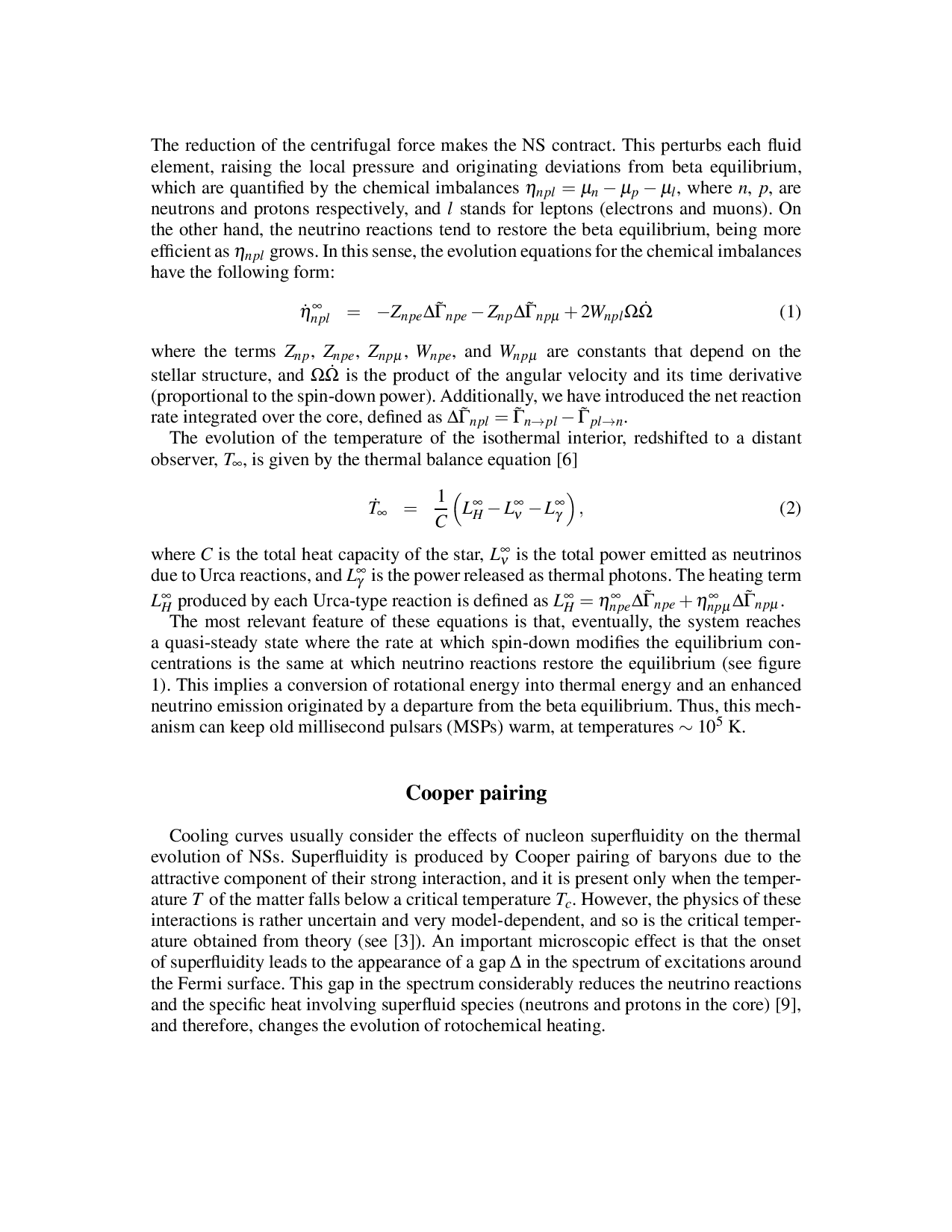
The reduction of the centrifugal force makes the NS contract. This perturbs each fluid element, raising the local pressure and originating deviations from beta equilibrium, which are quantified by the chemical imbalances η npl = µ n -µ p -µ l , where n, p, are neutrons and protons respectively, and l stands for leptons (electrons and muons). On the other hand, the neutrino reactions tend to restore the beta equilibrium, being more efficient as η npl grows. In this sense, the evolution equations for the chemical imbalances have the following form:
where the terms Z np , Z npe , Z npµ , W npe , and W npµ are constants that depend on the stellar structure, and Ω Ω is the product of the angular velocity and its time derivative (proportional to the spin-down power). Additionally, we have introduced the net reaction rate integrated over the core, defined as ∆ Γnpl = Γn→pl -Γpl→n . The evolution of the temperature of the isothermal interior, redshifted to a distant observer, T ∞ , is given by the thermal balance equation [6]
where C is the total heat capacity of the star, L ∞ ν is the total power emitted as neutrinos due to Urca reactions, and L ∞ γ is the power released as thermal photons. The heating term L ∞ H produced by each Urca-type reaction is defined as
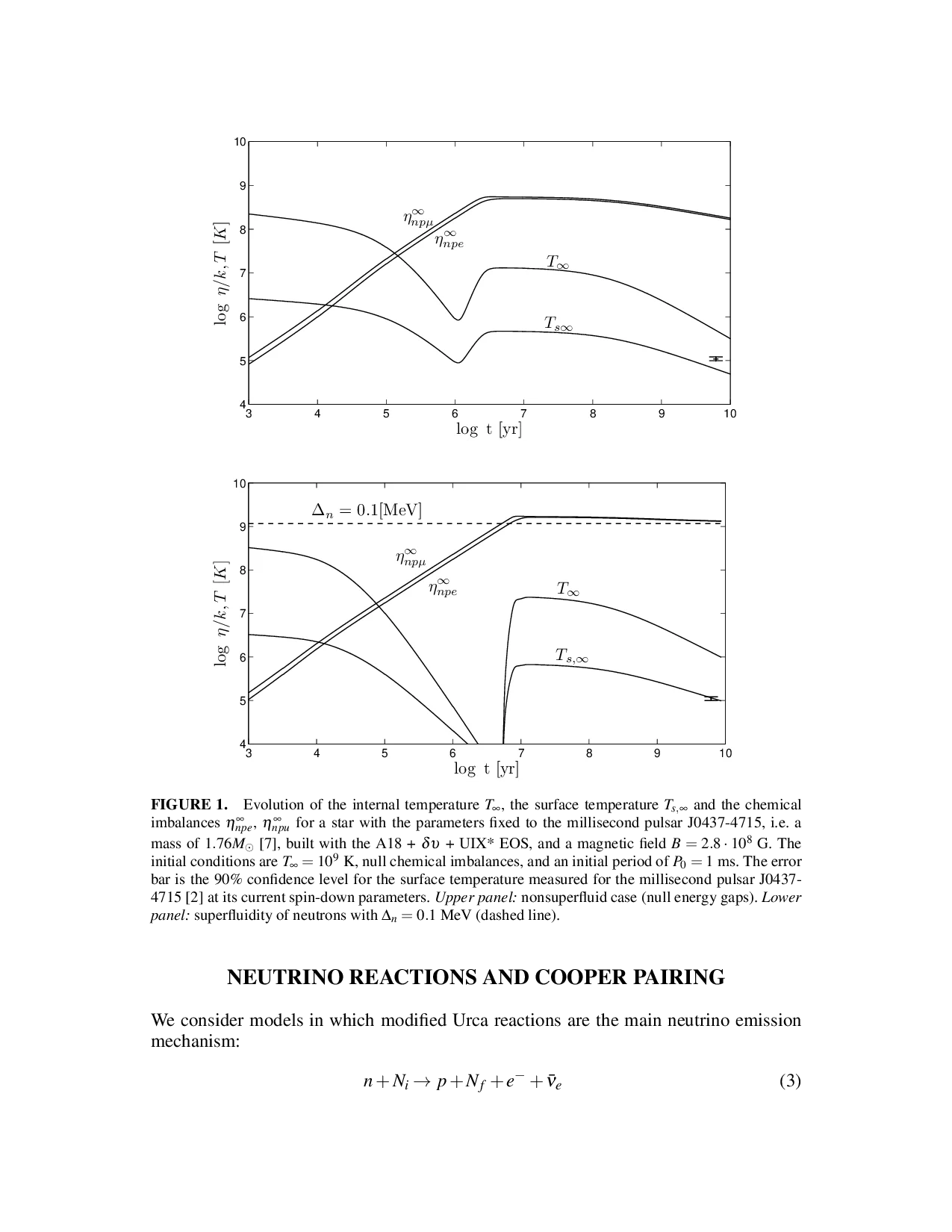
The most relevant feature of these equations is that, eventually, the system reaches a quasi-steady state where the rate at which spin-down modifies the equilibrium concentrations is the same at which neutrino reactions restore the equilibrium (see figure 1). This implies a conversion of rotational energy into thermal energy and an enhanced neutrino emission originated by a departure from the beta equilibrium. Thus, this mechanism can keep old millisecond pulsars (MSPs) warm, at temperatures ∼ 10 5 K.
Cooling curves usually consider the effects of nucleon superfluidity on the thermal evolution of NSs. Superfluidity is produced by Cooper pairing of baryons due to the attractive component of their strong interaction, and it is present only when the temperature T of the matter falls below a critical temperature T c . However, the physics of these interactions is rather uncertain and very model-dependent, and so is the critical temperature obtained from theory (see [3]). An important microscopic effect is that the onset of superfluidity leads to the appearance of a gap ∆ in the spectrum of excitations around the Fermi surface. This gap in the spectrum considerably reduces the neutrino reactions and the specific heat involving superfluid species (neutrons and protons in the core) [9], and therefore, changes the evolution of rotochemical heating.
Evolution of the internal temperature T ∞ , the surface temperature T s,∞ and the chemical imbalances η ∞ npe , η ∞ npu for a star with the parameters fixed to the millisecond pulsar J0437-4715, i.e. a mass of 1.76M ⊙ [7], built with the A18 + δ υ + UIX* EOS, and a magnetic field B = 2.8 • 10 8 G. The initial conditions are T ∞ = 10 9 K, null chemical imbalances, and an initial period of P 0 = 1 ms. The error bar is the 90% confidence level for the surface temperature measured for the millisecond pulsar J0437-4715 [2] at its current spin-down parameters. Upper panel: nonsuperfluid case (null energy gaps). Lower panel: superfluidity of neutrons with ∆ n = 0.1 MeV (dashed line).
We consider models in which modified Urca reactions are the main neutrino emission mechanism:
where the subscripts i and f stand for the initial and final state of the spectator nucleon N.
As in [8], we compute the net reaction rate ∆ Γnpl and the neutrino emissivity for these reactions numerically, considering the chemical imbalances η npl , the energy gaps ∆ in the energy spectra of the nucleons, and the temperature as free parameters (see details in [5]). We find that at low temperatures, i.e. T ≪ η npl , which is the regime of interest in rotochemical heating (see the upper panel of figure 1), these reactions are alm
…(Full text truncated)…
This content is AI-processed based on ArXiv data.