Low-complexity Fusion Filtering for Continuous-Discrete Systems
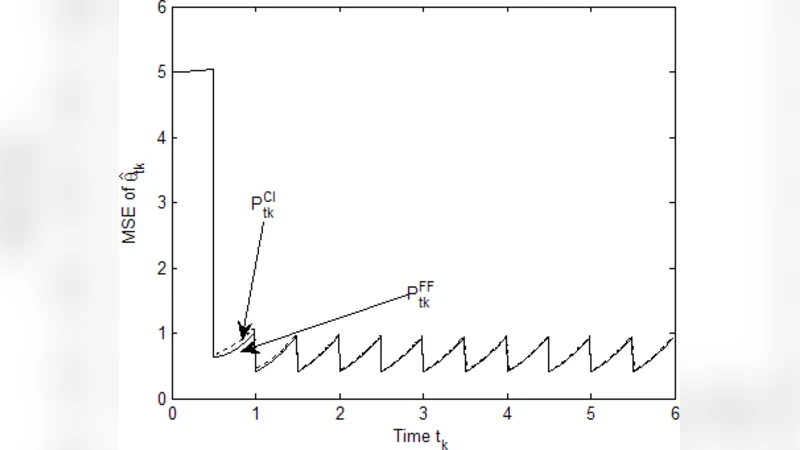
In this paper, low-complexity distributed fusion filtering algorithm for mixed continuous-discrete multisensory dynamic systems is proposed. To implement the algorithm a new recursive equations for local cross-covariances are derived. To achieve an effective fusion filtering the covariance intersection (CI) algorithm is used. The CI algorithm is useful due to its low-computational complexity for calculation of a big number of cross-covariances between local estimates and matrix weights. Theoretical and numerical examples demonstrate the effectiveness of the covariance intersection algorithm in distributed fusion filtering.
💡 Research Summary
**
The paper addresses the problem of distributed state estimation for continuous‑discrete dynamical systems, where the underlying process evolves continuously in time while measurements are taken at discrete, possibly asynchronous, sampling instants. Such a situation is common in navigation, robotics, power‑grid monitoring, and many other cyber‑physical domains where multiple heterogeneous sensors operate with different rates. Conventional distributed fusion approaches either (i) collect all raw measurements at a central processor and run a full Kalman filter—an option that quickly becomes computationally prohibitive as the number of sensors grows, or (ii) fuse local estimates without accounting for the cross‑covariances between them, which leads to overly optimistic uncertainty estimates (information double‑counting) and degraded accuracy.
The authors propose a two‑stage solution that simultaneously preserves the statistical consistency of the fused estimate and dramatically reduces computational load. The first stage introduces a novel recursive formula for the cross‑covariance matrices between any pair of local estimators. Starting from the continuous‑time state transition matrix Φ(t_k, t_{k‑1}) and the Kalman gains K_k^{(i)} of each local filter, the new recursion propagates the previous cross‑covariance C_{ij,k‑1} forward and adds correction terms that depend only on locally available quantities (local error covariances, measurement matrices, and gains). This eliminates the need for a full O(N²) recomputation at every time step; instead, each sensor updates only O(N) quantities, where N is the number of sensors. The authors provide a rigorous proof that the recursion yields the exact cross‑covariance under the linear‑Gaussian assumptions, and they verify numerically that it matches the results of a brute‑force calculation.
The second stage applies the Covariance Intersection (CI) algorithm to fuse the local estimates using the cross‑covariances obtained in the first stage. CI is a well‑known robust fusion technique that does not require knowledge of the exact correlation structure; it constructs a fused covariance as the inverse of a convex combination of the inverses of the individual covariances:
P_CI⁻¹ = α P₁⁻¹ + (1‑α) P₂⁻¹,
x̂_CI = P_CI