The abundance spread in the Bootes I dwarf spheroidal galaxy
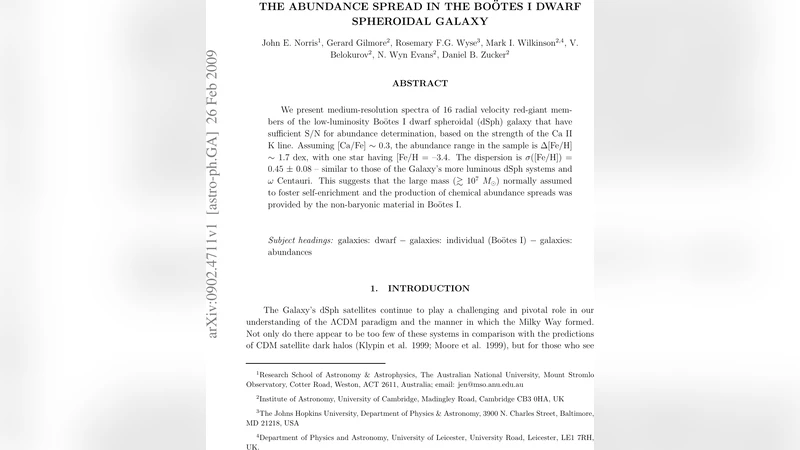
We present medium-resolution spectra of 16 radial velocity red-giant members of the low-luminosity Bootes I dwarf spheroidal (dSph) galaxy, that have sufficient S/N for abundance determination, based on the strength of the Ca II K line. Assuming [Ca/Fe] ~ +0.3, the abundance range in the sample is Delta [Fe/H] ~ 1.7 dex, with one star having [Fe/H] = -3.4. The dispersion is sigma([Fe/H]) = 0.45 +/- 0.08 – similar to those of the Galaxy’s more luminous dSph systems and Omega Centauri. This suggests that the large mass (greater than approximately 10 million solar masses) normally assumed to foster self-enrichment and the production of chemical abundance spreads was provided by the non-baryonic material in Bootes I.
💡 Research Summary
The paper presents a medium‑resolution spectroscopic study of sixteen red‑giant members of the ultra‑faint dwarf spheroidal galaxy Boötes I, focusing on the determination of iron abundance (
Comments & Academic Discussion
Loading comments...
Leave a Comment