X-ray views of neutron star low-mass X-ray binaries
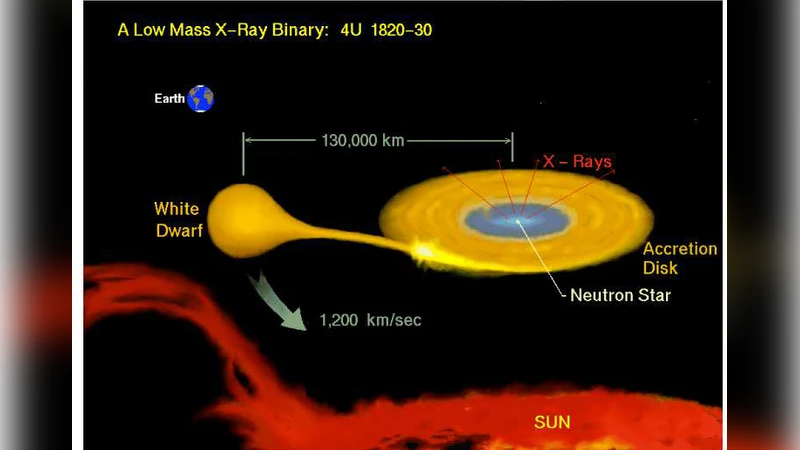
A neutron star low-mass X-ray binary is a binary stellar system with a neutron star and a low-mass companion star rotating around each other. In this system the neutron star accretes mass from the companion, and as this matter falls into the deep potential well of the neutron star, the gravitational potential energy is released primarily in the X-ray wavelengths. Such a source was first discovered in X-rays in 1962, and this discovery formally gave birth to the “X-ray astronomy”. In the subsequent decades, our knowledge of these sources has increased enormously by the observations with several X-ray space missions. Here we give a brief overview of our current understanding of the X-ray observational aspects of these systems.
💡 Research Summary
Neutron star low‑mass X‑ray binaries (NS‑LMXBs) are systems in which a neutron star accretes matter from a low‑mass companion, converting gravitational potential energy into X‑ray radiation. Since the first X‑ray detection in 1962, a succession of space missions—Uhuru, HEAO‑1, RXTE, Chandra, XMM‑Newton, NICER, NuSTAR, Insight‑HXMT, among others—have progressively refined our observational picture. This review synthesizes the current observational knowledge, focusing on spectral, timing, and bursting phenomena, and places them in the context of theoretical models.
The sources are traditionally divided into two classes based on mass‑transfer rate and colour‑colour diagram morphology: Z‑sources (high 𝑀̇ ≈10⁻⁸ M⊙ yr⁻¹) trace a Z‑shaped track with three branches (horizontal, normal, flaring), while atoll sources (lower 𝑀̇ ≈10⁻⁹–10⁻¹⁰ M⊙ yr⁻¹) form island and banana states. In Z‑sources, low‑frequency QPOs (LF‑QPOs) appear on the horizontal branch, and kilohertz QPOs (kHz‑QPOs) are seen on the normal and flaring branches, reflecting disk‑shear and boundary‑layer oscillations. Atoll sources display a hard state dominated by Comptonised emission and a soft state where a multicolour disk blackbody and a boundary‑layer blackbody dominate; transitions between these states are accompanied by changes in QPO properties.
Thermonuclear (type‑I) X‑ray bursts arise when accumulated hydrogen/helium ignites unstably on the neutron‑star surface. Burst light curves, recurrence times, and peak fluxes encode the fuel composition, accretion rate, and neutron‑star mass–radius relation. Rare, long‑duration “superbursts” are thought to be carbon flashes, providing a probe of deep crustal heating and thermal transport.
High‑precision timing has revealed twin kHz‑QPOs whose frequency separation sometimes matches the neutron‑star spin inferred from coherent pulsations (in accreting millisecond X‑ray pulsars). Competing models—beat‑frequency, relativistic precession, and resonance models—attempt to link these frequencies to orbital motion near the stellar surface, offering a potential avenue to constrain the equation of state of dense matter.
Spectroscopy has progressed from broadband continuum fitting to high‑resolution line studies. The Fe Kα fluorescence line and associated reflection continuum, resolved by Chandra and XMM‑Newton, trace the inner accretion‑disk radius and ionisation state, revealing relativistic broadening that tests strong‑gravity effects. Hard‑X‑ray observations by NuSTAR and Insight‑HXMT have measured the high‑energy cutoff and Comptonisation parameters, constraining the temperature and optical depth of the boundary layer.
Theoretical frameworks combine a geometrically thin, optically thick Shakura‑Sunyaev disk, a radiatively supported inner flow, and a boundary layer where the Keplerian disk material decelerates onto the neutron‑star surface. Magnetic fields of 10⁸–10⁹ G can truncate the disk, giving rise to accretion‑powered pulsations in a subset of sources. General‑relativistic magnetohydrodynamic simulations are increasingly used to model the disk‑magnetosphere interaction and the generation of QPOs.
Looking ahead, next‑generation missions such as XRISM (high‑resolution microcalorimeter spectroscopy), Athena (large effective area and high‑throughput spectroscopy), and eXTP (combined timing, spectroscopy, and polarimetry) will deliver unprecedented data quality. These instruments will enable precise measurements of disk reflection, burst oscillations, and polarization signatures, thereby tightening constraints on neutron‑star mass, radius, and the physics of ultra‑dense matter.
In summary, decades of X‑ray observations have transformed NS‑LMXBs from mere point sources into laboratories for strong‑gravity astrophysics, nuclear burning, and accretion physics. Continued multi‑mission synergy and advanced theoretical modelling promise to resolve remaining ambiguities and to exploit these systems as powerful probes of fundamental physics.
Comments & Academic Discussion
Loading comments...
Leave a Comment