Remarks on the preservation of topological covering properties under Cohen forcing
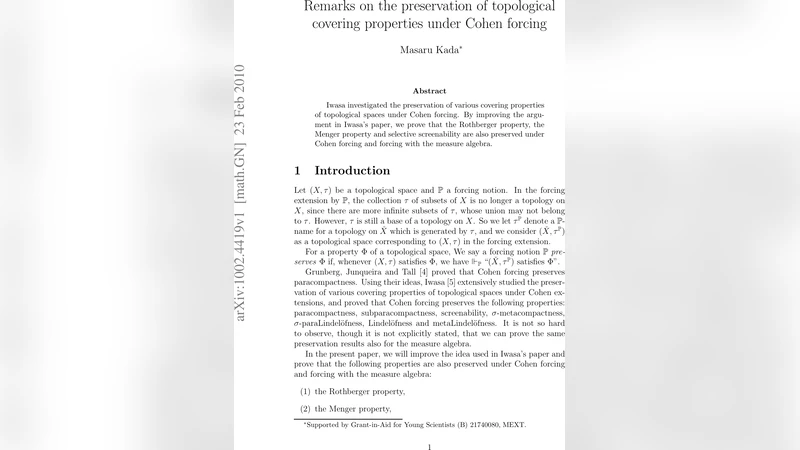
Iwasa investigated the preservation of various covering properties of opological spaces under Cohen forcing. By improving the argument in Iwasa’s paper, we prove that the Rothberger property, the Menger property and selective screenability are also preserved under Cohen forcing and forcing with the measure algebra.
💡 Research Summary
The paper revisits the problem of whether certain selection‑type covering properties of topological spaces are preserved under forcing extensions, focusing on Cohen forcing and forcing with the measure algebra. The motivation stems from Iwasa’s earlier work, which established preservation for a handful of properties (such as the Hurewicz property and γ‑spaces) but left open the status of the Rothberger property, the Menger property, and selective screenability. The author’s main contribution is a refined analysis of names and conditions in the Cohen forcing poset that yields a uniform method for transferring selection principles from the ground model to the generic extension.
The technical core consists of three steps. First, the author proves a “normalization lemma” for Cohen names of open covers: every name for an open set can be replaced by a canonical name whose interpretation in any generic extension is an actual open set, and this replacement respects the ordering of conditions. The lemma exploits the ℵ₁‑chain condition of Cohen forcing to guarantee a dense set of conditions that decide the relevant pieces of the cover. Second, a “density argument” shows that for any countable sequence of such normalized names, one can find a single condition that simultaneously decides a finite (or singleton) subfamily of each name. This provides the combinatorial backbone needed for the selection principles. Third, the author translates these combinatorial facts into the language of selection games: for Rothberger (S₁(𝒪,𝒪)) one builds a winning strategy that picks a single open set from each normalized cover; for Menger (S_fin(𝒪,𝒪)) one constructs a strategy that picks a finite subfamily at each stage; for selective screenability (SS*) a two‑stage strategy is defined, first splitting each cover into two parts and then applying the previous arguments to each part. In each case the strategy is definable in the ground model and remains valid in the generic extension because the normalized names are already decided by a dense set of conditions.
The paper then extends the argument to forcing with the measure algebra. Since the measure algebra is a σ‑complete Boolean algebra, the same normalization and density techniques apply, with the additional observation that measure‑zero sets can be ignored without affecting the selection properties. Consequently, the Rothberger, Menger, and selective screenability properties are shown to be preserved under measure‑algebra forcing as well.
The structure of the paper is as follows: after a concise introduction and a review of Iwasa’s results, Section 2 develops the normalization lemma and the density lemma for Cohen forcing. Sections 3, 4, and 5 apply these lemmas respectively to Rothberger, Menger, and selective screenability, providing detailed proofs of preservation. Section 6 adapts the arguments to the measure algebra, and Section 7 discusses broader implications, suggesting that the normalization technique may be useful for other forcing notions such as Random or Sacks forcing. The results fill the gap left by Iwasa, establishing that all three classical selection properties considered are robust under the most common forcing extensions used in set‑theoretic topology.
Comments & Academic Discussion
Loading comments...
Leave a Comment