Hopf cyclic cohomology and Hodge theory for proper actions
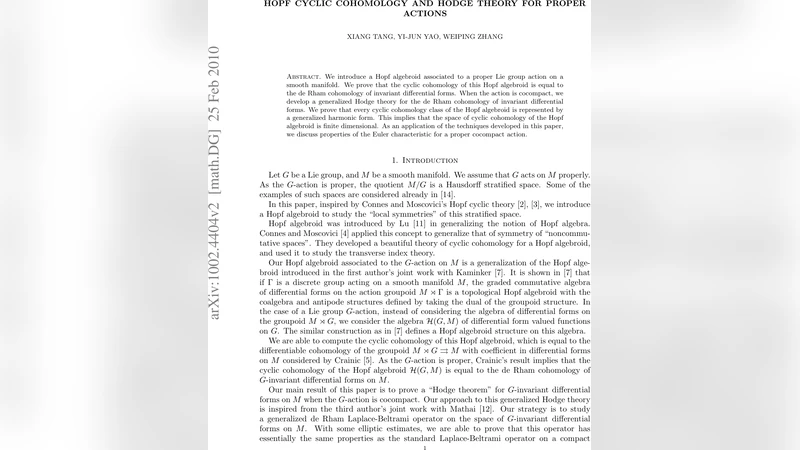
We introduce a Hopf algebroid associated to a proper Lie group action on a smooth manifold. We prove that the cyclic cohomology of this Hopf algebroid is equal to the de Rham cohomology of invariant differential forms. When the action is cocompact, we develop a generalized Hodge theory for the de Rham cohomology of invariant differential forms. We prove that every cyclic cohomology class of the Hopf algebroid is represented by a generalized harmonic form. This implies that the space of cyclic cohomology of the Hopf algebroid is finite dimensional. As an application of the techniques developed in this paper, we discuss properties of the Euler characteristic for a proper cocompact action.
💡 Research Summary
The paper develops a new bridge between non‑commutative geometry and classical Hodge theory by attaching a Hopf algebroid to any proper Lie‑group action on a smooth manifold (M). The construction starts from the crossed‑product algebra (C^{\infty}(M)\rtimes C^{\infty}(G)) and equips it with source, target, coproduct and antipode maps that satisfy the axioms of a Hopf algebroid; properness guarantees that all structure maps are well defined and continuous.
The authors then compute the cyclic cohomology of this Hopf algebroid. By building the Connes‑Moscovici type cyclic complex for the algebroid and comparing it with the de Rham complex of (G)‑invariant differential forms, they produce an explicit chain map that is a quasi‑isomorphism. Consequently the cyclic cohomology (HC^{\bullet}(\mathcal{H})) is canonically isomorphic to the de Rham cohomology (H_{\mathrm{dR}}^{\bullet}(M)^{G}) of invariant forms. This result extends the well‑known identification for group algebras and for the Hopf algebroid of a foliation to the setting of proper actions, even when the action is not free.
When the action is additionally cocompact (the orbit space (M/G) is compact), the paper introduces a generalized Hodge theory. Choosing a (G)‑invariant Riemannian metric, the authors define a Laplace‑type operator (\Delta_{G}) acting on invariant forms. Properness ensures that (\Delta_{G}) is essentially self‑adjoint on the (L^{2})‑completion of invariant forms, has discrete non‑negative spectrum, and admits a Hodge decomposition
\
Comments & Academic Discussion
Loading comments...
Leave a Comment