Splitting in the K-theory localization sequence of number fields
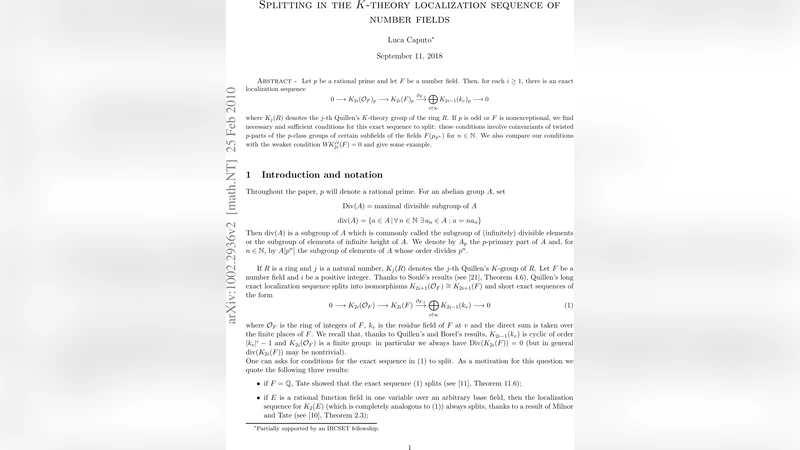
Let p be a rational prime and let F be a number field. Then, for each i>0, there is a short exact localization sequence for K_{2i}(F). If p is odd or F is nonexceptional, we find necessary and sufficient conditions for this exact sequence to split: these conditions involve coinvariants of twisted p-parts of the p-class groups of certain subfields of the fields F(\mu_{p^n}) for n\in N. We also compare our conditions with the weaker condition WK^{et}_{2i}(F)=0 and give some example.
💡 Research Summary
The paper investigates the splitting behavior of the short exact localization sequence for the even‑degree algebraic K‑groups of a number field F. For any rational prime p and any integer i > 0 there is a canonical exact sequence
0 → K₂ᵢ(𝒪_F) → K₂ᵢ(F) → ⊕_{v∤∞} K₂ᵢ₋₁(k_v) → 0,
where the sum runs over all finite places v of F and k_v denotes the corresponding residue field. The central question is: under what arithmetic conditions does this sequence split (i.e., admit a section)?
The author proves that when p is odd or when F is non‑exceptional (i.e., not a real field in which 2 remains inert), the splitting is completely governed by the Galois coinvariants of certain twisted p‑parts of class groups. More precisely, for each n ≥ 1 consider the cyclotomic extension F(μ_{pⁿ}) and any intermediate subfield L⊂F(μ_{pⁿ}). Let Cl_L(p) be the p‑primary part of the ideal class group of L and denote its i‑th Tate twist by Cl_L(p)(i)=Cl_L(p)⊗ℤ_p(i). The Galois group G=Gal(L/F) acts on this twisted module, and the paper shows:
The localization sequence splits ⇔ (Cl_L(p)(i))_G = 0 for every n and every such L.
In other words, the vanishing of the G‑coinvariants of the twisted p‑class groups is both necessary and sufficient for a splitting. The proof combines the classical description of the boundary maps in the localization sequence with Iwasawa‑theoretic tools: norm maps, transfer maps, and the structure of Tate‑twisted modules. By analysing the image of K₂ᵢ(F) in the direct sum of residue‑field K‑groups, the author identifies the obstruction to splitting with the aforementioned coinvariants.
The paper also introduces the étale weak K‑group
WK^{et}{2i}(F)=\varprojlim_n H^2{et}(Spec 𝒪_F
Comments & Academic Discussion
Loading comments...
Leave a Comment