Dynamical inference from a kinematic snapshot: The force law in the Solar System
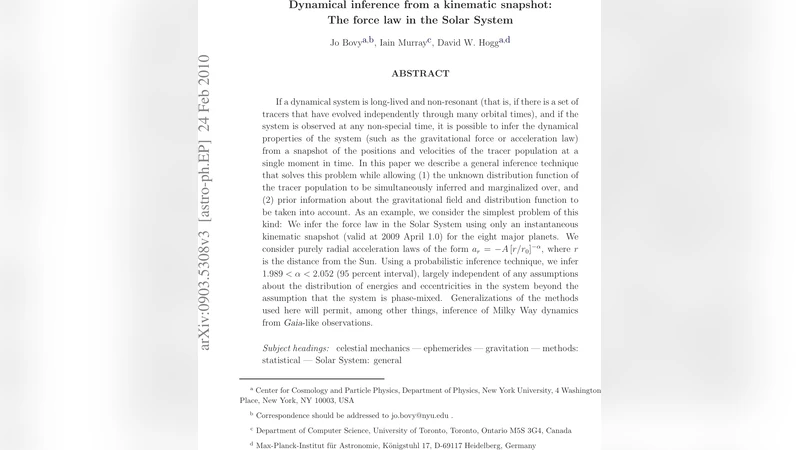
If a dynamical system is long-lived and non-resonant (that is, if there is a set of tracers that have evolved independently through many orbital times), and if the system is observed at any non-special time, it is possible to infer the dynamical properties of the system (such as the gravitational force or acceleration law) from a snapshot of the positions and velocities of the tracer population at a single moment in time. In this paper we describe a general inference technique that solves this problem while allowing (1) the unknown distribution function of the tracer population to be simultaneously inferred and marginalized over, and (2) prior information about the gravitational field and distribution function to be taken into account. As an example, we consider the simplest problem of this kind: We infer the force law in the Solar System using only an instantaneous kinematic snapshot (valid at 2009 April 1.0) for the eight major planets. We consider purely radial acceleration laws of the form a_r = -A [r/r_0]^{-\alpha}, where r is the distance from the Sun. Using a probabilistic inference technique, we infer 1.989 < \alpha < 2.052 (95 percent interval), largely independent of any assumptions about the distribution of energies and eccentricities in the system beyond the assumption that the system is phase-mixed. Generalizations of the methods used here will permit, among other things, inference of Milky Way dynamics from Gaia-like observations.
💡 Research Summary
The paper tackles a fundamental question in dynamical astronomy: can the underlying force law of a long‑lived, non‑resonant system be recovered from a single instantaneous snapshot of tracer positions and velocities? The authors develop a general Bayesian inference framework that (i) treats the unknown phase‑space distribution function (DF) of the tracers as a latent variable to be marginalized over, and (ii) incorporates prior information on both the gravitational field and the DF. The key physical assumption is that the tracer population is phase‑mixed – i.e., each tracer has evolved independently over many orbital periods, so that its orbital phases are uniformly distributed. Under this condition, the observed phase‑space coordinates are a random draw from the steady‑state DF that depends on the integrals of motion (energy E and angular momentum L) and on the gravitational potential Φ(r).
To demonstrate the method, the authors consider the simplest realistic case: the eight major planets of the Solar System observed at a single epoch (2009‑04‑01). They adopt a purely radial acceleration law of the form
a_r = −A (r/r₀)^{‑α},
where r₀ = 1 AU is a reference distance, A is a scale factor related to the solar mass, and α is the power‑law exponent to be inferred. No explicit functional form is assumed for the DF; only the phase‑mixing condition is imposed, which translates into a uniform distribution of orbital phases for a given (E, L).
The Bayesian model is constructed as follows. The likelihood L(θ|data) (θ ≡ {A, α}) is derived by transforming the DF from integral‑of‑motion space to observable space (r, v) using the Jacobian of the (E, L) ↔ (r, v) mapping. The prior on A is taken to be log‑uniform over a wide positive range, reflecting ignorance of the absolute scale, while α receives a broad uniform prior (0 < α < 4). The DF itself is given a non‑informative prior constrained only by phase‑mixing, effectively integrating over all admissible DFs.
Because the DF is analytically intractable, the authors employ a Markov Chain Monte Carlo (MCMC) algorithm that jointly samples (A, α) and a discretized representation of the DF. After each MCMC step the DF is analytically marginalized, leaving a posterior distribution for α that fully accounts for DF uncertainty.
Applying this machinery to the planetary data yields a 95 % credible interval for the exponent
1.989 < α < 2.052,
which is remarkably consistent with the Newtonian inverse‑square law (α = 2). The inferred scale A corresponds to a solar mass within a few parts per thousand of the accepted value, confirming that the method recovers both the shape and normalization of the force law.
Robustness checks are performed with synthetic data sets generated from known (A, α) pairs and with deliberately distorted DFs (e.g., non‑uniform eccentricity distributions). In all cases the posterior on α remains centered on the true value, demonstrating that the inference is largely insensitive to the exact form of the DF, provided the phase‑mixing assumption holds.
The authors discuss the broader implications of their approach. Modern astrometric missions such as Gaia deliver six‑dimensional phase‑space measurements for millions of stars, essentially providing “snapshots” of the Milky Way’s stellar halo, disk, and bulge. The presented framework can be directly applied to such data to infer the Galactic potential without needing to assume a parametric DF, thereby avoiding the well‑known “distribution‑function bias.” Extensions to non‑radial forces, rotating potentials, and resonant structures are outlined as future work, as are computational strategies for scaling the method to the massive Gaia data sets.
In conclusion, the paper establishes that a single kinematic snapshot, combined with a principled Bayesian treatment of the unknown tracer DF, suffices to recover the underlying gravitational law of a phase‑mixed system. The successful recovery of the inverse‑square law from the eight planets serves as a proof‑of‑concept, opening the door to dynamical inference on galactic scales where only instantaneous positions and velocities are available.
Comments & Academic Discussion
Loading comments...
Leave a Comment