On the construction and topological invariance of the Pontryagin classes
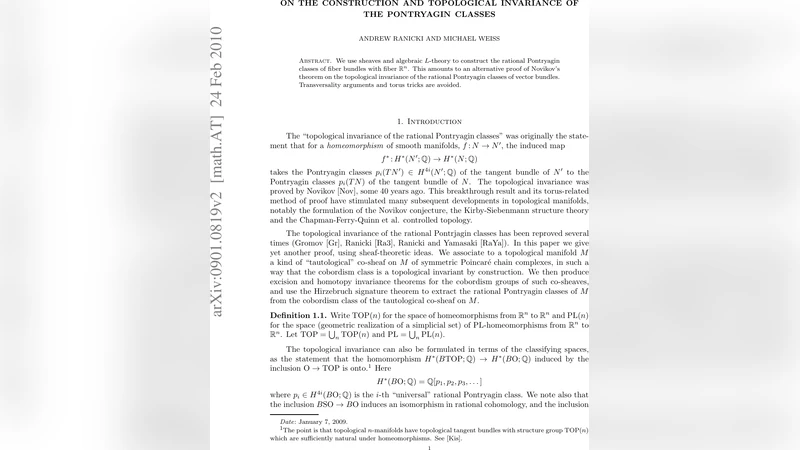
We use sheaves and algebraic L-theory to construct the rational Pontryagin classes of fiber bundles with fiber R^n. This amounts to an alternative proof of Novikov’s theorem on the topological invariance of the rational Pontryagin classes of vector bundles. Transversality arguments and torus tricks are avoided.
💡 Research Summary
The paper presents a completely algebraic construction of the rational Pontryagin classes for fiber bundles whose fibers are Euclidean spaces ℝⁿ, and uses this construction to give a new proof of Novikov’s theorem on the topological invariance of these classes. The authors begin by recalling that the classical definition of Pontryagin classes relies on a smooth structure and that the traditional proofs of Novikov’s theorem employ smoothing theory, transversality arguments, and the torus trick to compare smooth and topological categories. Their goal is to avoid all such geometric machinery.
The central idea is to replace the smooth geometric data with a sheaf of algebraic Poincaré complexes over the base space B of the bundle π : E → B. For each sufficiently small open set U ⊂ B, the bundle trivializes as U × ℝⁿ, and the authors associate to U a finite free chain complex C_U equipped with a symmetric form φ_U that makes (C_U, φ_U) a 0‑dimensional symmetric L‑theory object (in the sense of Ranicki). These local objects are glued together using the language of sheaves: the assignment V ↦ ⊕{U_i⊂V} C{U_i} defines a soft sheaf 𝔖 of chain complexes, and the symmetric forms glue compatibly, giving 𝔖 the structure of a sheaf of symmetric L‑theory classes.
The next step is to apply the algebraic L‑theory assembly map. In the rational setting, the assembly map A : H_(B; 𝔏) → L_(ℚ) is an isomorphism, where 𝔏 denotes the L‑theory spectrum. By evaluating A on the class represented by the sheaf 𝔖, the authors obtain an element of L⁰(ℚ) that, after rationalization, corresponds precisely to a cohomology class in H^{4k}(B; ℚ). They identify this cohomology class with the k‑th rational Pontryagin class p_k(E). The identification uses the fact that, for a trivial ℝⁿ‑bundle, the construction recovers the standard generator of H^{4k}(B; ℚ), and naturality of the assembly map ensures that the same holds for any bundle.
Having produced a rational Pontryagin class purely algebraically, the authors then address topological invariance. Suppose h : E → E′ is a homeomorphism covering a homeomorphism of bases. Because the fibers are ℝⁿ, h induces an isomorphism of the sheaves 𝔖 and 𝔖′ that respects the symmetric L‑theory structures. Consequently, the assembled L‑class is unchanged under h, and the resulting cohomology class satisfies h^*p_k(E′) = p_k(E). This argument avoids any need for transversality or smoothing, relying only on the functoriality of the sheaf construction and the rational assembly isomorphism.
The paper concludes with a discussion of advantages over classical proofs. The algebraic approach eliminates the delicate geometric steps of placing sections in general position and the torus trick used to reduce dimensions. It also highlights the flexibility of the method: the same sheaf‑theoretic framework could be adapted to other characteristic classes (e.g., Stiefel‑Whitney, L‑classes) and to bundles with more exotic fibers, potentially opening new avenues in high‑dimensional topology and the study of non‑smoothable manifolds.
In summary, by constructing a sheaf of symmetric L‑theory complexes and exploiting the rational assembly isomorphism, the authors provide a concise, purely algebraic proof that rational Pontryagin classes are invariant under topological homeomorphisms, offering a clear alternative to the classical transversality‑based arguments.
Comments & Academic Discussion
Loading comments...
Leave a Comment