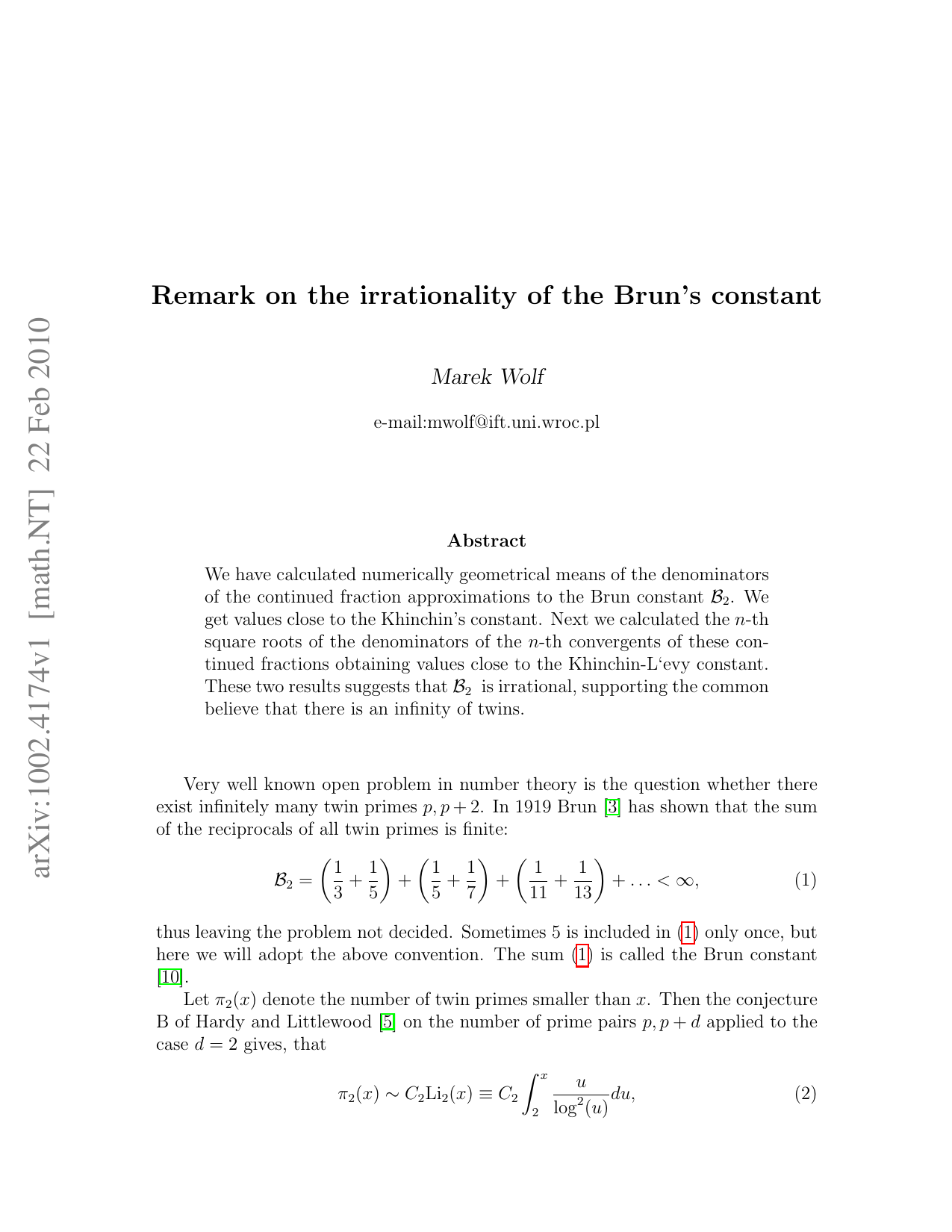
We have calculated numerically geometrical means of the denominators of the continued fraction approximations to the Brun constant B2. We get values close to the Khinchin constant. Next we calculated the n-th square roots of the denominators of the n-th convergents of these continued fractions obtaining values close to the Khinchin-Levy constant. These two results suggests that B2 is irrational, supporting the common believe that there is an infinity of twins.
Deep Dive into Remark on the irrationality of the Bruns constant.
We have calculated numerically geometrical means of the denominators of the continued fraction approximations to the Brun constant B2. We get values close to the Khinchin constant. Next we calculated the n-th square roots of the denominators of the n-th convergents of these continued fractions obtaining values close to the Khinchin-Levy constant. These two results suggests that B2 is irrational, supporting the common believe that there is an infinity of twins.
Very well known open problem in number theory is the question whether there exist infinitely many twin primes p, p + 2. In 1919 Brun [3] has shown that the sum of the reciprocals of all twin primes is finite:
thus leaving the problem not decided. Sometimes 5 is included in (1) only once, but here we will adopt the above convention. The sum (1) is called the Brun constant [10]. Let π 2 (x) denote the number of twin primes smaller than x. Then the conjecture B of Hardy and Littlewood [5] on the number of prime pairs p, p + d applied to the case d = 2 gives, that
arXiv:1002.4174v1 [math.NT] 22 Feb 2010 where C 2 is called “twin constant” and is defined by the following infinite product:
There is a large evidence both analytical and experimental in favor of (2). Besides the original circle method used by Hardy and Littlewood [5] there appeared the paper [8] where another heuristic arguments were presented. In May 2004, in a preprint publication [1] Arenstorf attempted to prove that there are infinitely many twins. Arenstorf tried to continue analytically to (s) = 1 the difference:
where the function
However shortly after an error in the proof was pointed out by Tenenbaum [11]. For recent progress in the direction of the proof of the infinite number of twins see [6].
Because there is no doubt that twins prime conjecture is true the Brun’s constant should be irrational.
The series ( 1) is very slowly convergent and there is a method based on the (2) to extrapolate finite size approximations B 2 (x) = q,q+2 both prime q≤x
to infinity [2]:
In this way from the straight sieving of primes up to x = 3 × 10 15 T. Nicely [7] gives
while P. Sebah [9] from computer search up to 10 16 gives
If there is an infinity of twins, as the formula (2) asserts, then the Brun’s constant should be an irrational number. Vice versa if the Brun’s constant is irrational then there is an infinity of twins.
There exists a method based on the continued fraction expansion which allows to detect whether a given number r can be irrational or not. Let r = [a 0 ; a 1 , a 2 , a 3 , . . .] = a 0 + 1
be the continued fraction expansion of the real number r, where a 0 is an integer and all a k , k = 1, 2, . . . are positive integers. Khinchin has proved that lim n→∞ a 1 a 2 . . . a n
is a constant for almost all real r, see e.g. [4, §1.8]. The exceptions are rational numbers, quadratic irrationals and some irrational numbers too, like for example the Euler constant e = 2.7182818285 . . ., but this set of exceptions is of the Lebesgue measure zero. The constant K 0 is called the Khinchin constant. If the quantities
for r given with accuracy of some number of digits are close to K 0 we can regard it as a hint that r is irrational.
For the numerical value of B 2 given by ( 9) we get continued fraction containing 23 terms:
We have calculated the geometrical means K(n) for the consecutive truncations of the continued fraction (13) for n = 7, 8, . . . 23. The results are presented in the second column of Table 1 and in Fig. 1 for n = 3, 4, . . . , 23 and K(n) are fluctuating around K 0 , suggesting B 2 is indeed irrational. Let the rational p n /q n be the n-th partial convergent of the continued fraction:
For almost all real numbers r the denominators of the finite continued fraction approximations fulfill: lim n→∞ (q n (r)) 1/n = e π 2 /12 ln 2 ≡ L 0 = 3.275822918721811 . . .
where L 0 is called the Khinchin-Lèvy’s constant [4, §1.8]. Again the set of exceptions to the above limit is of the Lebesgue measure zero and it includes rational numbers, quadratic irrational etc. From (13) we get the following sequence of convergents p n (B 2 )/q n (B 2 ): From these denominators q n (B 2 ) we can calculate the quantities L(n):
The obtained values of L(n) for n ≥ 7 are presented in the third column of the Table 1 and are shown in the Fig. 2. These values scatter around the red line representing the Khinchin-Lèvy’s constant again suggesting that B 2 is irrational.
In conclusion we can say that to draw firmer statement much more digits of the Brun’s constant are needed.
This content is AI-processed based on ArXiv data.