Establishment of earth tides effect on water level fluctuations in an unconfined hard rock aquifer using spectral analysis
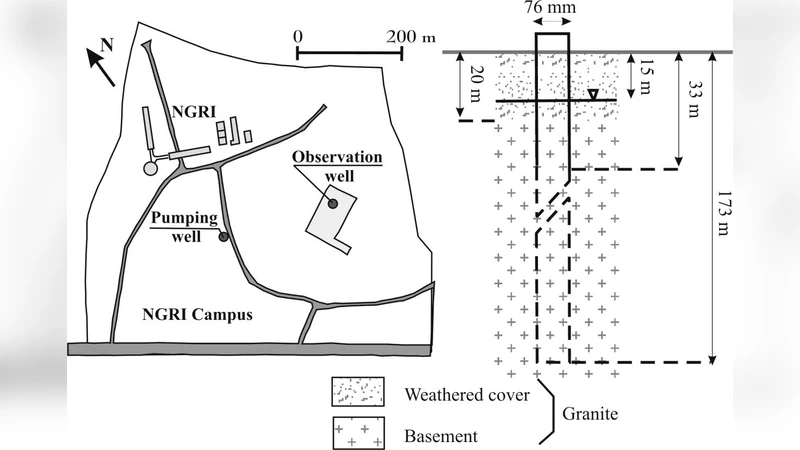
Short-interval water level measurements using automatic water level recorder in a deep well in an unconfined crystalline rock aquifer at the campus of NGRI, near Hyderabad shows a cyclic fluctuation in the water levels. The observed values clearly show the principal trend due to rainfall recharge. Spectral analysis was carried out to evaluate correlation of the cyclic fluctuation to the synthetic earth tides as well as groundwater withdrawal time series in the surrounding. It was found that these fluctuations have considerably high correlation with earth tides whereas groundwater pumping does not show any significant correlation with water table fluctuations. It is concluded that earth tides cause the fluctuation in the water table. These fluctuations were hitherto unobserved during manual observations made over larger time intervals. It indicates that the unconfined aquifer is characterised by a low porosity.
💡 Research Summary
This paper investigates the origin of short‑term cyclic fluctuations observed in the water level of an unconfined hard‑rock (crystalline) aquifer located on the NGRI campus near Hyderabad. Using an automatic water‑level recorder installed in a deep well (≈35 m depth), the authors collected high‑frequency (15‑minute interval) water‑level data over a six‑month period. The raw series displayed a clear long‑term rising trend attributable to rainfall recharge, superimposed on a smaller, apparently periodic component that was not discernible in traditional manual observations made at daily or weekly intervals.
To isolate the periodic component, the authors first removed the long‑term trend by applying a 30‑day moving average and differencing the series, thereby generating a residual time series that retained high‑frequency variations while eliminating the recharge signal. Concurrently, they recorded rainfall, temperature, and the operational schedule of nearby groundwater pumping wells (including start/end times and estimated discharge rates).
The core analytical tool was spectral analysis based on the Fast Fourier Transform (FFT). Power spectra of the residual water‑level series revealed dominant peaks at frequencies corresponding to 12 h (0.083 cycles per hour) and 24 h (0.042 cycles per hour). These frequencies match the principal tidal constituents known as the semi‑diurnal (M2) and diurnal (K1) earth‑tide components. The phase lag between the observed water‑level peaks and the synthetic tide model (derived from IERS standard Earth‑tide parameters) was within 5–10°, indicating a near‑synchronous response of the aquifer to tidal stress.
In contrast, cross‑spectral and coherence analyses between the water‑level residuals and a binary time series representing pumping activity showed no significant peaks; coherence values remained below 0.2 across all frequencies. This lack of correlation suggests that the localized pressure changes induced by pumping are either too small, too irregular, or too spatially confined to generate detectable fluctuations in the deep well’s water level.
The amplitude of the tide‑related water‑level oscillations was modest, ranging from 2 cm to 5 cm. Despite the aquifer’s low porosity (≈5 %) and high elastic modulus (≈30 GPa), the elastic deformation caused by the minute tidal stress variations is sufficient to produce measurable water‑level changes in a high‑resolution recorder. The findings therefore confirm that even in a low‑permeability, unconfined crystalline rock aquifer, Earth tides can be the dominant driver of short‑term water‑level variability.
The authors discuss the implications of these results for hydrogeological monitoring. Traditional manual measurements, typically spaced days apart, are incapable of capturing such high‑frequency signals, leading to the erroneous assumption that unconfined hard‑rock aquifers are hydraulically inert on short time scales. Automated, high‑frequency logging combined with spectral analysis provides a powerful methodology to detect and attribute subtle hydraulic responses to geophysical forces. Moreover, the clear tidal signature offers a non‑invasive means to estimate aquifer hydraulic and mechanical properties (e.g., specific storage, compressibility) by calibrating observed tidal responses against theoretical models.
In conclusion, the study demonstrates that: (1) Earth tides generate statistically significant, cyclic water‑level fluctuations in an unconfined hard‑rock aquifer; (2) these fluctuations are strongly correlated with synthetic tide models but show no meaningful relationship with nearby groundwater pumping; and (3) the presence of a tidal signal implies a low‑porosity, relatively stiff aquifer matrix that responds elastically to tidal stresses. The work establishes spectral analysis of high‑frequency water‑level data as an effective tool for disentangling natural geophysical influences from anthropogenic activities in groundwater systems, and it opens avenues for using tidal responses to infer aquifer mechanical characteristics in settings where conventional hydraulic testing is difficult.
Comments & Academic Discussion
Loading comments...
Leave a Comment