Spaces of maps into topological group with the Whitney topology
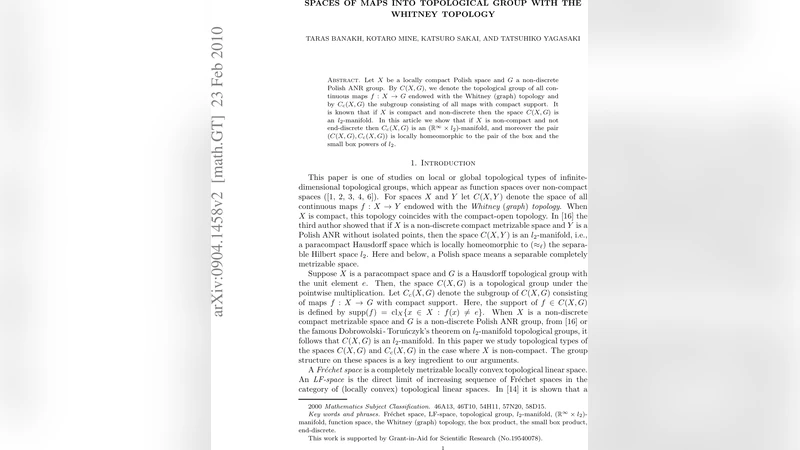
Let X be a locally compact Polish space and G a non-discrete Polish ANR group. By C(X,G), we denote the topological group of all continuous maps f:X \to G endowed with the Whitney (graph) topology and by C_c(X,G) the subgroup consisting of all maps with compact support. It is known that if X is compact and non-discrete then the space C(X,G) is an l_2-manifold. In this article we show that if X is non-compact and not end-discrete then C_c(X,G) is an (R^\infty \times l_2)-manifold, and moreover the pair (C(X,G), C_c(X,G)) is locally homeomorphic to the pair of the box and the small box powers of l_2.
💡 Research Summary
The paper investigates the topological structure of the space of continuous maps C(X,G) and its compact‑support subgroup C_c(X,G) when equipped with the Whitney (graph) topology. Here X is assumed to be a locally compact Polish space (i.e., a separable completely metrizable space that is locally compact) and G is a non‑discrete Polish ANR (absolute neighbourhood retract) group. The Whitney topology on C(X,G) is defined by viewing each map f as its graph Γ_f ⊂ X×G and inheriting the subspace topology from the product X×G; this topology is strictly finer than the compact‑open topology and is well‑suited for handling support conditions.
Background. For compact, non‑discrete X it is classical (by Toruńczyk’s characterization of l₂‑manifolds) that C(X,G) is an l₂‑manifold. The proof relies on the fact that C(X,G) is a complete metrizable, σ‑locally compact space with the strong countable‑dimensional property, and that G being an ANR ensures local contractibility needed for manifold charts.
Main Results. The author extends the picture to non‑compact bases that are not end‑discrete (i.e., X possesses “ends” that cannot be isolated by compact neighborhoods). The two principal theorems are:
-
Theorem A. If X is non‑compact and not end‑discrete, and G is a non‑discrete Polish ANR group, then the compact‑support subgroup C_c(X,G) is homeomorphic to the product R^∞ × l₂, where R^∞ denotes the countable direct sum of copies of the real line (the infinite‑dimensional Euclidean space) and l₂ is the separable Hilbert space. Consequently, C_c(X,G) is an (R^∞ × l₂)‑manifold.
-
Theorem B. Under the same hypotheses, the pair (C(X,G), C_c(X,G)) is locally homeomorphic to the pair (□{ℵ₀} l₂, ⊞{ℵ₀} l₂), where □{ℵ₀} l₂ is the box power of l₂ (the product equipped with the box topology) and ⊞{ℵ₀} l₂ is the small‑box power (the subspace consisting of sequences that are eventually zero). In other words, near any point f∈C(X,G) there exist neighborhoods U⊂C(X,G) and V⊂C_c(X,G) such that (U,V) ≅ (□{ℵ₀} l₂, ⊞{ℵ₀} l₂).
Proof Strategy. The argument proceeds by decomposing any compact‑support map f into finitely many pieces supported in compact subsets K₁,…,K_n⊂X. For each compact K_i, the restriction map \
Comments & Academic Discussion
Loading comments...
Leave a Comment