A Monoidal Category for Perturbed Defects in Conformal Field Theory
Starting from an abelian rigid braided monoidal category C we define an abelian rigid monoidal category C_F which captures some aspects of perturbed conformal defects in two-dimensional conformal field theory. Namely, for V a rational vertex operator…
Authors: ** *Ingo Runkel* (주된 저자) – 독일 막스 플랑크 연구소 (MPI für Mathematik) 및 베를린 자유대학. (공동 저자 정보가 논문에 명시되지 않아 확인이 필요함) --- **
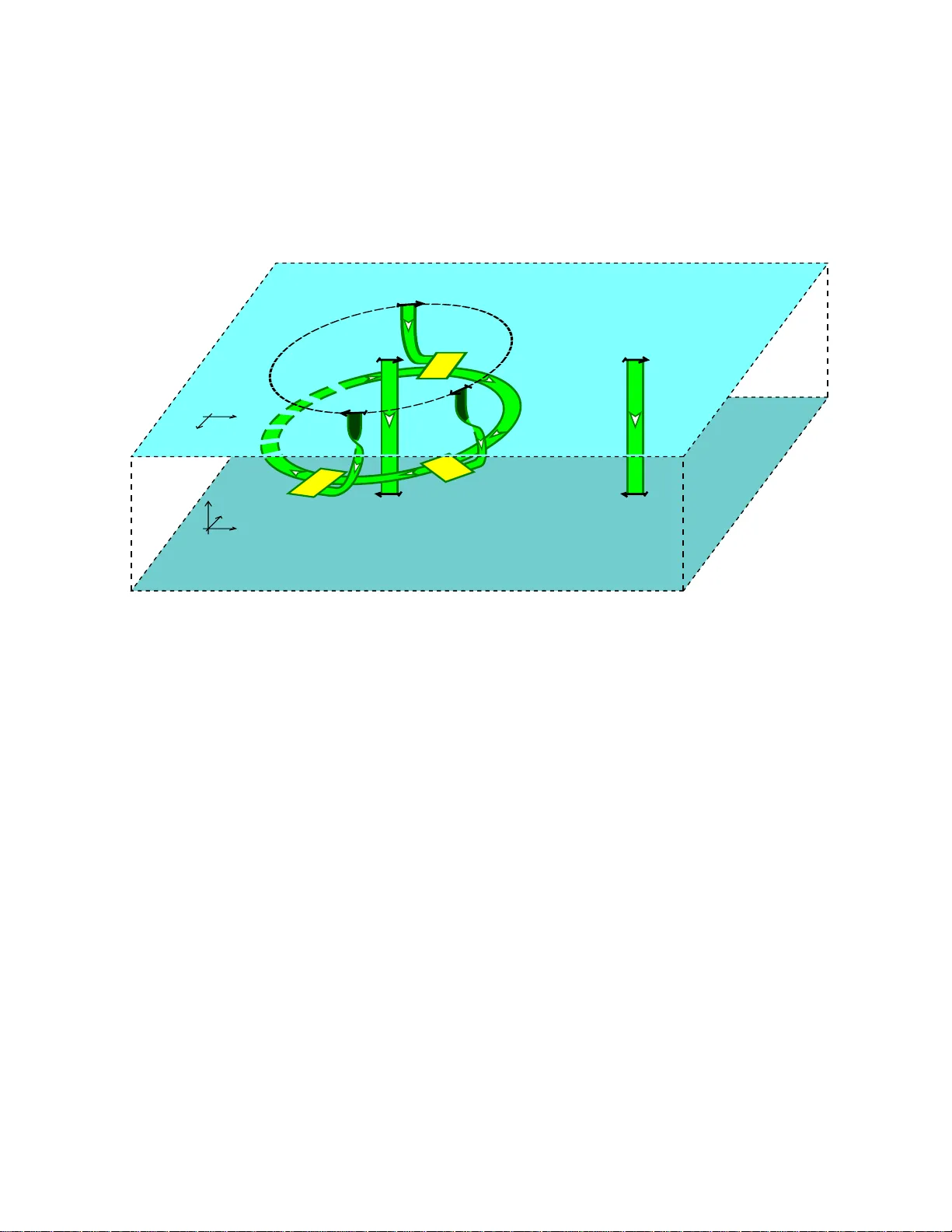
K CL-MTH-09-03 0904.1122 [hep-th] A Monoidal C ategory for P erturb ed Defects in Conformal Fie ld Theory Dimitr ios Manolop oulos ∗ and Ingo Runkel † Departmen t of Mathematics, King’s College London Strand, London W C2R 2LS, United Kingdom April 2009 Abstract Starting f r om an ab elian r igid braided monoidal categ ory C w e d efine an ab elian rigid monoidal category C F whic h captures some asp ects of p erturb ed conformal defects in tw o -dimensional conformal field theory . Namely , for V a rational v ertex op erator algebra w e consider the c harge-co njugation CFT constructed from V (the Cardy case). Then C = R ep ( V ) and an ob ject in C F corresp onds to a conformal defect condition together with a dir ection of p ertur bation. W e assign to eac h ob j ect in C F an op erator on the space of states of the C FT, the p erturb ed d efect op erator, and show that the assignment factors thr ough the Grothendiec k ring of C F . This allo ws one to fi nd functional r elations b et w een p erturb ed defect op erators. Such relations are int eresting b ecause they contai n information ab out the in tegrable stru cture of the CFT. ∗ Email: dimi trios. manol opoulos@kcl.ac.uk † Email: ingo .runke l@kcl .ac.uk Con ten ts 1 In tro duction 2 2 Category theory for p er t urb ed defects 5 2.1 The category C F . . . . . . . . . . . . . . . . . . . . . . . . . . . . . . . . . . 5 2.2 Monoidal structure on C F . . . . . . . . . . . . . . . . . . . . . . . . . . . . 6 2.3 Dualit y on C F . . . . . . . . . . . . . . . . . . . . . . . . . . . . . . . . . . . 8 3 Relation to defect op erator s 10 3.1 T op ological defect lines . . . . . . . . . . . . . . . . . . . . . . . . . . . . . . 10 3.2 Correlators of c hiral defect fields . . . . . . . . . . . . . . . . . . . . . . . . . 11 3.3 P erturb ed top ological defects . . . . . . . . . . . . . . . . . . . . . . . . . . 15 4 Example: Lee-Y ang mo del 17 4.1 Bulk theory and p erturb ed defects . . . . . . . . . . . . . . . . . . . . . . . 17 4.2 The category C F for the Lee-Y ang mo del . . . . . . . . . . . . . . . . . . . . 19 4.3 Some exact sequences in C F . . . . . . . . . . . . . . . . . . . . . . . . . . . 20 4.4 Some implications fo r defect flows . . . . . . . . . . . . . . . . . . . . . . . . 21 5 Conclusions 22 A App endix 25 A.1 Relation to ev aluation represen tations of quan tum affine sl(2) . . . . . . . . . 25 A.2 Pro of of Theorem 2.3 and Lemma 2.4 . . . . . . . . . . . . . . . . . . . . . . 26 A.3 Finite semi-simple monoidal categories . . . . . . . . . . . . . . . . . . . . . 29 A.4 T ( f , g ) and c ( f ) for the Lee-Y ang mo del . . . . . . . . . . . . . . . . . . . . 34 1 In tr o duc t ion Conformal symme try is a p otent to ol in the construction of t w o-dimensional conformal quan- tum field theories [BPZ]. Their infinite-dimensional sy mmetry algebra, the Vir a soro algebra, is generated b y the mo des of t w o conserv ed curren ts: t he holomorphic and an ti-holomorphic part of the stress tensor. Besides suc h ‘chiral symm etries’ o btained from conserv ed currents , in man y examples the CFT also has an in tegrable symmetry , tha t is, infinite families of comm uting conserv ed c harges [BLZ1]. Prese n t approaches to CFT tend to fa v o ur either the conformal or the in tegrable symmetry , and it seems worth while to ev entually com bine these t w o symmetries in to a single formalism. In this pap er w e hop e to take a step in this direction b y con tin uing to deve lop the approac h of [Ru ] whic h allo ws one to identify integrable structures of a CFT by studying the represen tation category of the c hiral algebra. It is w ort h remarking that the idea to find questions ab out CFT that can b e formulated on a purely categorical lev el, and that can then b e inv estigated indep enden t of whe ther there is an underlying CFT or not, has pro v ed us eful already in [F uS, FR S1] (the in terested reader could consult [KR] for a brief o v erview). 2 In [Ru] families of conserv ed c harges are constructed as p erturbations of ce rtain conformal defects. A conformal defect is a line o f inhomogeneity on the w o rld sh eet o f the CFT, that is, a line where t he fields can hav e discon tinuitie s or singularities. By putting a circular defect line on a cylinder w e obta in the defect op erator, a linear opera t or on the space of stat es. If one considers a particular class of conf o rmal defects (so-called top olo g ical defects) a nd p erturbs suc h a defect b y a particular type of relev an t defect field, one obtains a family of defect op erators whic h still comm ute with L 0 + L 0 , the sum of the zero mo des of the holomorphic and an ti-holomorphic comp onen t of the stress tensor. Sometimes these p erturb ed defect op erators ob ey f unctional relations. An example is pro vided by the no n- unitary Lee-Y ang CFT, the Virasoro minimal mo del of cen tral charge c = − 22 / 5. T here, one obtains a fa mily of op erators D ( λ ), λ ∈ C , on the space o f stat es of the mo del, whic h ob ey , for all λ, µ ∈ C , [ L 0 + L 0 , D ( λ )] = 0 , [ D ( λ ) , D ( µ )] = 0 , D ( e 2 π i/ 5 λ ) D ( e − 2 π i/ 5 λ ) = id + D ( λ ) . (1.1) The last r elatio n ab ov e is closely link ed to the description of the Lee-Y ang mo del via the massless limit of factorising scattering and the t hermo dynamic Bethe Ansatz, see e.g. the review [DD T]. This example illustrat es that the functional relations ob ey ed by p erturb ed defect op erators enco de at least part of the integrable structure of the mo del. In fa ct, the defect o p erator in (1.1) (and more generally those for t he M 2 , 2 m +1 minimal mo dels) can b e understo o d as certain linear com binations of the c hira l o p erators whic h were constructed in [BLZ1] to capture the in t egr a ble structure of these mo dels. In this pap er w e presen t a categorical structure that captures some asp ects of p erturb ed defect op erators, a nd in particular allows one to find functional relations suc h as the o ne in (1.1). W e w ork in rat ional conformal field theory , so that the holomorphic fields of the mo del form a rationa l 1 v ertex op era t or algebra V . W e consider the ‘Cardy case’ CFT constructed from V , namely t he CFT with charge-conjugation mo dular inv ariant – the conclusions in Section 5 con tain a brief commen t on how to extend the formalism to general ra tional CFTs. In the Cardy case the defects are lab elled b y represen tations of V . Denote C = Rep( V ) . The category describing the properties of p erturb ed defects is called C F . It is an enlargemen t of C whic h dep ends on a choice of ob ject F ∈ C . Roughly sp eaking, F is the represen tation of V from whic h the p erturbing field is tak en, and the ob jects of C F are pairs of an unp erturb ed defect together with a direction of p erturbation. Concretely , the ob jects in C F are pairs ( R , f ) where R ∈ C and f : F ⊗ R → R is a morphism in C . The morphisms in C F are those morphisms in C which make the ob vious diagram commute (see Definition 2.1 b elo w). If in addition to b eing monoidal, the category C is also ab elian rigid and braided (as it w o uld b e for C = Rep( V ) with V a ratio nal v ertex op erator algebra) , then C F is an ab elian rigid mo no ida l category (Theorem 2 .1 1). In pa rticular, the G rothendiec k ring K 0 ( C F ) is w ell-defined. How ev er, C F is typically not braided. W e will see in the example of the Lee-Y ang mo del that there can b e simple ob jects ( U, f ) and ( V , g ) in C F suc h that ( U, f ) ˆ ⊗ ( V , g ) ≇ ( V , g ) ˆ ⊗ ( U, f ), where ˆ ⊗ denotes the tensor pro duct in C F . If C = Rep( V ), w e can assign a p erturb ed defect op erator D [( R, f )] to an ob ject ( R, f ) ∈ C F , provided certain in tegrals and su ms con v erg e (see Sec tion 3.3 b elo w). Sup- 1 By ‘ra tional’ we mean that the v e rtex o p er ator alg ebra sa tis fie s the conditions in [Hu2, Sect. 1]. 3 p ose t ha t for tw o ob jects ( R , f ) , ( S, g ) ∈ C F the p erturb ed defect op erators exist. Then the tensor pro duct in C F is compatible with comp osition of defect op erators, D [( R, f ) ˆ ⊗ ( S, g )] = D [( R, f )] D [( S, g )] (Theorem 3.2), and D [( R, f )] = D [( S, g )] if ( R , f ) and ( S, g ) represen t the same class in the G r o thendiec k ring K 0 ( C F ) (Corollary 3.3). Th us, iden tities of the form [( A, a )] · [( B , b )] = [( C 1 , c 1 )] + · · · + [( C n , c n )] in K 0 ( C F ) will giv e rise to f unctiona l relations among the defect op erat o rs, such as the one quoted in (1.1) (see Section 4 for the L ee-Y ang example). The cat ego ry C F has similarities to categorical structures that a pp ear in the treatment of defects in other con texts. In B-t wisted N = 2 supersymmetric Landau- Ginzburg mo dels, b oundary conditions [KL, BHLS, La ] and defects [BRo] can b e desc rib ed by so-called matrix factorisations. There, one considers a category whose ob jects are pairs: a Z 2 -graded f r ee mo dule M o v er a p olynomial ring and an o dd morphism f : M → M , so that f ◦ f takes a prescrib ed v alue. The morphisms of this category hav e to mak e the same diagram commu te as those of C F . And as in C F , the mo dule M can b e in terpreted as a defect in an unp erturb ed theory , a nd f as a p erturbation. Ho w ev er, in the contex t of matrix factorisations one passes to a homotop y category , whic h is something we do no t do for C F . A more direct link comes from integrable lattice mo dels. In one approac h to these mo dels, one uses the represen tation theory of a quantum affine algebra t o construct families of commuting transfer matrices. The decomp osition of t ensor pro ducts of represen tations of the quan tum affine algebra giv es rise to functional relations among the transfer matrices [KNS, R W, Ko]. The categor y of finite-dimensional represen tations of a quan tum affine algebra [CP] shares a num b er of features with the category C F . F or example, the tensor pro duct of simple ob jects tends to be simple itse lf, except at sp ecific p oin ts in the parameter space, where the tensor pro duct is the middle term in a non-split exact sequence. T o mak e the similarit y a little more concrete, in App endix A.1 w e p oin t o ut that the ev alua tion represen tations of U q ( b sl ( 2)) can b e thought o f as a full sub cat ego ry of C F for appropria te C and F . This pap er is or g anised as follo ws. In Section 2 w e in tr o duce t he category C F and study its prop erties. In this section w e make no referen ce to confo rmal field theory or v ertex o p erator algebras. The relation of C F to defect op erators in conformal field theory is describ ed in Section 3. There, w e also s ho w that the assignmen t of defect op erators to ob jects in C F factors through the Grothendiec k ring of C F . In Section 4 w e study the Lee-Y a ng Virasoro minimal mo del confo r ma l field theory in some detail. Section 5 con tains our conclusions. Ac kno wledgemen ts: W e would lik e to thank Nils Carqueville, J ¨ urgen F uc hs, Andrew Pressley , Christoph Sc h w eigert, Carl Stigner, G´ erard W atts, and R ob ert W eston for helpful discussions and useful commen t s o n a draft of this pap er. DM is supp orted by the STFC Studen tship PP A/S/S/20 0 7/04644 and IR is partially supported b y the EPSR C First Gran t EP/E005047/1 and the STFC R olling Grant ST/G00039 5/1. 4 2 Category theor y for p erturb ed de fects In this section we start from a monoidal category C and enlarg e it to a new categor y C F , dep ending on an ob ject F ∈ C . W e then in v estigate how prop erties of C carry ov er to C F . In particular w e will see that if C is braided and additiv e then w e can define a monoidal structure o n C F . The relation to p erturb ed defects is discussed in more detail in Section 3. The basic idea is that a n ob ject in C F giv es an unp erturb ed defect t o gether with a direction for the p erturbatio n b y a defect field in the represen tation F . 2.1 The c ategory C F Definition 2.1. Let C b e a monoidal category and let F ∈ C . The category C F has as ob jects pairs U f ≡ ( U, f ), where U ∈ C and f : F ⊗ U → U . The morphisms a : U f → V g are all morphisms a : U → V in C suc h that the follow ing diag r a m comm utes: F ⊗ U F ⊗ V U V / / a / / id F ⊗ a f g The iden tit y morphism id U f is id U in C , a nd the comp osition of morphisms is that of C . Remark 2.2. (i) The condition which singles out the subset of morphisms in C that b elong to C F is linear. Therefore, if C is an Ab-categor y (i.e. eac h Hom-set is an a dditiv e ab elian group and comp osition is bilinear), then so is C F . Similarly , if C is k -linear for some field k , then so is C F . (ii) There is an action of the monoid End( F ) op on C F . Namely , for eac h ϕ ∈ End( F ) w e define the endofunctor R ϕ of C F on ob jects as R ϕ ( U f ) = ( U, f ◦ ( ϕ ⊗ id U )) and on morphisms U f a → V g as R ϕ ( a ) = a . W e ha v e R ϕ ◦ R ψ = R ψ ◦ ϕ without the need for natural isomorphisms. This also sho ws that w e ha v e an action of End( F ) op instead of End( F ). If C is k -linear, in this w a y w e in particular obtain an action of k via λ 7→ R λ id F . (iii) If C is an Ab-category , w e obtain an em b edding I of C into C F . The functor I : C → C F is defined via I ( U ) = ( U, 0) a nd I ( f ) = f ; it is full and faithful. The forg etful functor C F → C is a left inv erse fo r I . (iv) One w ay t o think of C F is a s a categor y of ‘ F -mo dules in C ’, where t he morphism f : F ⊗ U → U in U f is the ‘action’, and t he morphisms of C F in tert wine this action. But F is not required to carry any additional structure, and so there is no restriction on the ‘action’ morphisms f . (v) The category C F can also b e obtained as a (non-f ull) sub category of the comma category ( F ⊗ ( − ) ↓ Id) (see [McL, Sect. I I.6] fo r more on comma categories). The ob jects of ( F ⊗ ( − ) ↓ Id) are triples ( U, V , f ) where U, V ∈ C and f : F ⊗ U → V . The morphisms ( U, V , f ) → ( U ′ , V ′ , f ′ ) are pairs ( x : U → U ′ , y : V → V ′ ) so that y ◦ f = f ′ ◦ (id F ⊗ x ). The sub category in question consists of all ob jects of the form ( U, U, f ) and all morphisms of the form ( x, x ). 5 (vi) The category of ev alua tion represen t ations of the quan t um affine algebra U q ( b sl ( 2)) is a full subcategor y o f Rep( U q ( sl (2))) F , where F is U q ( b sl (2)) understo o d as a U q ( sl (2))-mo dule. The details can b e found in App endix A.1. As briefly men tioned in the in tro duction, short exact sequence s of represen tations o f U q ( b sl ( 2)) pro vide iden tities b etw een transfer matrices for certain in tegrable lattice mo dels. On the other hand, in Section 3 b elo w w e will see that short exact sequence s in C F giv e iden t it ies b etw een certain defect op erators in CFT. W e hop e that this similarity can b e made more concrete in the future. Recall that the Gro t hendiec k gro up K 0 ( C ) of a n ab elian category C is the free ab elian group generated b y isomorphism classes ( U ) of o b jects U in C , quotien ted b y the subgroup generated b y the relations ( U ) = ( K ) + ( C ) for all short exact sequences 0 → K → U → C → 0. W e de note t he equiv alence class of ( U ) in K 0 ( C ) by [ U ]. The f o llo wing theorem pro vides a sufficien t condition for C F to b e ab elian, so that it make s sense to talk ab out the Grothendiec k group o f C F . The pro of is g iv en in App endix A.2. Theorem 2.3. If C is an ab elian monoida l c ate gory with righ t-ex a ct tensor pr o duct, then C F is ab elian. Recall that a functor G : C → D is said to b e right-exact if for U, V , W ∈ C , exactness of U → V → W → 0 implies exactness of G ( U ) → G ( V ) → G ( W ) → 0. A tensor pro duct bifunctor is called righ t- exact if X ⊗ ( − ) and ( − ) ⊗ X are righ t-exact functors for all X ∈ C . The following lemma will b e useful; it is also pro v ed in App endix A.2. Lemma 2.4. L et C b e as in T h e or em 2.3 and U f a − → V g b − → W h b e a c omplex in C F . Then U f a − → V g b − → W h is exact at V g in C F iff U a − → V b − → W is exact at V in C . 2.2 Monoidal structure on C F Let C b e a braided monoidal Ab-category . F o llowing the con ven tions of [McL, Sect. VI I.1 ] w e denote the asso ciator b y α U,V ,W : U ⊗ ( V ⊗ W ) ∼ → ( U ⊗ V ) ⊗ W and the unit isomorphisms by λ U : 1 ⊗ U ∼ → U and ρ U : U ⊗ 1 ∼ → U . The braiding isomorphisms ar e c U,V : U ⊗ V ∼ → V ⊗ U . The braiding and the a b elian group structure on Hom-spaces allow s us to define a tensor pro duct ˆ ⊗ on C F as follow s. On ob jects U f , V g ∈ C F w e set U f ˆ ⊗ V g = ( U ⊗ V , T ( f , g )) , (2.1) where T ( f , g ) : F ⊗ ( U ⊗ V ) → U ⊗ V is defined as T ( f , g ) = ( f ⊗ id V ) ◦ α F ,U,V + (id U ⊗ g ) ◦ α − 1 U,F ,V ◦ ( c F ,U ⊗ id V ) ◦ α F ,U,V . (2.2) This definition, and some o f the definitions a nd argumen ts b elow , are easier to understand up on replacing C by an equiv alent strict categor y (whic h has trivial associators and unit isomorphisms) and using the graphical represen tation o f morphisms in braided monoidal categories, cf. [BK, Sect. 2.3]. W e use the con ven tions in [FRS1, Sect. 2]. F or example, the 6 graphical represen tation of (2.2) is T ( f , g ) = F f U V U V + F g U V U V . (2.3) W e will write 1 for the ob ject 1 0 ≡ ( 1 , 0) in C F . This will b e the tensor unit for ˆ ⊗ . Lemma 2.5. The asso c i a tor and unit isomorphisms of C ar e isomorph isms in C F as fol lows: α U,V ,W : U f ˆ ⊗ ( V g ˆ ⊗ W h ) → ( U f ˆ ⊗ V g ) ˆ ⊗ W h , λ U f : 1 ˆ ⊗ U f → U f and ρ U f : U f ˆ ⊗ 1 → U f . Pr o of. W e ha ve to show that α U,V ,W : U ⊗ ( V ⊗ W ) , T ( f , T ( g , h )) → ( U ⊗ V ) ⊗ W , T ( T ( f , g ) , h ) , λ U : 1 ⊗ U, T (0 , f ) → ( U, f ) , ρ U : U ⊗ 1 , T ( f , 0) → ( U, f ) (2.4) mak e the diagram in D efinition 2.1 commute . These are all straigh tfor ward calculations. F or example, ρ U ◦ T ( f , 0) = ρ U ◦ ( f ⊗ id 1 ) ◦ α F ,U, 1 = f ◦ ρ F ⊗ U ◦ α F ,U, 1 = f ◦ (id F ⊗ ρ U ). Lemma 2.6. L et a : U f → U ′ f ′ and b : V g → V ′ g ′ b e morphisms in C F . Then a ⊗ b : U ⊗ V → U ′ ⊗ V ′ is also a morphism U f ˆ ⊗ V g → U ′ f ′ ˆ ⊗ V ′ g ′ in C F . Pr o of. W e ha ve to show that ( a ⊗ b ) ◦ T ( f , g ) = T ( f ′ , g ′ ) ◦ (id F ⊗ ( a ⊗ b )). By (2.2), T ( f , g ) splits into tw o summands as T ( f , g ) = T ( f , 0) + T (0 , g ) (same also ho lds for T ( f ′ , g ′ )). W e start b y sho wing t hat ( a ⊗ b ) ◦ T ( f , 0) = T ( f ′ , 0) ◦ (id F ⊗ ( a ⊗ b )): ( a ⊗ b ) ◦ T ( f , 0) = (( a ◦ f ) ⊗ b ) ◦ α F ,U,V (1) = ( f ′ ⊗ id V ′ ) ◦ ((id F ⊗ a ) ⊗ b ) ◦ α F ,U,V (2) = ( f ′ ⊗ id V ′ ) ◦ α F ,U ′ ,V ′ ◦ (id F ⊗ ( a ⊗ b )) = T ( f ′ , 0) ◦ (id F ⊗ ( a ⊗ b )) . (2.5) In step (1) w e used the fact that a ◦ f = f ′ ◦ (id F ⊗ a ), since a is a morphism in C F , and step (2 ) amounts t o nat uralit y of α F ,U,V in U and V . The pro of of ( a ⊗ b ) ◦ T (0 , g ) = T (0 , g ′ ) ◦ (id F ⊗ ( a ⊗ b )) go es alo ng the same lines, using also that c F ,U is natural in U . According to the previous lemma, on morphisms a, b w e can define the tensor pro duct to b e the same as in C , a ˆ ⊗ b = a ⊗ b . (2.6) One c hec ks that ˆ ⊗ is a bifunctor. T ogether with Lemma 2.5 this show s t hat C F is a monoida l category . Remark 2.7. (i) Ev en tho ugh C is braided, C F is in general not. The reason is that c U,V is t ypically not a morphism in C F . Also, we a ctually demand to o m uch when w e require C to b e braided, since all w e use a r e the braiding isomorphisms where one of the a r gumen ts is giv en b y F . (ii) The functors R ϕ defined in Remark 2.2 are strict monoida l functors. That is, R ϕ ( U f ˆ ⊗ V g ) = R ϕ ( U f ) ˆ ⊗ R ϕ ( V g ) for ob jects and R ϕ ( a ˆ ⊗ b ) = R ϕ ( a ) ˆ ⊗ R ϕ ( b ) for morphisms . This follows from T ( f ◦ ( ϕ ⊗ id U ) , g ◦ ( ϕ ⊗ id V )) = T ( f , g ) ◦ ( ϕ ⊗ id U ⊗ V ). 7 Theorem 2.8. I f C is an ab e lian br aide d monoidal c ate gory with right-exact tensor pr o duct, then C F is an ab elian monoidal c ate gory w i th right-exact tensor pr o duct. If the tensor pr o duct of C is exact, then so is that of C F . Pr o of. W e ha ve seen ab ov e that C F is monoidal and in Theorem 2.3 that C F is ab elian. W e will sho w that if ⊗ is righ t-exact, then the functor X x ˆ ⊗ ( − ) is righ t-exact. The argumen ts for ( − ) ˆ ⊗ X x and for ‘exact’ in place of ‘right-exac t’ a re analogous. Let U f a − → V g b − → W h → 0 b e exact. Then X ⊗ U id X ⊗ a − − − − → X ⊗ V id X ⊗ b − − − − → X ⊗ W → 0 is exact in C . By Lemma 2 .4, X x ˆ ⊗ U f id X ⊗ a − − − − → X x ˆ ⊗ V g id X ⊗ b − − − − → X x ˆ ⊗ W h → 0 is exact in C F . If C is monoidal with exact tensor pro duct, then the Grothendiec k group K 0 ( C ) carr ies a ring structure defined via [ U ] · [ V ] = [ U ⊗ V ]. In this case, K 0 ( C ) is called the Gr othendie ck ring . Corollary 2.9. If C is an ab elian br aide d mono i d al c ate gory with exact tensor pr o d uct, then C F has a wel l-define d Gr othen d ie ck ring K 0 ( C F ) . 2.3 Dualit y on C F Let C b e a monoidal category . W e sa y that C has right-duals if for eac h ob ject U there is an ob ject U ∨ together with morphisms b U : 1 → U ⊗ U ∨ , d U : U ∨ ⊗ U → 1 suc h that ρ U ◦ (id U ⊗ d U ) ◦ α − 1 U,U ∨ ,U ◦ ( b U ⊗ id U ) ◦ λ − 1 U = id U , λ U ∨ ◦ ( d U ⊗ id U ∨ ) ◦ α U ∨ ,U,U ∨ ◦ (id U ∨ ⊗ b U ) ◦ ρ − 1 U ∨ = id U ∨ , (2.7) see e.g. [BK, Sect. 2.1]. A graphical represen tation of these iden t it ies can b e found in [BK, Sect. 2.3] or [FRS1, Eqn. (2.10)]. W e say that C has left duals if for each ob ject U there is an ob ject ∨ U together with morphisms ˜ b U : 1 → ∨ U ⊗ U , ˜ d U : U ⊗ ∨ U → 1 suc h that λ U ◦ ( ˜ d U ⊗ id U ) ◦ α U, ∨ U,U ◦ (id U ⊗ ˜ b U ) ◦ ρ − 1 U = id U , ρ ∨ U ◦ (id ∨ U ⊗ ˜ d U ) ◦ α − 1 ∨ U,U, ∨ U ◦ ( ˜ b U ⊗ id ∨ U ) ◦ λ − 1 ∨ U = id ∨ U . (2.8) Supp ose no w that C is a braided monoidal Ab-categor y whic h ha s right duals. T o a giv en ob ject U f ∈ C F w e assign the ob ject ( U f ) ∨ = ( U ∨ , c ( f )) ; c ( f ) = − λ U ∨ ◦ ( d U ⊗ id U ∨ ) ◦ ((id U ∨ ⊗ f ) ⊗ id U ∨ ) ◦ ( α − 1 U ∨ ,F ,U ⊗ id U ∨ ) ◦ α U ∨ ⊗ F ,U,U ∨ ◦ ( c F ,U ∨ ⊗ b U ) ◦ ( ρ F ⊗ U ∨ ) − 1 . (2.9) If C has left duals, w e define analogo usly ∨ ( U f ) = ( ∨ U, ˜ c ( f ) ) ; ˜ c ( f ) = − ρ ∨ U ◦ (id ∨ U ⊗ ˜ d U ) ◦ α − 1 ∨ U,U, ∨ U ◦ ((id ∨ U ⊗ ( f ◦ c − 1 F ,U )) ⊗ id ∨ U ) ◦ ( α − 1 ∨ U,U,F ⊗ id ∨ U ) ◦ (( ˜ b U ⊗ id F ) ⊗ id ∨ U ) ◦ ( λ − 1 F ⊗ id ∨ U ) . (2.10) 8 As for (2 .2) it is helpful to pass to a strict category and write out the graphical rep resen ta tion of ( 2.9) and (2.10 ). This leads to the simple expressions c ( f ) = − F f U ∨ U ∨ , ˜ c ( f ) = − F f ∨ U ∨ U . (2.11) Lemma 2.10. ( i) If C has rig ht duals, then b U : 1 → U f ˆ ⊗ ( U f ) ∨ and d U : ( U f ) ∨ ˆ ⊗ U f → 1 ar e morphisms in C F . (ii) If C ha s left duals, then ˜ b U : 1 → ∨ ( U f ) ˆ ⊗ U f and ˜ d U : U f ˆ ⊗ ∨ ( U f ) → 1 ar e morphisms in C F . Pr o of. The pro of w orks similar in all four cases. Consider b U as an example. The comm ut- ing diagram in D efinition 2.1 b oils do wn to the condition t ha t the mo r phism T ( f , c ( f )) ◦ (id F ⊗ b U ) : F ⊗ 1 → U ⊗ U ∨ has to b e zero, i.e. that T ( f , 0) ◦ (id F ⊗ b U ) = − T (0 , c ( f )) ◦ (id F ⊗ b U ) . (2.12) Let us supp ose that C is strict. The non- strict case then f ollo ws b y in v o king coherence and v erifying that the α , ρ and λ sit in the required places. The calculatio n is really b est done using the graphical no t a tion, but let us write out the individual steps in equations. The righ t hand side of the ab o v e equation then reads − T (0 , c ( f )) ◦ (id F ⊗ b U ) = (id U ⊗ d U ⊗ id U ∨ ) ◦ (id U ⊗ U ∨ ⊗ f ⊗ id U ∨ ) ◦ (id U ⊗ c F ,U ∨ ⊗ b U ) ◦ ( c F ,U ⊗ id U ∨ ) ◦ (id F ⊗ b U ) (1) = (id U ⊗ d U ⊗ id U ∨ ) ◦ (id U ⊗ U ∨ ⊗ f ⊗ id U ∨ ) ◦ ( c F ,U ⊗ U ∨ ⊗ b U ) ◦ (id F ⊗ b U ) (2) = (id U ⊗ d U ⊗ id U ∨ ) ◦ ( b U ⊗ id U ∨ ⊗ id U ∨ ) ◦ ( f ⊗ id U ∨ ) ◦ (id F ⊗ b U ) (3) = ( f ⊗ id U ∨ ) ◦ (id F ⊗ b U ) = T ( f , 0) ◦ (id F ⊗ b U ) . (2.13) Step (1) amoun t s to one of the hexagon iden tit ies for the braiding, (2 ) uses naturalit y of the braiding to pull b U through c F ,U ⊗ U ∨ and the fact t ha t c F , 1 = id F . Step (3) is prop ert y (2.7 ) of the right duality . A monoidal cat ego ry is c alled rigid if ev ery ob ject has left and righ t duals [BK, Def. 2.1.2]. The ab ov e lemma immediately implies the fo llowing theorem. Theorem 2.11. L e t C b e a br aide d mon o idal A b-c ate gory. If C h as right and/o r left duals, then so has C F . In p articular, if C is ri g id, so is C F . Remark 2.12. (i) Supp ose C has left and r ig h t duals. Ev en if in C w e w ould ha v e U ∨ = ∨ U , the same need not b e true in C F due to the distinct definitions of c ( f ) a nd ˜ c ( f ). Also, ev en if in C we would ha v e ( U ∨ ) ∨ ∼ = U , the same need not hold in C F . W e will see this explicitly in the Lee-Y ang example in Section 4.3. 9 (ii) Let C b e as in Corollary 2.9. If C has r igh t duals, then the existenc e of a righ t dualit y for C F tells us that in K 0 ( C F ) w e ha ve [( U f ) ∨ ] · [ U f ] = [ 1 ] + [ W h ] and [ U f ] · [( U f ) ∨ ] = [ 1 ] + [ W ′ h ′ ] for some W h , W ′ h ′ ∈ C F . This will imply functional identities for p erturb ed defect op erato rs via the relation described in Section 3. The same holds for left duals. (iii) The functors R ϕ defined in Remark 2.2 are compatible with these dua lit ies in the sense that R ϕ (( U f ) ∨ ) = ( R ϕ ( U f )) ∨ and R ϕ ( ∨ ( U f )) = ∨ ( R ϕ ( U f )). This fo llows from c ( f ◦ ( ϕ ⊗ id U )) = c ( f ) ◦ ( ϕ ⊗ id U ∨ ) and ˜ c ( f ◦ ( ϕ ⊗ id U )) = ˜ c ( f ) ◦ ( ϕ ⊗ id ∨ U ). 3 Relation to d efect op erators 3.1 T op ological defect lines Defects are lines on the w o r ld sheet where the fields can b e discontin uous o r ev en singular. Supp ose w e are give n a CFT that is w ell-defined on surfaces with defect lines, that is, it satisfies the axioms in [RS, Sect. 3] (or at least a gen us 0 vers ion thereof ) . T o a defect w e can assign a linear o p erator D on the space o f states H o f the CFT. This o p erator can b e extracted by wrapping the defect line around a short cylinder [ − ε, ε ] × S 1 , where we place t w o states u and v on the t wo b oundary circle s. The resulting amplitude, in the limit ε → 0, is the pairing h u, D v i . W orking with field s rather than with states, the defect op erator D is obtained as the correlator assigned t o the Riemann sphere C ∪ {∞} with o ne in-going puncture at 0 and one out-going puncture at ∞ , b oth with standard lo cal co ordinates, a nd a defect line placed on the unit circle S 1 . By the state-field corresp ondence, the space of states H is at the same time the space of lo cal bulk fields, so that again D : H → H . W e call the defect c onformal if it is tr ansparen t to the field T − ¯ T , the difference of the holomorphic and a nti-holomorphic parts of the stress tensor. In terms of mo des, this condition reads D conformal ⇔ [ L m − ¯ L − m , D ] = 0 . (3.1) This includes totally transmitting defects, suc h as the in visible defect described b y the iden- tit y op erator D = id, and tot a lly reflecting defects, suc h as the pro duct of t w o b oundary states D = | a i ih h b | . Here we are in terested in the tota lly transmitting case, more precisely in defe cts whic h are transparen t to b oth T and ¯ T separately . Suc h defects w ere first in- v estigated in the con text of ra t io nal CFT in [PZ1] and were termed top olo gic al defe cts in [BG], D top ological ⇔ [ L m , D ] = 0 = [ ¯ L m , D ] . (3.2) W e will b e w orking in rational CFT, so that the c hiral algebra of the CFT will b e a rational vertex op erator alg ebra V ( r ecall fo o tnote 1). Denote by C = Rep( V ) the category of (appropriate) represen tations of V . It is a semi-simple finite rigid braided monoidal category which is mo dular [HL, Hu2] (see [BK, Sect. 3.1] for more on mo dular categories). W e will not need many details ab out mo dular categories, but w e note that C satisfies t he conditions of Theorems 2 .8 and 2.11. 10 Let us pic k a set of represen tativ es 2 { R i | i ∈ I } of the isomorphism classes of simple ob jects 3 , so that 1 ≡ R 0 ≡ V is the monoida l unit. W e restrict ourselv es in this pa p er to the Cardy case constructed from V . The space of states of this mo del is H = M i ∈I R i ⊗ C R ∨ i , (3.3) where R ∨ i denotes the con tra g redien t represen tation to R i . Also, w e will only consider top ological defects whic h are maximally symmetric in that they are compatible with the en tir e c hiral symmetry V ⊗ C V , i.e. (3.2) holds f or the mo des o f all fields in V ⊗ C V not just for those of the stress tensor. According to [PZ1, F RS1] the different maximally symmetric top ological defects are lab elled by represen tations of V , that is, ob jects R ∈ C . W e denote the defect op erato r of the defect lab elled by R ∈ C b y D [ R ]. The defect op erat o r assigned to a simple o b ject R i is [PZ2, F r2] D [ R i ] = X j ∈I S ij S 0 j id R j ⊗ C R ∨ j , (3.4) where b y id R j ⊗ C R ∨ j w e mean the pro jector to the direct summand R j ⊗ C R ∨ j of H , and S is the mo dular matrix, i.e. the |I | ×|I | -matrix whic h describ es the mo dular transformation of c ha r acters. If R ∼ = L i ∈I ( R i ) ⊕ n i then D [ R ] = P i ∈I n i D [ R i ]. 3.2 Correlators of c hiral defect fields By a chir al defe ct field w e mean a field that ‘liv es on the defect’ and that has left/righ t conformal w eight ( h, 0 ). The notion of defect fields is described fo r example in [FRS3, Sect. 3.4] and [RS, Sect. 3.2 ]. The defect fields hav e w ell-defined weigh ts with resp ect to L 0 and ¯ L 0 b ecause w e a r e considering top o logical defects, and those are transparen t to the holomorphic and anti-holomorphic part of the stress tensor. The space of c hiral defect fields on a defec t lab elled b y R ∈ C consists of all v ectors v ⊗ C Ω ∈ ( R ⊗ R ∨ ) ⊗ C V , where Ω ∈ V is the v acuum vec tor o f V and the tensor pro duct R ⊗ R ∨ is the fusion tensor pro duct in C , see [FRS3, Eq n. (3.37)] a nd [PZ1, PZ2, FRS1]. Pic k a represen tation F ∈ C . A chir al defe ct field in r epr esentation F is sp ecified by a v ector φ ∈ F and a morphism ˜ f : F → R ⊗ R ∨ in C . Instead of ˜ f w e find it mo r e conv enien t to giv e a morphism f : F ⊗ R → R . W e are going to define a defect op erator f or a defect lab elled by a represen tation R with c hira l defect fields φ inserted a t mutually distinct p oin ts e iθ 1 , . . . , e iθ n on the unit circle, where for each insertion w e allow a differen t morphism f 1 , . . . , f n . W e will denote this o p erator by D [ R ; f 1 , . . . , f n ; θ 1 , . . . , θ n ] : H → H . (3.5) 2 The notation R i , where i is an index of a simple ob ject, should not be confused w ith the notation R f for ob jects of C F (for some F ), where f : F ⊗ R → R is a morphism. The meaning of the index should be clear from the context, and in an y ca s e w e will mostly us e i, j, k for indices o f s imple ob jects and f , g , h , as well as c and x , for morphisms. 3 An ob ject U is simple iff it does not hav e proper sub ob jects, that is, iff every monomorphism s : S → U is either zero or an isomor phism. 11 The op erat o r D may ha v e con tributions in a n infinite n um b er of graded comp onen ts of t he target vec tor spaces. Hence w e hav e to pa ss to a completion of H , namely to the direct pro duct H of the graded comp onen ts of H . W e will lat er integrate ov er the v ariables θ k , and the resulting op erator commute s with the grading, so that w e obtain an op erato r H → H . Let us restrict D to the sector R i ⊗ C R ∨ i of H and call the resulting op erator D i . Bec ause the defect fields are a ll c hira l, they do not affect the anti-holomorphic sector, and hence the image of D i will lie en t ir ely in the summand R i ⊗ C R ∨ i of H . The op erator D i is an elemen t of a suitable space of conformal blo c ks, namely of a tensor pr o duct (ov er C ) of tw o spaces of conformal blo ck s on the sphere, related to the t w o chiral halfs of the CFT. On the first sphere C ∪ {∞} w e hav e insertions of R i at 0 and ∞ , a nd of F at e iθ 1 , . . . , e iθ n . Insertions at ∞ will alwa ys b e treated as out-going, the others as in-going. Because the defect fields are c hira l, on the second sphere w e j ust hav e insertions of R ∨ i at 0 and ∞ . Altogether, the conformal blo c k is a n op erato r C [ R ; f 1 , . . . , f n ; θ 1 , . . . , θ n ] i : R i ⊗ C R ∨ i ⊗ C F ⊗ C · · · ⊗ C F − → R i ⊗ C R ∨ i . (3.6) It determines the defect op erator D i on a v ector u ⊗ v ∈ R i ⊗ C R ∨ i ⊂ H via D i ( u ⊗ v ) = C [ R ; f 1 , . . . , f n ; θ 1 , . . . , θ n ] i ( u ⊗ v ⊗ φ ⊗ · · · ⊗ φ ) . (3.7) The v ector space of confo rmal blo c ks from whic h (3 .6 ) is t a k en is finite- dimensional, as is alw a ys the case in ratio nal CFT, but its dimension can b e quite high and will grow with the n um b er n o f insertions. W e th us need an efficien t metho d to sp ecify elemen ts in the space of conformal blo c ks. Suc h a metho d is prov ided by using three-dimensional top ological field theory to describ e correlators of rational CFT, see [FFFS, F RS1] a nd also [F RS3, F r1, F r2], whic h treat defect lines and defect fields in detail. The 3d TFT assigns to a three-manifold M with em b edded framed Wilson graph (to b e called a ribb on graph) an elemen t in the space of conformal blo c ks o n the b oundary surface ∂ M of M . If the 3d TFT is Chern-Simons theory for a g a uge group G , the conformal blocks are those of the corresp onding WZ W mo del [Wi, FK]. There is also a general construction, whereb y the 3 d TFT is defined b y a mo dular category C [T u , BK], whic h in turn is obtained from the represen tatio ns o f a rational v ertex op erator algebra [MS, Hu2]. Let us denote this TFT as tft C . In the TFT a pproac h to correlators of rational CFT, one starts from a w orld sheet X , p ossibly with b oundary and defect lines, and with v a r io us field insertions, and constructs from this a three-manifold M X with embedded ribb on graph. The b oundary of M X is the double ˆ X of the surface X and the TFT assigns to M X a conformal blo c k in ˆ X , whic h we write as tft C ( M X ). This is the correlator for the w orld sheet X . Let us see how this w orks in t he case at hand, where X is C ∪ {∞} with bulk fields in represen tation R i ⊗ C R ∨ i inserted at 0 and ∞ , and with a defect line lab elled R placed o n the unit circle on whic h defect fields in represen tatio n F are inserted at the p oints e iθ 1 , . . . , e iθ n . As X is o r iented and has empt y b oundary , the three-manifold is simply M X = X × [ − 1 , 1]. Note tha t ∂ M X do es indeed consist of tw o Riemann spheres, so that the TFT will determine an elemen t in the tensor product of t w o spaces of conformal blo ck s on the sphere, as discussed ab ov e. It remains to construct the ribb on graph em b edded in M X . T o do this, w e place a 12 circular ribb on lab elled b y the represen tat io n R on t he unit circle in the plane X × { 0 } . This ribb on is connected to the mark ed p oin ts e iθ k on the b oundary X × { 1 } of M X with ribb ons lab elled b y F . The junction of F and R is formed b y the in t ertwiner f k : F ⊗ R → R . F or the bulk insertions a t 0 and ∞ one places a v ertical ribb on inside M X connecting the mar ked p oints on the b oundary comp onen ts X × { 1 } a nd X × {− 1 } . The resulting ribb on gr a ph is M [ R ; f 1 , . . . , f n ; θ 1 , . . . , θ n ] i = C ∪ {∞} − 1 0 1 1 2 3 1 2 z =0 z = ∞ R i R ∨ i f σ 1 f σ 2 f σ n θ σ 1 θ σ 2 θ σ n F F F R R R R (3.8) F or the TFT con ve n tions used here, see [FRS1, Sect. 2], and for more details on the construc- tion of the ribb o n graph consult [FRS3, Sect. 3 & 4]. The orien t a tion of the ‘top’ plane of M is obtained fro m tha t of M by taking the in ward po in ting no rmal. The a r ro ws at the ends of the ribb ons refer to a particular c ho ice of lo cal co o rdinates around the F -insertions, namely the lo cal co ordinate at exp( iθ σk ) is giv en b y ζ 7→ − i (e xp( − iθ σk ) ζ − 1 ), so that exp( iθ σk ) gets mapp ed to zero and the real axis o f the lo cal co ordinat e system is tangent to the defect circle. W e do not demand that the θ 1 , . . . , θ n are ordered. Instead w e define σ ∈ S n to b e the unique p erm utation of n elemen ts for whic h 0 ≤ θ σ 1 < θ σ 2 · · · < θ σn < 2 π . Finally , the conformal blo c k (3.6 ) is giv en by C [ R ; f 1 , . . . , f n ; θ 1 , . . . , θ n ] i = tft C M [ R ; f 1 , . . . , f n ; θ 1 , . . . , θ n ] i . (3.9) One can w ork out this conformal blo c k in terms of intert winers as in [FRS3, Sect. 5], but we will not need suc h an explicit expression here. This conformal blo c k in turn determines the defect op era t o r (3.5 ) via D = L i D i with D i giv en in (3.7 ). The strength o f the represen t a tion (3.9) lies in the fact that w e can now use iden tities that hold within the 3 d TFT, i.e. manipulations whic h change the ribb on graph inside M without mo difying the v alue of tf t C ( M ), to pro v e iden tities among conformal blo ck s. This will b e used extensiv ely in the pro of of the next lemma. In fact, the manipulations b elo w will only in v olv e a neigh b ourho o d of the circular ribb on in (3.8). F or this reason, it is con v enien t 13 to ha v e a shorthand for (3.8) whic h only show s this r egion of M . W e will write M [ R ; f 1 , . . . , f n ; θ 1 , . . . , θ n ] i = M f σ 1 f σ 2 f σ n θ σ 1 θ σ 2 θ σ n F F F R R R R R . (3.10) Lemma 3.1. (i) L et 0 → K h → R f → C c → 0 b e an e xact se quenc e in C F , and let θ 1 , . . . , θ m ∈ [0 , 2 π [ b e mutual ly d istinct. Th e n D [ R ; f , . . . , f ; θ 1 , . . . , θ m ] = D [ K ; h, . . . , h ; θ 1 , . . . , θ m ] + D [ C ; c, . . . , c ; θ 1 , . . . , θ m ] (3.1 1) (ii) L e t R f , S g ∈ C F , and let θ 1 , . . . , θ m , η 1 , . . . , η n ∈ [0 , 2 π [ b e mutual ly d istinct. Th e n lim ε → 0+ D [ R ; f , . . . , f ; θ 1 , . . . , θ m ] e ε ( L 0 + ¯ L 0 ) D [ S ; g , . . . , g ; η 1 , . . . , η n ] = D [ R ⊗ S ; T ( f , 0) , . . . , T ( f , 0 ) , T (0 , g ) , . . . , T (0 , g ); θ 1 , . . . , θ m , η 1 , . . . , η n ] (3.12) Pr o of. (i) Denote the mo r phisms in the exact sequence b y e K : K h → R f and r C : R f → C c . In the presen t situation, the category C = Rep( V ) is mo dular, and th us in particular semi-simple. Therefore, in C the exact sequence 0 → K e K − → R r C − → C → 0 splits , i.e. w e can find r K : R → K and e C : C → R suc h that r K ◦ e K = id K , r C ◦ e C = id C , and e K ◦ r K + e C ◦ r C = id R . Using the decomp osition of id R w e can write C [ R ; f , . . . , f ; θ 1 , . . . , θ n ] i = tft C ( M K ) + tft C ( M C ) (3.13) where M K = M r K e K f f θ σ 1 θ σ n F F R K R R R R , M C = M r C e C f f θ σ 1 θ σ n F F R C R R R R . (3.14) Since e K : K h → R f is a morphism in C F , it satisfies the identit y e K ◦ h = f ◦ (id F ⊗ e K ). This can b e used to mov e e K past f , for example, tft C ( M K ) = tft C M r K h e K f θ σ 1 θ σ n F F R K K R R R . (3.15) If one rep eats this pro cedure and in this w ay tak es e K around the lo op, one a rriv es at tft C ( M K ) = tft C M e K r K h h θ σ 1 θ σ n F F K R K K K K = C [ K ; h, . . . , h ; θ 1 , . . . , θ n ] i . (3.16) 14 In the last step w e used r K ◦ e K = id K and Equation (3.9). F or tft C ( M C ) one pro ceeds similarly , only that here r C : R f → C c is the morphism in C F , and so one has to mov e r C around the lo op in the opp osite sense. This results in tft C ( M C ) = C [ C ; c, . . . , c ; θ 1 , . . . , θ n ] i . (3.17) Com bining (3 .13), (3.16) and (3.17) establishes part (i) of the lemma. (ii) Because the conformal blo c k in (3.9) is a map from R i ⊗ C R ∨ i to the direct pro duct R i ⊗ C R ∨ i of the L 0 , L 0 -eigenspaces in R i ⊗ C R ∨ i , w e hav e to tak e care that the comp osition is we ll-defined. This is ensured by the exp onential in (3.12). Since the insertion p oints e iθ of t he inte rtw ining op erators (of the v ertex op erator algebra represen tations) are distinct, the limit ε → 0 is w ell- defined. Let C lhs and C rhs b e the confor mal blo ck s obtained from the left and righ t hand side of ( 3 .12), respectiv ely . T o see that C lhs = C rhs w e again use the 3 d TFT. Let us lo ok at a particular example of the or dering o f the θ k and η k , sa y θ 1 < η 1 < η 2 < θ 2 < · · · < η n < θ m . The general case w or ks along the same lines. Substituting the definitions, one finds that the three-manifold and ribb on graph for C rhs is C lhs = C rhs = tft C M g 1 g 2 g n f 1 f 2 f n η 1 η 2 η n θ 1 θ 2 θ m F F F F F F S S S S S R R R R R . (3.18) T o see that C lhs leads to the same result, one has to translate the comp osition of conformal blo c ks in t o a gluing of three-manifolds as in [FFFS, Thm. 3.2]. Namely , one needs to cut out a cylinder around the R i -ribb on at z = 0 o f D [ R ; . . . ] and ar o und the R ∨ i -ribb on at z = ∞ of D [ S ; . . . ], and iden tify the resulting cylindrical b oundaries. The resulting ribb on g r a ph can b e deformed t o giv e (3.18 ). This establishes part (ii) of the lemma. 3.3 P erturb ed top ological defects The op erator of the p erturb ed defect is defined via an exp o nen t ia ted integral. That is, fo r an ob ject R f ∈ C F w e set 4 D [ R f ] = ∞ X n =0 1 n ! D [ R f ] ( n ) , D [ R f ] ( n ) = Z 2 π 0 D [ R ; f , . . . , f ; θ 1 , . . . , θ n ] dθ 1 · · · dθ n . (3.19) Because of the p erm utation t hat o rders the argumen ts in the definition (3.8), (3.9) and (3.7) of the defect op erator, a path-o r dering prescription is automatically imp osed and do es not need t o b e included explicitly in the in tegration regions for D [ R f ] ( n ) . The in tegrals in D [ R f ] ( n ) and the infinite sum in D [ R f ] ma y or may not con v erge. In lack of a direct w a y 4 Recall fro m b elow (3 .9) that the lo cal co ordinate around the inser tio n o f a defect field φ at e iθ was chosen to b e ζ 7→ − i ( e − iθ ζ − 1 ). This choice makes (for exa mple) D [ R ; f ; θ ] per io dic under θ θ + 2 π . Had we instead chosen the standard lo cal co ordinates ζ 7→ ζ − p o n the complex plane aro und a po int p , D [ R ; f ; θ ] w o uld hav e pick ed up the phase e − 2 π ih φ . 15 to ensure con v ergence, w e sa y that an ob ject R f ∈ C F has fin ite inte gr als if ϕ ( D [ R f ] ( n ) v ) exists for each ϕ ∈ H ∗ , v ∈ H , and n ≥ 0. Note that this is not a prop ert y of t he category C F alone, but instead also dep ends on the v ertex op erator a lg ebra V and the v ector φ ∈ F . Generically o ne exp ects that if the elemen t φ ∈ F has conformal w eigh t h φ < 1 2 , then all R f ∈ C F ha v e finite in tegr a ls (but w e ha ve no pro of ). Let R f ∈ C F ha v e finite in tegr a ls. It is demonstrated in [R u, Sect. 2.2] that [ L 0 , D [ R f ] ( n ) ] = 0 and [ L m , D [ R f ] ( n ) ] = 0 fo r all m ∈ Z . (3.20) W e will not discuss the con ve rgence of the infinite sum in (3.19). Instead w e will treat it a s a formal p ow er series in the following w ay . F or ζ ∈ C w e hav e D [ R ζ f ] ( n ) = ζ n D [ R f ] ( n ) . No w tak e ζ to b e a f ormal parameter a nd let us define, by slight a buse of notatio n, D [ R ζ f ] = ∞ X n =0 ζ n n ! D [ R f ] ( n ) ∈ End( H ) [ [ ζ ] ] . (3.21) Theorem 3.2. L et ζ b e a formal p ar ameter. (i) L et 0 → K h → R f → C c → 0 b e an exact se quenc e in C F , an d let K h , R f , C c have finite inte gr als. T h en D [ R ζ f ] = D [ K ζ h ] + D [ C ζ c ] . (ii) L e t R f , S g ∈ C F have finite inte gr als. Then D [ R ζ f ] D [ S ζ g ] = D [( R ⊗ S, ζ T ( f , g ))] . Pr o of. P art (i) holds b ecause b y Lemma 3.1 (i) it already holds b efore in tegration. F or part ( ii) first note that the exp onen tial in (3.12) is not necessary to mak e t he comp osi- tion D [ R ζ f ] D [ S ζ g ] we ll-defined, b ecause D [ R ζ f ] commute s with L 0 + L 0 and we can write D [ R ζ f ] D [ S ζ g ] = lim ε → 0 e − ε ( L 0 + ¯ L 0 ) D [ R ζ f ] e ε ( L 0 + ¯ L 0 ) D [ S ζ g ]. W e will therefore not write the limit in the equations b elo w. Define op erators A n and B n via D [ R ζ f ] D [ S ζ g ] = ∞ X n> 0 1 n ! ζ n A n and D [( R ⊗ S , ζ T ( f , g ))] = ∞ X n> 0 1 n ! ζ n B n . (3.22) W e hav e to sho w that A n = B n . Starting from A n w e find A n = n X m =0 n m D [ R ζ f ] ( m ) D [ S ζ g ] ( n − m ) = n X m =0 n m Z D [ R ; f , . . . , f ; θ 1 , . . . , θ m ] D [ S ; g , . . . , g ; η 1 , . . . , η n − m ] = n X m =0 n m Z D [ R ⊗ S ; T ( f , 0) , . . . , T ( f , 0) , T (0 , g ) , . . . , T (0 , g ); θ 1 , . . . , θ m , η 1 , . . . , η n − m ] (3.23) where R ≡ R 2 π 0 dθ 1 · · · dθ m dη 1 · · · dη n − m and in the last step we used Lemma 3 .1 (ii). F or B n w e get B n = Z 2 π 0 dα 1 · · · dα n D [ R ⊗ S ; T ( f , g ) , . . . , T ( f , g ); α 1 , . . . , α n ] . (3.24) T o see t ha t this is equal to the right hand side of (3.23) one first writes T ( f , g ) = T ( f , 0) + T (0 , g ), then expands o ut the integrand into 2 n summands and groups together those with 16 the same n um b er o f T ( f , 0) and T ( 0 , g ). The distinct ordering in eac h term can b e absorb ed in to a c hange of integration v ariables as the a ngles α k are all in tegrated fro m 0 to 2 π . Theorem 3.2 implies the follo wing corollary . Corollary 3.3. L et ζ b e a fo rm al p ar ameter and le t R f , S g ∈ C F have finite inte gr als. (i) If [ R f ] = [ S g ] in K 0 ( C F ) , then D [ R ζ f ] = D [ S ζ g ] . (ii) If [ R f ] · [ S g ] = [ M m ] in K 0 ( C F ) then D [ R ζ f ] D [ S ζ g ] = D [ M ζ m ] . Remark 3 .4. (i) If all R f ∈ C F ha v e finite integrals, then Corollary 3.3 sa ys that the map [ R f ] 7→ D [ R ζ f ] defines a ring homomorphism K 0 ( C F ) → End ( H )[ [ ζ ] ]. Since D [ R ζ f ] comm utes with L 0 and L 0 (and in fact with all mo des of t he anti-holomorphic cop y of the c hiral algebra) the ‘represen tation’ of K 0 ( C F ) on H splits into an infinite direct sum of subrepresen tations. One may then w onder wh y one should conside r all of them together, rather than restricting o ne’s atten tion to a g iven eigenspace. One reason to do this is that one exp ects D [ R f ] to ha v e the follo wing appealing b eha viour under mo dular tra nsformations. Let Z [ R f ]( τ ) = tr H q L 0 − c/ 24 ( q ∗ ) L 0 − c/ 24 D [ R f ], where q = exp(2 π iτ ), and let us assume that the infinite sum in D [ R f ] con verges , and that t he trace ov er H conv erges for τ in the upp er half plane. The resulting pow er series in q and q ∗ will t ypically not ha ve in tegral co efficien ts. But when ex pressed in terms of ˜ q = exp( − 2 π i/τ ) and ˜ q ∗ w e ar e coun ting the states that liv e on a circle in tersected by the p erturb ed defect, and so w e exp ect that Z [ R f ]( τ ) = X ( x,y ) ∈ C × C n [ R f ] x,y · ˜ q x ( ˜ q ∗ ) y , n [ R f ] x,y ∈ Z ≥ 0 , (3.25) and n [ R f ] x,y 6 = 0 only for coun tably man y pairs. The infinite direc t sum of subrepre sen- tations on H ha s to conspire in a precise wa y in order to give rise to non-negativ e in teger co efficien ts in t he crossed c hannel. (ii) The construction of perturb ed topolo gical defec ts and their relation to C F applies also to p erturbations of conformal b oundary conditions. Of course, in this case the comp osition in Theorem 3.2 (ii) do es not mak e sense, but Theorem 3.2 (i) remains v alid. In the Cardy case, the discuss ion of p erturb ed b oundary conditions is how ev er subsumed in that of p erturb ed top ological defects b ecause (in the Cardy case) the b oundary state of a p erturb ed b ound- ary condition can alw ay s b e written as D [ R f ] | 1 i i for | 1 i i the Cardy b oundar y state [Ca] asso ciated to the v a cuum represen t a tion of V . This fo llo ws from the 3d TFT formulation of b oundary and defect correlators [FF FS, F RS3]. So in the Cardy case, treating p erturb ed conformal b oundaries instead of p erturb ed top ological defects amoun ts to forgetting the monoidal structure on C F . 4 Example: Le e-Y ang mo del 4.1 Bulk th eory and p erturb ed d efects The Lee-Y ang mo del is the Virasoro minimal mo del M (2 , 5) of cen tra l charge c = − 22 / 5. The t w o ir reducible highest w eigh t represen tations o f the Vira soro algebra that lie in the Kac 17 table hav e highest w eigh ts h (1 , 1) = h (1 , 4) = 0 and h (1 , 2) = h (1 , 3) = − 1 / 5. W e will abbreviate 1 = (1 , 1) and φ = (1 , 2), and w e will denote the corresp onding represen tations by R 1 (for h = 0) and R φ (for h = − 1 / 5). As already remark ed in fo ot no te 2 , the notat io n R 1 and R φ should not b e confused with ob jects R f of C F (for some C and F ); in any case w e will neve r use 1 or φ to denote morphisms. Let Rep( V 2 , 5 ) b e the category of all Virasoro repre sen tations at c = − 22 / 5 whic h are isomorphic t o finite direct sums of R 1 and R φ . On Rep( V 2 , 5 ) we ha ve the f usion tensor pro duct 5 with non-trivial fusion R φ ⊗ R φ ∼ = R 1 ⊕ R φ . The Grothendiec k group of Rep( V 2 , 5 ) is therefore isomor phic to Z × Z with generators [ R 1 ] and [ R φ ]. The pro duct on K 0 (Rep( V 2 , 5 )) has [ R 1 ] as m ultiplicativ e unit, and [ R φ ] · [ R φ ] = [ R 1 ] + [ R φ ]. The c haracters o f R 1 and R φ are (see e.g. [Na]) χ 1 ( τ ) = tr R 1 q L 0 − c/ 24 = q 11 / 60 Y n ≡ 2 , 3 mo d 5 (1 − q n ) − 1 = q 11 / 60 (1 + q 2 + q 3 + q 4 + . . . ) , χ φ ( τ ) = tr R φ q L 0 − c/ 24 = q − 1 / 60 Y n ≡ 1 , 4 mo d 5 (1 − q n ) − 1 = q − 1 / 60 (1 + q + q 2 + q 3 + 2 q 4 + . . . ) , (4.1) where q = e 2 π iτ and the pro ducts are from n = 1 to infinit y with the restriction mo d 5 as s ho wn. Under the mo dular transformation τ 7→ − 1 /τ they transform as χ a ( − 1 /τ ) = P b ∈{ 1 ,φ } S ab χ b ( τ ) with S = S 11 S 1 φ S φ 1 S φφ = − 1 | √ d +2 | 1 d d − 1 , where d = 1 − √ 5 2 = − 0 . 618 ... . (4.2) The space of states o f the Lee-Y ang mo del is H = R 1 ⊗ C R 1 ⊕ R φ ⊗ C R φ . (4.3) The partition function Z ( τ ) = tr H ( q L 0 − c/ 24 ( q ∗ ) L 0 − c/ 24 ) = | χ 1 ( τ ) | 2 + | χ φ ( τ ) | 2 is mo dular in v a rian t, as it should b e. As de scrib ed in Section 3.1, to eac h ob ject in R ∈ Rep( V 2 , 5 ) we can asso ciate a t o p ological defect o p erator D [ R ] : H → H that comm utes with the t w o copies of the Vira soro a lgebra. Since D [ R ] dep ends only on [ R ] ∈ K 0 (Rep( V 2 , 5 )), it is enough to give D [ R 1 ] and D [ R φ ] as in (3.4), D [ R 1 ] = id H , D [ R φ ] = d · id R 1 ⊗ C R 1 − d − 1 · id R φ ⊗ C R φ , (4.4) where d is as in ( 4 .2). It is easy to c hec k that indeed D [ R φ ] D [ R φ ] = id + D [ R φ ], as required b y the corresp onding relation in K 0 (Rep( V 2 , 5 )). W e can now p erturb the defect lab elled R φ b y a c hiral defect field with left/right con- formal w eigh t s ( − 1 5 , 0) as described in Section 3.3. This amoun ts to considering the ob jects R φ ( µ ) ≡ ( R φ , µ · λ ( φφ ) φ ) in C R φ , where µ ∈ C and λ ( φφ ) φ is a fixed non-zero morphism 5 More precis ely , V 2 , 5 is the Viras o ro vertex op erator algebra built on R 1 . Rep( V 2 , 5 ) is the catego r y of admissible mo dules o f V 2 , 5 ; this category is finite and semi-simple [W a , Def. 2.3 & Thm. 4 .2] and forms a braided mo noidal ca tegory [Hu1, Cor. 3.9 ]. 18 R φ ⊗ R φ → R φ . W e then obtain a family of defect op erators D [ R φ ( λ )]. In [Ru] it w as show n – assuming con v ergence – that these op erat o rs mutually comm ute, D [ R φ ( λ )] , D [ R φ ( µ )] = 0 for all λ, µ ∈ C , (4.5) and that they satisfy the functional relation D [ R φ ( e 2 π i/ 5 λ )] D [ R φ ( e − 2 π i/ 5 λ )] = id + D [ R φ ( λ )] for all λ ∈ C . (4.6) In the next section w e recov er this functional relation from studying the tensor pro duct and exact sequence s in the cor r esp o nding category C F . 4.2 The c ategory C F for the Lee-Y ang mo d el The cat ego ry Rep( V 2 , 5 ) is equiv alen t (as a C -linear braided monoidal category) to a category V defined as follo ws. The ob jects A of V a re pairs A = ( A 1 , A φ ) of finite-dimensional complex v ector spaces indexed b y the lab els { 1 , φ } used for simple ob jects in Rep( V 2 , 5 ). A morphism f : A → B is a pair f = ( f 1 , f φ ) of linear maps, where f 1 : A 1 → B 1 and f φ : A φ → B φ . This construction is describ ed in more detail in App endix A.3. The tensor pro duct ⊛ o f V is giv en on ob jects as A ⊛ B = A 1 ⊗ C B 1 ⊕ A φ ⊗ C B φ , A 1 ⊗ C B φ ⊕ A φ ⊗ C B 1 ⊕ A φ ⊗ C B φ . (4.7) The tensor pro duct o n morphisms and the non-trivial asso ciato r a re describ ed in App endix A.3. The dual of an ob ject A ∈ V is A ∨ = ( A ∗ 1 , A ∗ φ ), where A ∗ 1 and A ∗ φ are the dual v ector spaces. The duality morphisms ar e giv en in App endix A.3. As represen tativ es of the tw o isomorphism classes o f simple ob jects w e tak e 1 = ( C , 0) and Φ = (0 , C ). W e are in terested in t he category V F for F = Φ. Note that Φ ⊛ A = ( A φ , A 1 ⊕ A φ ). Therefore, in an ob ject A f ∈ V Φ , the morphism f : Φ ⊛ A → A has comp o nen ts f 1 : A φ → A 1 and f φ : A 1 ⊕ A φ → A φ . W e will denote the t w o summands o f f φ as f φ 1 : A 1 → A φ and f φφ : A φ → A φ ; for consistency of notation w e will also denote f 1 ≡ f 1 φ . It is con ve nien t to collect these three linear maps in to a matrix f = A 1 A φ A 1 A φ 0 f 1 φ f φ 1 f φφ , (4.8) where w e ha v e also indicated the source and targ et v ector spaces. W e can now compute the dual of an ob ject A f ∈ V Φ according to (2 .9). This is done in App endix A.4 with the simple result ( A f ) ∨ = ( A ∨ , c ( f )) with c ( f ) = A ∗ 1 A ∗ φ A ∗ 1 A ∗ φ 0 − dζ 2 f ∗ φ 1 − d − 1 f ∗ 1 φ − ζ f ∗ φφ and ζ = e − π i/ 5 . (4.9) The tensor pro duct in V Φ is more length y . W e hav e A f ˆ ⊛ B g = ( A ⊛ B , T ( f , g )) where T ( f , g ) : Φ ⊛ ( A ⊛ B ) → A ⊛ B . The source vector spaces o f T ( f , g ) are (w e omit the ‘ ⊗ C ’) Φ ⊛ ( A ⊛ B ) = ( A 1 B φ ⊕ A φ B 1 ⊕ A φ B φ , A 1 B 1 ⊕ A φ B φ ⊕ A 1 B φ ⊕ A φ B 1 ⊕ A φ B φ ) . (4.10) 19 In App endix A.4 w e ev aluate equation (2.2) for T ( f , g ) in the category V Φ . The result is b est represen ted in a 5 × 5-ma t r ix, aga in omitting ‘ ⊗ C ’, A 1 B 1 A φ B φ A 1 B φ A φ B 1 A φ B φ A 1 B 1 A φ B φ A 1 B φ A φ B 1 A φ B φ 0 0 id A 1 g 1 φ f 1 φ id B 1 0 0 0 f φ 1 id B φ ζ 2 id A φ g φ 1 f φφ + ζ g φφ id A 1 g φ 1 1 d f 1 φ id B φ id A 1 g φφ 0 w f φ 1 id B φ f φ 1 id B 1 1 ζ 2 d id A φ g 1 φ 0 f φφ id B 1 w ζ id A φ g 1 φ 0 1 w d ( f φφ + 1 ζ g φφ ) f φ 1 id B φ ζ id A φ g φ 1 − 1 d ( f φφ + g φφ ) . (4.11) Here ζ w as giv en in (4.9), w ∈ C × is a norma lisatio n constant (see App endix A.4), and in the entries with sums w e ha v e o mitted the identit y maps. F or example, f φφ + ζ g φφ stands for f φφ ⊗ C id B φ + ζ id A φ ⊗ C g φφ . 4.3 Some exact sequences in C F Tw o ob jects A f and B g in V Φ are isomorphic if and only if there exist isomorphisms γ 1 : A 1 ∼ → B 1 and γ φ : A φ ∼ → B φ suc h that 0 g 1 φ g φ 1 g φφ = 0 γ 1 ◦ f 1 φ ◦ γ − 1 φ γ φ ◦ f φ 1 ◦ γ − 1 1 γ φ ◦ f φφ ◦ γ − 1 φ . (4.12) F or λ ∈ C write Φ( λ ) ≡ (Φ , f ( λ )) with f ( λ ) 1 = 0 and f ( λ ) φ = λ · id C . In other words, Φ( λ ) = (0 , C ) , ( λ ) . Then Φ( λ ) ∼ = Φ( µ ) if and only if λ = µ . As another example, ( C , C ) , 0 a b c ! ∼ = ( C , C ) , 0 a ′ b ′ c ′ ! ⇔ ( ab = a ′ b ′ , c = c ′ and rk( a ) = rk( a ′ ) , rk( b ) = rk( b ′ ) , (4.13 ) where rk( a ) ∈ { 0 , 1 } denotes the rank o f t he linear map a · id C . F or 1 and Φ( λ ) there are no non-trivial exact sequences as the underlying ob jects in V are already simple. F or ( C , C ) , 0 a b c there are tw o exact sequences, 0 → Φ( λ ) → ( C , C ) , 0 0 b λ → 1 → 0 , 0 → 1 → ( C , C ) , 0 a 0 λ → Φ( λ ) → 0 . (4.14) Let us explain ho w one a rriv es at the first one. One c hec ks that there is a surjectiv e morphism ( C , C ) , 0 a b c → 1 in V Φ iff (1 , 0) 0 a b c = 0, i.e. iff a = 0. T o complete this to an exact sequence , w e need an injectiv e morphism Φ( λ ) → ( C , C ) , 0 a b c . This exis ts iff 0 a b c 0 1 = 0 λ , i.e. iff a = 0 and λ = c . F rom (4.14) it follows that in K 0 ( V Φ ) w e ha v e ( C , C ) , 0 0 b λ = [ 1 ] + [Φ( λ )] = ( C , C ) , 0 a 0 λ , (4.15) ev en though ( C , C ) , 0 0 b λ and ( C , C ) , 0 a 0 λ are not isomorphic unless a = b = 0. 20 Next let us lo ok at the simplest non-trivial tensor pro duct, Φ( λ ) ˆ ⊛ Φ( µ ). F ormu la (4.11) simplifies to Φ( λ ) ˆ ⊛ Φ( µ ) = ( C , C ) , 0 λ + ζ µ 1 w d ( λ + ζ − 1 µ ) − d − 1 ( λ + µ ) ! . (4.16) By compar ing to (4.13) w e see that Φ( λ ) ˆ ⊛ Φ( µ ) ∼ = Φ( µ ) ˆ ⊛ Φ( λ ) iff either λ = µ = 0 o r ( λ + ζ µ )( λ + ζ − 1 µ ) 6 = 0. In part icular, Φ( − ζ µ ) ˆ ⊛ Φ( µ ) ≇ Φ( µ ) ˆ ⊛ Φ( − ζ µ ) unless µ = 0. This sho ws that V Φ cannot b e braided. The reducibilit y of Φ( λ ) ˆ ⊛ Φ( µ ) is summarised in three cases: (i) if λ / ∈ {− ζ µ , − ζ − 1 µ } then Φ( λ ) ˆ ⊛ Φ( µ ) is irreducible, (ii) if λ = − ζ µ w e hav e 0 → Φ( ζ − 2 µ ) → Φ( − ζ µ ) ˆ ⊛ Φ( µ ) → 1 → 0, (iii) if λ = − ζ − 1 µ w e ha v e 0 → 1 → Φ( − ζ − 1 µ ) ˆ ⊛ Φ( µ ) → Φ( ζ 2 µ ) → 0. In K 0 ( V Φ ) w e therefore get the relations [Φ( ζ − 2 λ )] · [Φ( ζ 2 λ )] (ii) = [1] + [Φ( λ )] (iii) = [Φ( ζ 2 λ )] · [Φ( ζ − 2 λ )] . (4.17) Com bining with the case when Φ( λ ) ˆ ⊛ Φ( µ ) is irreducible w e find that in K 0 ( V Φ ) w e ha v e [Φ( λ )] · [Φ( µ )] = [Φ( µ )] · [Φ( λ )] for all λ , µ ∈ C . (4.18) In fact w e could hav e obtained the reducibilit y in (ii) a nd (iii) ab ov e already from the existence of duals. Namely , b y (4.9), (Φ( λ )) ∨ = Φ( − ζ λ ) and b y Lemma 2.10 w e ha v e non- zero morphisms b Φ : 1 → Φ( λ )Φ( − ζ λ ) and d Φ : Φ( − ζ λ )Φ( λ ) → 1 . Also note that taking t he dual n -times giv es Φ( λ ) ∨···∨ = Φ(( − ζ ) n λ ), and since − ζ is a 10th ro ot of unit y , the 10-fold dual is the first one that is again isomorphic to Φ( λ ) (for λ 6 = 0). This is differen t from e.g. fusion categories (whic h ar e by definition semi-simple [CE, Def. 1.9]) where V ∨∨ ∼ = V for all simple ob jects V , see [CE , Prop. 1 .1 7]. T o conclude our sample calculations in V Φ w e p oin t out that for a g iv en ( C , C ) , 0 a b c at least one of the isomorphisms ( C , C ) , 0 a b c ∼ = 1 ⊕ Φ( λ ) , ( C , C ) , 0 a b c ∼ = Φ( λ ) ˆ ⊛ Φ( µ ) , (4.1 9 ) holds for some λ, µ ∈ C . This is easy to c heck b y comparing cases in (4.13) and (4.16). 4.4 Some implications for defect flo ws The relation (4 .17) in K 0 ( V Φ ) giv es the functional relation (4.6) for the p erturb ed R φ -defect in the Lee-Y ang mo del. Let us point out o ne application of suc h functional relations, namely ho w they can give info rmation ab out endp oints of renormalisatio n gr o up flo ws. W e use the notation for ob jects a s in V Φ , e.g. w e write D [Φ( λ )] instead of D [ R φ ( λ )]. W e shall assume that D [Φ( λ )] is a n op erato r v alued meromorphic function on C , and that its asymptotics for λ → + ∞ along the real a xis is give n b y (compare to [BL Z 1, Eqn. (62)] or [BLZ2, Eqn. (2 .21)]) D [Φ( λ )] ∼ exp( f λ 1 / (1 − h φ ) ) D ∞ + less singular terms , (4.20) 21 where λ 1 / (1 − h φ ) = λ 5 / 6 has dimension of length, f > 0 is a f ree energy p er unit length, a nd D ∞ is the op erator describing the defect at the endp oin t of the flo w. W e assume that this asymptotic b ehaviour remains v alid in the direction λ = r e iθ , r → + ∞ , of the complex plane at least a s long a s the real part o f ( e iθ ) 5 / 6 remains p ositive , i.e. for | θ | < 3 π / 5 . This is a subtle p oin t as in analog y with integrable mo dels the asymptotics will b e sub ject to Sto k es’ phenomenon, see e.g. [DDT, App. D.1]. With these a ssumptions, w e can substitute the asymptotic b eha viour (4.20) in to t he functional relation (4.6), whic h giv es exp f ( ζ 2 λ ) 5 / 6 + f ( ζ − 2 λ ) 5 / 6 D ∞ D ∞ = id + exp( f λ 5 / 6 ) D ∞ . (4 .2 1) As f > 0, the iden tit y op erator will be subleading, a nd since ( ζ 2 ) 5 / 6 + ( ζ − 2 ) 5 / 6 = 1 the leading asymptotics demands that D ∞ D ∞ = D ∞ . (4.22) Since D ∞ is t he endpo in t of a renormalisation gro up flow, w e expect it to b e a confor- mal defect, i.e. [ L m + ¯ L − m , D ∞ ] = 0 . On the other hand fo r eve ry v a lue of λ w e ha v e ¯ L m , D [Φ( λ )] = 0, so that D ∞ is again a top o lo gical defect. Th us D ∞ = m · id + n · D φ for some m, n ∈ Z ≥ 0 . This is consisten t with (4 .22) only for D ∞ = id. W e thus obta in the asymptotic b ehaviour D [Φ( λ )] λ → + ∞ − − − − − → exp( f λ 5 / 6 ) id . (4.23) This is the exp ected result, b ecause via the relation of p erturb ed defects and p erturb ed b oundaries men tioned in Remark 3.4 (ii), the ab ov e flo w agrees with the corresp onding b oundary flo w obta ined in [DPTW, Sect. 3]. It also agrees with the correspo nding free field expression [BLZ2, Eqn. (2.21)]. This result allows us to mak e some statemen ts ab out p erturbations of the sup erp osition of the 1- and φ -defect, i.e. the top ological defect lab elled b y R 1 ⊕ R φ . W e can either p erturb it b y a defect field on the to p ological defect lab elled R φ alone, in which case w e w ould get the op erator id + D [Φ( λ )] whic h flo ws to D ∞ = id as λ → + ∞ . Or we can in additio n p erturb b y defect c hanging fields. In this case w e can use the result (4 .19), whic h tells us that we can write the p erturb ed defect as the comp osition D [Φ( λ )] D [Φ( µ )] for some λ, µ . Then, if the necessary λ, µ lie in the w edge of the complex plane where (4.23) is v alid, w e a g ain ha v e D h ( C , C ) , 0 r a r b r c i r → + ∞ − − − − − → ex p( f ′ r 5 / 6 ) id . (4.24) 5 Conclus ions In this pap er w e hav e prop o sed an ab elian rigid monoidal category C F , constructed f r o m an ab elian r igid braided monoidal category C and a c hoice of ob ject F ∈ C , that captures some of t he prop erties of p erturb ed top ological defects. T o mak e the connection to defects, w e set C = Rep( V ), for V a rational v ertex operato r alg ebra, and choo se a V - mo dule F ∈ C together with a v ector φ ∈ F . Then w e consider the c harge-conjugation CFT constructed from V (the Cardy case). An ob ject U f ∈ C F corresp onds to an unp erturb ed top ological 22 defect lab elled U and a p erturbing field giv en b y the c hiral defect field defined via φ ∈ F and the morphism f : F ⊗ U → U . Assuming conv ergence of the m ultiple in tegra ls a nd the infinite sum in (3.19), to U f w e can assign an o p erator D [ U f ] on the space of states H = L i ∈I R i ⊗ C R ∨ i of the CFT. This op erato r describ es the top ological defect p erturb ed b y the sp ecified defect field. Again assuming con v ergence o f all D [ . . . ] in v olved, the main prop erties of the assignmen t U f 7→ D [ U f ] are (i) D [ 1 ] = id H , (ii) D [ U f = 0 ] = P i,j ∈I dim Hom( R i , U ) S ij /S 0 j id R j ⊗ C R ∨ j , (iii) L 0 , D [ U f ] = 0 and L m , D [ U f ] = 0 for m ∈ Z , (iv) if 0 → K h → U f → C g → 0 is an exact sequence, then D [ U f ] = D [ K h ] + D [ C g ], (iv ′ ) if [ U f ] = [ V g ] in K 0 ( C F ), then D [ U f ] = D [ V g ], (v) D [ U f ˆ ⊗ V g ] = D [ U f ] D [ V g ]. There is an anti-holomorphic counterpart of the construction in this pap er, where o ne p er- turbs the top ological defect by a defect field of dimension (0 , h ). This generates a nother set of defect op erators whic h comm ute with those introduced here. The results of this pap er also leav e a large nu m b er of question unansw ered, and we hop e to come back to some of t hese in the future: 1. In the Lee -Y ang example it should b e p o ssible to describ e t he category C F and its Grothen- diec k ring more explicitly . F or example it w ould b e in t eresting to kno w if C F is generated b y the Φ( λ ) in the sense that ev ery o b ject o f C F is obta ined b y taking direct sums, tensor pro ducts, sub ob jects and quotien ts starting from Φ( λ ). Note that we do at this stage not ev en kno w whether or not C F is comm utativ e in the Lee-Y ang example. 2. Consider the case C = Rep( V ) for a rational v ertex op erator a lgebra V and let U f ∈ C F ha v e finite in tegrals. Supp ose the infinite sum O ( ζ ) = D [ U ζ f ] has a finite radius of con ve r- gence in ζ . One can then extend the doma in of definition of O ( ζ ) by analytic con tinuation. T o solve the functional relations it is most imp orta nt to understand t he g lo bal pro p erties of O ( ζ ), in particular whether all functions ϕ ( O ( ζ ) v ) (for ϕ ∈ H ∗ and v ∈ H ) are entire functions on C , a nd what their a symptotic b ehaviours are. It should b e p ossible t o address these questions with the metho ds review ed and deve lop ed in [DDT] and [In]. 3. The category C F is designed sp ecifically for the Cardy case. The for ma lism deve lop ed in [FRS1 , F r2] allows one to extend this treatmen t to all rational CFTs with chiral symmetry V ⊗ C V . The differen t CFTs with this symmetry are in one- t o-one correspondence with Morita-classes of sp ecial symmetric F rob enius a lg ebras A in C = Rep( V ). Give n suc h an algebra A , the category C F has to b e r eplaced b y a category C ( A ) F whose ob jects are pairs ( B , f ) where B is an A - A -bimo dule a nd f : F ⊗ + B → B is an in tert winer of bimo dules (see [FRS3, Sect. 2 .2] for the definition of ⊗ + ). The details remain to b e w ork ed out. F or A = 1 one reco v ers the Cardy case discussed in this pap er. 4. It w o uld be inte resting to understand if the map K 0 ( C F ) → End( H ) from the Grothendiec k ring to defect operator s is injectiv e. The map K 0 ( C ) → End ( H ) taking the class [ R ] of a represen tation of the r a tional v ertex o p erator algebra V to the t o p ological defect D [ R ] is 23 kno wn to b e injectiv e, and in fact a corresp onding statemen t holds for symmetry preserving top ological defects in all rational CFTs with chiral symmetry V ⊗ C V [FRS4]. 5. It w ould b e go o d to inv estigate the prop erties of C F in more examples. The eviden t ones are the Virasoro minimal mo dels, the SU(2)-WZW mo del, the rational free b oson, etc. O r, coming from the opp osite side, one could use the fact that mo dular catego r ies with three or less simple ob jects (and unitar y mo dular categories with f our or less simple ob jects) hav e b een classified [RSW], and study C F for all C in that list and different c hoices of F . The prop er treatmen t of supersymmetry in the presen t fo rmalism also remains to b e w orked out. 6. One application of the p erturb ed defect op erat o rs is the in ves tigation of b o undary flows. As p ointed out in Remark 3.4 (ii), in the Cardy case the b oundary state of a p erturb ed conformal b oundary conditio n can b e written as D [ U f ] | 1 i i . Ho w eve r, fo r other mo dular in- v arian ts this need not b e true. But, as in the unp erturb ed case [SFR, Sect. 2], t he category of p erturb ed b oundary conditions will form a mo dule categor y o v er the catego ry of c hirally p erturb ed defect lines. It w ould b e in teresting to inv estigate this situation in cases where the t w o categories are distinct (as ab elian categories). 7. In general an o b ject U f ∈ C F describes a top ological defect p erturb ed b y defect changing fields. Placed in front of the conformal b oundary lab elled by the v acuum represen tation 1 ∈ C one obtains the b oundary condition U p erturb ed b y b oundary c ha ng ing fields. Suc h p erturbations ha v e b een studied for unitary minimal mo dels in [G r]. While our metho d is not direc tly applicable to unitar y minimal mo dels (the multiple in tegrals div erge in this case as h 1 , 3 ≥ 1 2 ), one could still study if the functional relations predict a similar flo w pattern for the non-unitary mo dels. 8. The relation to finite-dimensional represen tations of quan tum affine algebras should b e w o r k ed out b ey ond the r emarks in App endix A.1. 9. Baxter’s Q -op era t or is a crucial to ol in the solution of in tegrable lattice mo dels. Suc h Q -op erators hav e b een obtained in c hiral conformal field theory [F eS, BLZ2, BLZ3], and in lattice mo dels via the represen tat ion theory of quan tum affine alg ebras [KNS, R W, Ko]. Recen tly they ha v e also b een studied in certain (discretised) non-rational conformal and massiv e field theories [BT ]. It would b e go o d to translate these constructions and obtain Q -op erators also in the presen t language. 24 A App endix A.1 Relation to ev aluation represen tations of quan tum affine sl(2) In this app endix we collect some preliminary remarks on the relation of a category of the form C F and ev a lua tion represen tatio ns of the quan t um affine algebra U q ( b sl ( 2)). W e follow the con v en tio ns of [CP]. Let q ∈ C × b e not a ro ot of unity . The quan tum gro up U q ( sl (2)) is generated b y elemen ts e ± , K ± 1 with relations K K − 1 = K − 1 K = 1 , K e ± K − 1 = q ± 2 e ± , [ e + , e − ] = K − K − 1 q − q − 1 . (A.1) The quan tum group U q ( b sl ( 2)) is generated by elemen ts e ± i , K ± 1 i , i = 0 , 1, with relations K i K − 1 i = K − 1 i K i = 1 , K i e ± i K − 1 i = q ± 2 e ± i , [ e + i , e − i ] = K i − K − 1 i q − q − 1 , (A.2) as w ell as, for i 6 = j , [ K 0 , K 1 ] = 0 , [ e ± 0 , e ∓ 1 ] = 0 , K i e ± j K − 1 i = q ∓ 2 e ± j ( e ± i ) 3 e ± j − e ± j ( e ± i ) 3 = q 3 − q − 3 q − q − 1 ( e ± i ) 2 e ± j e ± i − e ± i e ± j ( e ± i ) 2 . (A.3) Let us abbreviate U ≡ U q ( sl (2)) and ˆ U ≡ U q ( b sl ( 2)). There ar e infinitely many w ay s in w hic h U is a subalgebra of ˆ U . W e will mak e use of the injectiv e algebra homomorphism ι 1 : U ֒ → ˆ U giv en b y (this is the case i = 0 in [CP, Sect. 2.4]) ι 1 ( K ± 1 ) = K ± 1 1 , ι 1 ( e ± ) = e ± 1 . (A.4) This turns ˆ U in to an infinite-dimensional represen tatio n o f U . Let C b e the category of (not necessarily finite-dimensional) represen tat ions of U . The copro duct of U giv es rise to a tensor pro duct o n C and the R -matrix of U to a braiding. F or eac h a ∈ C × , there is a surjectiv e algebra homomorphism ev a : ˆ U → U , describ ed in [CP, Sect. 4]. It has the pro p ert y that ev a ◦ ι 1 = id U . An evaluation r epr e s entation o f ˆ U is a pull-bac k of a represen tation V of U via ev a for some a ∈ C × . W e denote this represen tation of ˆ U b y V ( a ). Let D b e the category of (not- necessarily finite-dimensional) ev a lua tion represen t ations of ˆ U . Theorem A.1. D is a ful l sub c ate gory of C ˆ U . Pr o of. Define a map G fro m D to C ˆ U on ob jects b y G ( V ( a )) = ( V , ev a ⊗ U id V ), where w e iden tified U ⊗ U V ≡ V . W e will sho w that f : V ( a ) → W ( b ) is a morphism in D iff f is a morphism G ( V ( a )) → G ( W ( b )) in C ˆ U . Indeed, the condition for f to b e an inte rtw iner f : V ( a ) → W ( b ) is that f o r all u ∈ ˆ U and v ∈ V we hav e ev b ( u ) .f ( v ) = f ( ev a ( u ) .v ) , (A.5) 25 and the condition for f to b e a morphism ( V , ev a ⊗ U id V ) → ( W , ev b ⊗ U id W ) is (ev b ⊗ U id W ) ◦ (id ˆ U ⊗ U f ) = f ◦ (ev a ⊗ U id V ) . (A.6) If we ev aluate this equalit y on u ⊗ U v for u ∈ ˆ U , v ∈ V , we obtain exactly (A.5). Th us w e can define G on morphisms a s G ( f ) = f . It is clear that G is compatible with comp osition, and that it is full. Since C is abelian br a ided monoidal with exact tensor pro duct, C ˆ U is ab elian and monoidal b y Theorem 2.8. L et ( C ˆ U ) f b e the full sub category of C ˆ U formed b y all ( V , g ) where V is a finite-dimensional represen tation of U . Not e that ( C ˆ U ) f is again an ab elian monoida l cate- gory . Let Rep f ( ˆ U ) b e the ab elian monoidal category of all finite-dimensional r epresen tations of ˆ U of t yp e (1,1 ) (as defined in [CP, Sect. 3.2]). It w o uld b e in teresting to understand the precise relation b et we en ( C ˆ U ) f and Rep f ( ˆ U ). F or example, one might exp ect tha t Rep f ( ˆ U ) is a full sub category of ( C ˆ U ) f . As a first step tow ards this goal, one could use that all finite-dimensional irreducible represen tations of ˆ U of t yp e (1,1) are isomorphic to tensor pro ducts of ev aluation represen- tations [CP, Sect. 4.11]. Ho w ev er, to mak e use of this prop erty one first has to establish tha t the tensor product of ˆ U -represen tations is compatible with ˆ ⊗ defined on ( C ˆ U ) f via the tensor pro duct and braiding on C . W e do not a ttempt this in the presen t pap er but hop e to return to this p oint in future w ork. A.2 Pro of of Theorem 2.3 and Lemma 2.4 In this app endix, C satisfies the assumptions of Theorem 2.3. Namely , C is an a b elian monoidal category with righ t-exact tensor pro duct. Lemma A.2. L et x : U f → V g and y : V g → W h b e morphisms in C F . (i) If x : U → V is a kernel of y in C , then x : U f → V g is a kernel of y in C F . (ii) If y : V → W is a c ok e rnel of x in C , then y : V g → W h is a c okernel of x in C F . Pr o of. (i) W e need to show that x has the univ ersal pro p ert y of k er y in C F , namely that for ev ery U ′ f ′ ∈ C F and ev ery c : U ′ f ′ → V g suc h that y ◦ c = 0 there exists a unique ˜ c : U ′ f ′ → U f suc h that c = x ◦ ˜ c . Since x = k er y in C w e kno w that there exists a unique ˜ c : U ′ → U suc h that c = x ◦ ˜ c . It remains to pro v e that ˜ c is a morphism in C F , i.e. t hat ˜ c ◦ f ′ = f ◦ (id F ⊗ ˜ c ). T o this end consider the following diagram in C : F ⊗ U F ⊗ V F ⊗ W U V W U ′ F ⊗ U ′ f g h / / id F ⊗ x / / id F ⊗ y / / x / / y O O c O O f ′ g g O O O O O O O O ˜ c id F ⊗ c Z Z id F ⊗ ˜ c J J W T P L E < 4 . ( $ (A.7) 26 By assumption the t w o triangles comm ute, and all squares but the one with the tw o dashed arro ws. T o establish that also the la tter commutes , since x is monic it is enough to show that x ◦ ˜ c ◦ f ′ = x ◦ f ◦ ( id F ⊗ ˜ c ). Indeed, x ◦ f ◦ (id F ⊗ ˜ c ) = g ◦ (id F ⊗ x ) ◦ (id F ⊗ ˜ c ) = g ◦ (id F ⊗ c ) = c ◦ f ′ = x ◦ ˜ c ◦ f ′ . (A.8) (ii) The pro of w orks along the same lines as that of part (i), but, as opp osed to part (i) here w e need to use that the tensor pro duct of C is righ t-exact. F or this reason w e sp ell out the details once more. W e need to show that y has the unive rsal prop ert y of cok x in C F . Giv en a W ′ h ′ and a morphism c : V g → W ′ h ′ suc h t hat c ◦ x = 0, since y = cok x in C w e kno w there exists a unique morphism ˜ c : W → W ′ in C suc h t ha t c = ˜ c ◦ y . It remains to sho w that ˜ c : W h → W ′ h ′ is a morphism in C F , i.e. that ˜ c ◦ h = h ′ ◦ (id F ⊗ ˜ c ). Consider the dia g ram: F ⊗ U F ⊗ V F ⊗ W U V W W ′ F ⊗ W ′ f g h / / id F ⊗ x / / id F ⊗ y / / x / / y c O O h ′ w w o o o o o o o o ˜ c id F ⊗ c id F ⊗ ˜ c q q ) & # w p l h e (A.9) Since y is an epimorphism and the tensor pro duct is rig ht-exact, also id F ⊗ y is a n epi- morphism. It is therefore enough t o sho w that ˜ c ◦ h ◦ (id F ⊗ y ) = h ′ ◦ (id F ⊗ ˜ c ) ◦ (id F ⊗ y ). Indeed, h ′ ◦ (id F ⊗ ˜ c ) ◦ (id F ⊗ y ) = h ′ ◦ (id F ⊗ c ) = c ◦ g = ˜ c ◦ y ◦ g = ˜ c ◦ h ◦ (id F ⊗ y ) . (A.10) Lemma A.3. C F has kernels. Pr o of. W e are giv en U f , V g ∈ C F and a morphism x : U f → V g . Since C has k ernels, there exists an o b ject K ∈ C and a mor phism k er : K → U suc h that ke r is a kerne l of x in C . W e no w wish t o construct a morphism k : F ⊗ K → K suc h that k er : K h → U f is a morphism in C F . Consider the following diagra m: F ⊗ K F ⊗ U F ⊗ V K U V ∃ ! h f g / / id F ⊗ k er / / id F ⊗ x / / k er / / x (A.11) Note that x ◦ f ◦ (id F ⊗ k er ) = g ◦ (id F ⊗ ( x ◦ k er) ) = 0. By the univ ersal prop ert y of k ernels in C , there exists a unique morphism h : F ⊗ K → K whic h mak es the a b ov e diagram comm ute. Th us, k er : K h → U f is a morphism in C F . Since ker is a k ernel of x in C , b y Lemma A.2 (i) k er is also a kerne l of x in C F . 27 Lemma A.4. C F has c okernels. Pr o of. The pro of is similar to that for the existence of kerne ls, with the difference that for the existence of cokerne ls w e need the tensor pro duct of C to b e right-exact. W e are giv en a mo r phism x : U f → V g . The morphism x ha s a coke rnel cok : V → C in C . Consider the follo wing diagram: F ⊗ U F ⊗ V F ⊗ C U V C f g ∃ ! c / / id F ⊗ x / / id F ⊗ cok / / x / / cok (A.12) Since ⊗ is right-exact, id F ⊗ cok is a cok ernel of id F ⊗ x . Note that cok ◦ g ◦ (id F ⊗ x ) = cok ◦ x ◦ f = 0 . By the univ ersal pr o p ert y of cok ernels in C , there exists a unique morphism c : F ⊗ C → C whic h mak es t he ab ov e diagram comm ute. Th us, cok : V g → C c is a morphism in C F . Since cok is a cok ernel of x in C , b y Lemma A.2 (ii) it is also a cok ernel of x in C F . The pro o f o f Lemma A.3 sho ws that there exists a k ernel for x : U f → V g of the form k er : K h → U f , with k er a k ernel of x in C . The pro o f of Lemma A.4 implies a similar statemen t for cok ernels. Since k ernels and cok ernels are unique up to unique isomorphism, w e get as a corollary t he con vers e statemen t to Lemma A.2. Corollary A.5. L et x : U f → V g and y : V g → W h b e morphisms in C F . (i) If x : U f → V g is a kernel of y in C F , then x : U → V is a kernel of y in C . (ii) If y : V g → W h is a c o kernel of x in C F , then y : V → W is a c okernel of x in C . W e hav e no w gathered the ingredien ts to pro v e Lemma 2.4 . Pr o of of L emma 2.4. By Lemmas A.3 and A.4 , C F has ke rnels and cok ernels. Let χ : K h → V g b e a ke rnel of b : V g → W h and let γ : V g → C c b e a cok ernel of a : U f → V g . By Corollary A.5, also in C w e ha v e that χ is a k ernel of b : V → W and γ is a cok ernel o f a : U → V . Supp ose U f a − → V g b − → W h is exact at V g in C F , i.e. χ is also a k ernel for γ in C F . By Corollary A.5, χ is a k ernel for γ in C and so U a − → V b − → W is exact at V in C . Con vers ely , if χ is a k ernel for γ in C , then by Lemma A.2 χ is also a k ernel f or γ in C F . Th us U f a − → V g b − → W h is exact at V g in C F . Corollary A.6. (to L emma 2.4) L e t x : U f → V g b e a morphism in C F . Then x is moni c in C F iff it is monic in C , and x is ep i in C F iff it is epi in C . Lemma A.7. C F has binary bipr o ducts. Pr o of. Let U f , V g ∈ C F b e giv en. Since C has binary bipro ducts, for U, V ∈ C , t here exists a W ∈ C and morphisms U W V / / e U o o e V o o r U / / r V (A.13) 28 where e A is the em b edding map and r A is the restriction map, such t ha t r U ◦ e U = id U , r V ◦ e V = id V , e U ◦ r U + e V ◦ r V = id W . (A.14) This implies r U ◦ e V = 0 and r V ◦ e U = 0. D efine a morphism h : F ⊗ W → W as h = e U ◦ f ◦ ( id F ⊗ r U ) + e V ◦ g ◦ (id F ⊗ r V ) . (A.15 ) W e claim that ( A.13) with U , W a nd V replaced b y U f , W h and V g , resp ective ly , defines a binary bipro duct in C F . T o show these w e need to che c k that the relev ant four squares in F ⊗ U F ⊗ W F ⊗ V / / id F ⊗ e U o o id F ⊗ e V o o id F ⊗ r U / / id F ⊗ r V U W V / / e U o o e V o o r U / / r V f h g (A.16) comm ute. F or the first square one has h ◦ (id F ⊗ e U ) = e U ◦ f ◦ (id F ⊗ ( r U ◦ e U | {z } =id U )) + e V ◦ g ◦ (id F ⊗ ( r V ◦ e U | {z } =0 )) = e U ◦ f , (A.17) and for the second one r U ◦ h = r U ◦ e U ◦ f ◦ (id F ⊗ r U ) + r U ◦ e V ◦ g ◦ (id F ⊗ r V ) = f ◦ (id F ⊗ r U ) . (A.18) In a similar fashion one c hec ks that also h ◦ (id F ⊗ e V ) = e V ◦ g and r V ◦ h = g ◦ (id F ⊗ r V ). Lemma A.8. In C F every monomorphism is a ke rn el and every epimorphism is a c okernel. Pr o of. First we show that ev ery monomo r phism is a k ernel. W e nee d to sho w that if x : U f → V g is mono in C F , there exists a W h and y : V g → W h suc h that x = ke r y . Since C F has cok ernels w e can c ho ose W h = C c and y = cok x . Since b y Corollary A.6 x is monic a lso in C , we ha v e x = k er(cok x ) in C . Finally , b y Lemma A.2 we get that x = k er(cok x ) also in C F . The pro of tha t eve ry epimorphism is a cok ernel go es along the same lines. Pr o of of The or em 2.3. Since C is an Ab-category , so is C F . As zero ob ject in C F w e ta k e ( 0 , 0), where 0 is the zero ob ject of C and 0 : F ⊗ 0 → 0 is the zero morphism. F urthermore, C F has binary bipro ducts (Lemma A.7), has k ernels and cokerne ls (Lemmas A.3 and A.4) and in C F ev ery monomorphism is a k ernel and ev ery epimorphism is a cok ernel (Lemma A.8). Th us C F is ab elian. A.3 Finite semi-simple monoidal categories Let k b e a field. In this section w e take C to b e a k -linear ab elian semi-simple finite braided monoidal category , suc h that 1 is simple, and End( U ) = k id U for all simple ob jects U . W e also assume that C has right duals a nd that C is strict. 29 Note tha t if w e w ould add to this the data/conditions that C has compatible left- duals and a t wist (so that C is ribb o n), w e w ould arriv e a t the definition o f a premo dular category [Br]. Here w e will con ten t o urselv es with right duals alo ne. F or explicit calcu lations in C F it is useful to hav e a realisation of C in t erms of v ector spaces. One w ay to obtain suc h a realisation is as follo ws. Pic k a set of represe n tativ es { U i | i ∈ I } of the isomorphism classes of simple ob jects in C suc h that U 0 = 1 . F o r each lab el a ∈ I define a la b el ¯ a via U ¯ a ∼ = U ∨ a . Define the fusion rule co efficien ts N k ij as N k ij = dim k Hom( U i ⊗ U j , U k ) . (A.19) W e r estrict ourselv es to the situation that N k ij ∈ { 0 , 1 } . (A.20) This is satisfied in the Lee-Y ang mo del studied b elo w, but also f o r other mo dels suc h as the rational free b o son or the c su (2) k -WZW mo del. Whenev er N k ij = 1 w e pic k basis v ectors λ ( ij ) k ∈ Hom( U i ⊗ U j , U k ) suc h that λ (0 i ) i = λ ( i 0) i = id U i . (A.21) The fusing matrices F ( ij k ) l pq ∈ k are defined to implemen t the c ha ng e of basis b et w een tw o bases of Hom( U i ⊗ U j ⊗ U k , U l ) as follow s, λ ( ip ) l ◦ (id U i ⊗ λ ( j k ) p ) = X q ∈I F ( ij k ) l pq · λ ( q k ) l ◦ ( λ ( ij ) q ⊗ id U k ) . (A.22) The fusing matr ices ob ey the p en tagon relation. See e.g. [FRS1, Sec t. 2.2] for a graphical represen tation and more details. The in v erse matrices are denoted b y G ( ij k ) l pq , X r ∈I F ( ij k ) l pr G ( ij k ) l r q = δ p,q . (A.23) The braiding c U,V giv es rise to the braid matrices R ( ij ) k ∈ k , λ ( j i ) k ◦ c U i ,U j = R ( ij ) k λ ( ij ) k . (A.24) With these ingredien t s, w e define a k -linear braided monoidal categor y V ≡ V [ k , I , 0 ∈ I , N , F , R ]. This definition will o ccup y the rest of this section. The ob jects of V are lists of finite-dimensional k -v ector spaces indexed by I , A = ( A i , i ∈ I ), and the morphisms f : A → B are lists of linear maps f = ( f i , i ∈ I ) with f i : A i → B i . There is an ob vious functor H : C → V which a cts on ob jects as H ( V ) = (Hom( U i , V ) , i ∈ I ). F or a mo r phism f : V → W w e set H ( f ) = ( H ( f ) i , i ∈ I ), where H ( f ) i : Hom( U i , V ) → Hom( U i , W ) is given b y α 7→ f ◦ α . Since H is fully faithful a nd surjectiv e w e hav e: Lemma A.9. The functor H : C → V is an e quivale n c e of k -line ar c ate gories. 30 W e can no w use H to t ransp ort the tensor pro duct, braiding and duality fr o m C to V . Let us start with the tensor pro duct in V , which we denote by ⊛ . F or an ob ject A ∈ V we denote b y ( A ) i (or just A i ) the i ’th comp onent of the list A . W e set ( A ⊛ B ) i = M j ∈I M k ∈I ,N i j k =1 A j ⊗ k B k . (A.25) The dir ect summand A j ⊗ k B k can app ear in sev eral comp onen ts ( A ⊛ B ) i . T o index o ne sp ecific direct summand, w e in tro duce t he notation ( A ⊛ B ) i ( j k ) to mean ( A ⊛ B ) i ( j k ) = A j ⊗ k B k ⊂ ( A ⊛ B ) i . (A.26) This notation can b e iterated. F or example ( A ⊛ ( B ⊛ C )) i ( j k ( l m )) stands fo r the direct summand (we do not write out the asso ciator and unit isomorphisms in the category of k -v ector spaces) A j ⊗ k B l ⊗ k C m ⊂ A j ⊗ k ( B ⊛ C ) k ⊂ ( A ⊛ ( B ⊛ C ) ) i . (A.27) while (( A ⊛ B ) ⊛ C ) i ( j ( k l ) m ) stands for the direct summand A k ⊗ k B l ⊗ k C m ⊂ ( A ⊛ B ) j ⊗ k C m ⊂ (( A ⊛ B ) ⊛ C ) i . (A.28) If v ∈ A j ⊗ k B k , w e denote by ( v ) i ( j k ) the elemen t v in the direct summand ( A ⊛ B ) i ( j k ) ⊂ ( A ⊛ B ) i , etc. On morphisms f : A → X and g : B → Y the tensor pro duct is defined to ha v e comp onen ts ( f ⊛ g ) i : ( A ⊛ B ) i → ( X ⊛ Y ) i , where, for a ∈ A j and b ∈ B k , f ⊛ g i ( a ⊗ k b ) i ( j k ) = f j ( a ) ⊗ k g k ( b ) i ( j k ) ∈ X j ⊗ k Y k ⊂ ( X ⊛ Y ) i . ( A.2 9) The tensor unit 1 ∈ V has comp onen ts 1 0 = k and 1 i = 0 for i 6 = 0. The unit isomor phisms of V are iden tit ies, but w e find it useful to write them out to k eep track of the indices of the direct summands, ( λ A ) i : ( 1 ⊛ A ) i − → A i (1 ⊗ k a ) i (0 i ) 7− → ( a ) i and ( ρ A ) i : ( A ⊛ 1 ) i − → A i ( a ⊗ k 1) i ( i 0) 7− → ( a ) i . (A.30) Finally , the asso ciator has comp onents ( α A,B ,C ) i : ( A ⊛ ( B ⊛ C ) ) i → (( A ⊛ B ) ⊛ C ) i , where, for v ∈ A j ⊗ k B k ⊗ k C l , ( α A,B ,C ) i ( v ) i ( j q ( kl )) = X p ∈I G ( j k l ) i pq v i ( p ( j k ) l ) . (A.31) Its in v erse is ( α A,B ,C ) − 1 i : (( A ⊛ B ) ⊛ C ) i → ( A ⊛ ( B ⊛ C )) i , ( α − 1 A,B ,C ) i ( v ) i ( q ( j k ) l ) = X p ∈I F ( j k l ) i pq v i ( j p ( k l )) . (A.32) 31 W e can now turn H in t o a monoidal functor. T o this end w e need to sp ecify natural isomorphisms H 2 U,V : H ( U ) ⊛ H ( V ) → H ( U ⊗ V ) and an isomorphism H 0 : 1 V → H ( 1 C ). T o describ e H 2 U,V w e need the basis dual to λ ( ij ) k , that is, elemen ts y ( ij ) k ∈ Hom( U k , U i ⊗ U j ) suc h that λ ( ij ) k ◦ y ( ij ) k = id U k . Note that ( H ( U ) ⊛ H ( V )) i ( j k ) = Hom( U j , U ) ⊗ k Hom( U k , V ) and H ( U ⊗ V ) i = Hom( U i , U ⊗ V ). W e set, fo r u ∈ Hom( U j , U ) and v ∈ Hom( U k , V ), ( H 2 U,V ) i (( u ⊗ k v ) i ( j k ) ) = (( u ⊗ v ) ◦ y ( j k ) i ) i . (A.33) Finally , ( H 0 ) i = 0 for i 6 = 0 and ( H 0 ) 0 (1) = id U 0 ∈ Hom( U 0 , U 0 ). Theorem A.10. ( H, H 2 , H 0 ) : C → V is a monoida l functor. Pr o of. W e ha v e to c hec k that for all U, V , W ∈ C the following equalities o f morphisms H ( U ) ⊛ ( H ( V ) ⊛ H ( W )) → H ( U ⊗ V ⊗ W ), 1 V ⊛ H ( U ) → H ( U ) and H ( U ) ⊛ 1 V → H ( U ), resp ectiv ely , hold, H 2 U ⊗ V , W ◦ ( H 2 U,V ⊛ id H ( W ) ) ◦ α H ( U ) ,H ( V ) ,H ( W ) = H 2 U,V ⊗ W ◦ (id H ( U ) ⊛ H 2 V , W ) , λ H ( U ) = H 2 H ( 1 ) ,H ( U ) ◦ ( H 0 ⊛ id H ( U ) ) , ρ H ( U ) = H 2 H ( U ) ,H ( 1 ) ◦ (id H ( U ) ⊛ H 0 ) . (A.34) (Recall that C is strict.) The iden tities in volving λ a nd ρ are most easy to c heck . F or example, the i th comp onen t of t w o sides of the identit y for λ are, for u ∈ Hom( U i , U ), ( λ H ( U ) ) i ((1 ⊗ k u ) i (0 i ) ) = ( u ) i and ( H 2 H ( 1 ) ,H ( U ) ) i ◦ ( H 0 ⊛ id H ( U ) ) i ((1 ⊗ k u ) i (0 i ) ) = ( H 2 H ( 1 ) ,H ( U ) ) i ((id U 0 ⊗ k u ) i (0 i ) ) = ((id U 0 ⊗ u ) ◦ y (0 i ) i ) i = ( u ) i . (A.35) T o c hec k the first condition in (A.34) w e pick elemen ts u ∈ Hom( U j , U ), v ∈ Hom( U k , V ), w ∈ Hom( U l , W ) a nd ev aluate b oth sides on the elemen t ( u ⊗ k v ⊗ k w ) i ( j q ( kl )) . F or the left hand side this g iv es H 2 U ⊗ V , W ◦ ( H 2 U,V ⊛ id H ( W ) ) ◦ α H ( U ) ,H ( V ) ,H ( W ) i ( u ⊗ k v ⊗ k w ) i ( j q ( kl )) = X p ∈I H 2 U ⊗ V , W ◦ ( H 2 U,V ⊛ id H ( W ) ) i ( G ( j k l ) i pq · u ⊗ k v ⊗ k w ) i ( p ( j k ) l ) = X p ∈I ( H 2 U ⊗ V , W ) i ( G ( j k l ) i pq · (( u ⊗ v ) ◦ y ( j k ) p ) ⊗ k w ) i ( pl ) = X p ∈I G ( j k l ) i pq · ((( u ⊗ v ) ◦ y ( j k ) p ) ⊗ w ) ◦ y ( pl ) i i = ( u ⊗ v ⊗ w ) ◦ (id U j ⊗ y ( kl ) q ) ◦ y ( j q ) i i . (A.36) F or the righ t hand side w e find H 2 U,V ⊗ W ◦ (id H ( U ) ⊛ H 2 V , W ) i ( u ⊗ k v ⊗ k w ) i ( j q ( kl )) = H 2 U,V ⊗ W i ( u ⊗ k [( v ⊗ w ) ◦ y ( kl ) q ]) i ( j q ) = ( u ⊗ [( v ⊗ w ) ◦ y ( kl ) q ]) ◦ y ( j q ) i i = ( u ⊗ v ⊗ w ) ◦ (id U j ⊗ y ( kl ) q ) ◦ y ( j q ) i i . (A.37) Th us H is indeed a monoida l functor. 32 W e define a braiding c A,B : A ⊛ B → B ⊛ A on V b y setting, for a ∈ A j and b ∈ B k , ( c A,B ) i (( a ⊗ b ) i ( j k ) ) = ( R ( j k ) i b ⊗ a ) i ( kj ) . (A.38) One verifie s t ha t H ( c U,V ) ◦ H 2 U,V = H 2 V , U ◦ c H ( U ) ,H ( V ) so t ha t H provides a braided monoidal equiv alence b etw een C a nd V . It remains to define the righ t dua lity on V . The comp onents of the dual of an ob ject are giv en by dual v ector spaces, ( A ∨ ) k = A ∗ ¯ k . W e iden tif y k ∗ = k so that 1 ∨ = 1 . The dualit y morphisms b A : 1 → A ⊛ A ∨ and d A : A ∨ ⊛ A → 1 ha v e comp onen ts ( b A ) i = 0 = ( d A ) i for i 6 = 0. T o describe the 0- comp onen t, w e fix a basis { a i,α } of eac h A i , and denote by { a ∗ i,α } the dual basis of A ∗ i . Then ( b A ) 0 : ( 1 ) 0 − → ( A ⊛ A ∨ ) 0 (1) 0 7− → X k ∈I X α a k ,α ⊗ k a ∗ k ,α 0( k ¯ k ) , ( d A ) 0 : ( A ∨ ⊛ A ) 0 − → ( 1 ) 0 ( ϕ ⊗ k a ) 0( ¯ k k ) 7− → ϕ ( a ) F ( k ¯ k k ) k 00 . (A.39) As an exercise in the use of the nested index notation we demonstrate the second iden tit y in (2.7). Let a i,α , a ∗ i,α b e as ab o v e. Then, for ϕ ∈ A ∗ ¯ k , ρ − 1 A ∨ k ( ϕ ) k = ( ϕ ⊗ k 1) k ( k 0) = ⋆ 1 id A ∨ ⊛ b A k ( ⋆ 1 ) = X l ∈I X α ( ϕ ) k ⊗ k ( a k ,α ⊗ k a ∗ k ,α ) 0( l ¯ l ) k ( k 0) = X l,α ϕ ⊗ k a k ,α ⊗ k a ∗ k ,α k ( k 0( l ¯ l )) = ⋆ 2 α A ∨ ,A,A ∨ k ( ⋆ 2 ) = X p ∈I X l,α G ( kl ¯ l ) k p 0 · ϕ ⊗ k a k ,α ⊗ k a ∗ k ,α k ( p ( kl ) ¯ l ) = ⋆ 3 d A ⊛ id A ∨ k ( ⋆ 3 ) = X p,l, α G ( kl ¯ l ) k p 0 · ( d A ) p (( ϕ ⊗ k a k ,α ) p ( k l ) ) ⊗ k ( a ∗ k ,α ) ¯ l k ( p ¯ l ) (a) = X α G ( k ¯ kk ) k 00 ( F ( ¯ k k ¯ k ) ¯ k 00 ) − 1 · ϕ ( a k ,α ) ⊗ k a ∗ k ,α k (0 k ) (b) = 1 ⊗ k ϕ k (0 k ) = ⋆ 4 λ A ∨ k ( ⋆ 4 ) = ( ϕ ) k . (A.40) In step (a) w e used that ( d A ) p is non-zero only for p = 0, and that in this case w e are also forced to c ho ose l = ¯ k (otherwise the direct summand ( · · · ) 0( kl ) is empty ). In step (b) the equalit y F ( ¯ k k ¯ k ) ¯ k 00 = G ( k ¯ kk ) k 00 (A.41) is used. This equalit y can b e deriv ed by using either F or G to simplify ( λ ( ¯ k k )0 ⊗ λ ( ¯ k k )0 ) ◦ (id U ¯ k ⊗ y ( k ¯ k )0 ⊗ id U k ) to λ ( ¯ k k )0 (whic h also sho ws that b oth are non-zero). Remark A.11. (i) The a b o v e construction is a straigh tforw ard generalisation of the w ay one defines a (braided) monoidal category starting from a (ab elian) gro up and a (ab elian) three-co cycle, see [F R S2, Sect. 2] and references therein. 33 (ii) The construction is differen t from what one w ould do in T annak a- Krein reconstruction for monoidal categories [Ha]. There one constructs a fibre-f unctor from C to a category o f R - R - bimo dules fo r a certain ring R (isomorphic to k ⊕|I | ). How ev er, this fibre-functor is t ypically neither a n equiv alence nor full. Let f : F ⊛ A → A and g : F ⊛ B → B b e morphisms in V . W e can now substitute the explicit structure morphisms (A.31), (A.32), (A.38) in to the definition of T ( f , g ) in Section 2.2. After a short calculation one finds, for u ∈ F j , a ∈ A l and b ∈ B m , T ( f , g ) i ( u ⊗ k a ⊗ k b ) i ( j k ( l m )) = X x,y ∈I δ y ,m G ( j l m ) i xk ( f ) x ( u ⊗ k a ) x ( j l ) ⊗ k ( b ) y + δ x,l R ( j k ) i R ( j m ) y F ( lmj ) i y k ( a ) x ⊗ k ( g ) y ( u ⊗ k b ) y ( j m ) i ( xy ) . (A.42) When v erifying t his one needs to use the following tw o equiv alen t expressions for the B - matrix (see e.g. [FRS3, Eqn. (5.46)]), one of whic h is [FRS3, Eqn. (5.47)] and the other one app ears in t he calculation of T (0 , g ) i ( u ⊗ k a ⊗ k b ) i ( j k ( l m )) , X p F ( lj m ) i y p R ( j l ) p G ( j l m ) i pk = B ( j l m ) i y k = R ( j k ) i R ( j m ) y F ( lmj ) i y k . (A.43) F or c ( f ) the calculation is sligh tly lo nger, and one finds, for u ∈ F j and ϕ ∈ A ∗ ¯ k , and using (A.41) at an interme diate step, c ( f ) i ( u ⊗ k ϕ ) i ( j k ) = − F ( ¯ ıi ¯ ı ) ¯ ı 00 F ( ¯ k k ¯ k ) ¯ k 00 R ( j k ) i F ( kj ¯ ı )0 ¯ k i X α ϕ ( f ) ¯ k (( u ⊗ a ¯ ı,α ) ¯ k ( j ¯ ı ) ) · a ∗ ¯ ı,α ∈ ( A ∨ ) i = A ∗ ¯ ı . (A.44) A.4 T ( f , g ) and c ( f ) for the Lee-Y ang mo del The Lee-Y ang mo del is the minimal mo del M (2 , 5). The fusing matrices of minimal mo dels are know n from [DF, F G P]. W e us e the conv en tions of [Ru, App. A.3]. The index set is I = { 1 , φ } and the unit elemen t is 1 ∈ I . The non-zero en tr ies in the braiding matrix are, for x ∈ { 1 , φ } R ( 1 x ) x = R ( x 1 ) x = 1 , R ( φφ )1 = ζ 2 , R ( φφ ) φ = ζ , where ζ = e − π i/ 5 . (A.45 ) The nonzero entries in the fusing matrices are, for x, y , z ∈ { 1 , φ } F (1 xy ) z z x = F ( x 1 y ) z y x = F ( xy 1) z y z = F ( xyz )1 xz = 1 , F ( φφφ ) φ 11 = 1 d , F ( φφφ ) φ 1 φ = w , F ( φφφ ) φ φ 1 = 1 w d , F ( φφφ ) φ φφ = − 1 d where d = 1 − √ 5 2 . (A.46) 34 Here d is the quan tum dimension of φ . The constan t w ∈ C × dep ends on the c hoice of normalisation of the basis v ectors λ ( φφ )1 and λ ( φφ ) φ . Differen t c hoices of w yield equiv alen t braided monoidal categor ies. There is a preferred choice related to the normalisation of the v ertex op erators, f or whic h w = Γ 1 5 Γ 6 5 Γ 3 5 Γ 4 5 = 2 . 431 ... , (A.47) but one may as well set w to 1. The in v erse matr ix of F is simply G ( ij k ) l pq = F ( kj i ) l pq . (A.48) Let us indicate how to obtain the explicit f o rm ulas quoted in Section 4.2 . First of all, in terms of the nota tion (A.26) for the direct summands of A ⊛ B , the individual comp onen ts in (4.7) are, in the same order, A ⊛ B = ( A ⊛ B ) 1 , ( A ⊛ B ) φ = ( A ⊛ B ) 1(11) ⊕ ( A ⊛ B ) 1( φφ ) , ( A ⊛ B ) φ (1 φ ) ⊕ ( A ⊛ B ) φ ( φ 1) ⊕ ( A ⊛ B ) φ ( φφ ) . (A.49) Consider a morphism f : Φ ⊛ A → A . In terms of three linear maps in (4.8) the action of f on the individual summands of Φ ⊛ A is as fo llo ws. F o r 1 ∈ Φ φ = C , a ∈ A 1 and b ∈ A φ , ( f ) 1 (1 ⊗ C b ) 1( φφ ) = f 1 φ ( b ) , ( f ) φ (1 ⊗ C a ) φ ( φ 1) = f φ 1 ( a ) , ( f ) φ (1 ⊗ C b ) φ ( φφ ) = f φφ ( b ) . (A.50) T o obtain the expression (4.9) fo r the dual of an ob ject in V Φ w e hav e to sp ecialise (A.44 ) to the Lee-Y ang mo del. F or example, for f : Φ ⊛ A → A and ϕ ∈ A ∗ φ one gets c ( f ) 1 (1 ⊗ C ϕ ) 1( φφ ) = − F (111)1 11 F ( φφφ ) φ 11 R ( φφ )1 F ( φφ 1)1 φ 1 X α ϕ ( f ) φ (( u ⊗ a 1 ,α ) φ ( φ 1) ) · a ∗ 1 ,α = − dζ 2 X α ϕ f φ 1 ( a 1 ,α ) · a ∗ 1 ,α = − dζ 2 f ∗ φ 1 ( ϕ ) , (A.51) whic h is the top righ t corner in (4.9). Expression (4.11) fo r the tensor pro duct of tw o morphisms in V Φ is obta ined fro m ( A.42). Denote by T i ( xy ) i ( φk ( l m )) the linear map T ( f , g ) i restricted to (Φ ⊛ ( A ⊛ B )) i ( φk ( l m )) and pro jected to the summand ( A ⊛ B ) i ( xy ) , T i ( xy ) i ( φk ( l m )) = δ y ,m F ( mlφ ) i xk f xl ⊗ C id B y + δ x,l R ( φk ) i R ( φm ) y F ( lmφ ) i y k id A x ⊗ C g y m (A.52) In terms of these, the elemen ts of the matrix (4.11 ) are A 1 B 1 A φ B φ A 1 B φ A φ B 1 A φ B φ A 1 B 1 A φ B φ A 1 B φ A φ B 1 A φ B φ 0 0 T 1(11) 1( φφ (1 φ )) T 1(11) 1( φφ ( φ 1)) T 1(11) 1( φφ ( φφ )) 0 0 T 1( φφ ) 1( φφ (1 φ )) T 1( φφ ) 1( φφ ( φ 1)) T 1( φφ ) 1( φφ ( φφ )) T φ (1 φ ) φ ( φ 1(11)) T φ (1 φ ) φ ( φ 1( φφ )) T φ (1 φ ) φ ( φφ (1 φ )) T φ (1 φ ) φ ( φφ ( φ 1)) T φ (1 φ ) φ ( φφ ( φφ )) T φ ( φ 1) φ ( φ 1(11)) T φ ( φ 1) φ ( φ 1( φφ )) T φ ( φ 1) φ ( φφ (1 φ )) T φ ( φ 1) φ ( φφ ( φ 1)) T φ ( φ 1) φ ( φφ ( φφ )) T φ ( φφ ) φ ( φ 1(11)) T φ ( φφ ) φ ( φ 1( φφ )) T φ ( φφ ) φ ( φφ (1 φ )) T φ ( φφ ) φ ( φφ ( φ 1)) T φ ( φφ ) φ ( φφ ( φφ )) (A.53) 35 F or example, the underlined entries are T 1( φφ ) 1( φφ ( φ 1)) = ζ 2 · id A φ ⊗ C g φ 1 , T 1( φφ ) 1( φφ ( φφ )) = f φφ ⊗ C id B φ + ζ · id A φ ⊗ C g φφ , T φ ( φφ ) φ ( φ 1( φφ )) = 1 w d · f φφ ⊗ C id B φ + 1 ζ w d · id A φ ⊗ C g φφ , (A.54) in agreemen t with (4.11). References [BG] C. Bac has and M.R. Gab erdiel, L o op op er ators and the Kondo pr oblem , JHEP 0411 (2004) 065 [hep-th/04110 67]. [BHLS] I. Bru nner, M. Herbst, W. Ler che and B. Scheuner, L andau-Ginzbur g r e alization of op en string TFT , JHEP 0611 (2006) 043 [hep-th/0305133]. [BK] B. Bak alo v and A.A. Kirillo v, L e ctur es on T ensor Cate gories and Mo dular F u nctors , Amer - ican Mathematical So ciet y , Pro vidence, 2001. [BLZ1] V.V. Bazhanov, S .L. Lukyano v and A.B. Zamolodchik o v, Inte gr able structur e of c onforma l field the ory, qu antum KdV the ory and thermo dynamic Bethe ansatz , Comm un. Math. Ph ys. 177 (1996) 381–398 [hep-th/9412229]. [BLZ2] V.V. Bazhanov, S .L. Lukyano v and A.B. Zamolodchik o v, Inte gr able structur e of c onforma l field the ory II. Q -op er ator and D DV e quation , Commun. Math. Ph ys. 190 (1997) 247–278 [hep-th/96040 44]. [BLZ3] V.V. Bazhanov, S .L. Lukyano v and A.B. Zamolodchik o v, Inte gr able structur e of c onforma l field the ory. III: The Y ang-Baxter r elation , C omm un. Math. Phys. 200 ( 1999) 297–324 [hep-th/98050 08]. [BPZ] A.A. Bela vin, A.M. P olya k o v and A.B. Zamolo d chik ov, Infinite c onformal symmetry in two-dimensional quantum field the ory , Nucl. Phys. B 241 (1984) 333–380 . [Br] A. Brugui` eres, Cat´ egories pr´ emo dulair es, mo dularisations e t invariants des vari ´ et´ es de di- mension 3 , Math. Ann al. 316 (2000) 215-236. [BRo] I. Brun ner and D. Roggenk amp, B-typ e d efe cts in L andau-Ginzbur g mo dels , JHEP 0708 (2007 ) 093 [0707.092 2 [hep-th]]. [BT] A. Bytsk o and J. T esc hner, The inte gr able structur e of nonr ational c onformal field the ory , 0902.4 825 [hep-th]. [Ca] J.L. Cardy , Boundary c onditions, fusi on rules and the V erlinde formula , Nucl. Ph ys. B 324 (1989 ) 581–596. [CE] D. Calaque, P . Etingof, L e ctur es on tensor c ate gories , math.QA/0401246 . [CP] V. C hari and A. Pressley , Quantum affine algebr as , Comm un. Ma th. Phys. 142 ( 1991) 261–2 83. [DDT] P . Dorey , C. Dunning and R. T ateo, The ODE/IM Corr esp ondenc e , J. Phys. A 40 (2007) R205 [hep-th/07030 66]. [DF] V.S. Dotsenk o and V.A. F ateev, F our-p oint c orr elation functions and the op er ator algebr a in 2D c onformal invariant the ories with c entr al char ge c ≤ 1, Nucl. Ph ys. B 251 (1985) 691. 36 [DPTW] P . Dorey , A. Poc klington, R. T ateo and G. W atts, TBA and TCSA with b oundaries and excite d states , Nucl. P h ys. B 525 (1998) 641–66 3 [hep -th/9712 197]. [F eS] P . F endley and H. Saleur, Exact p erturb ative solution of the Kondo p r oblem , Ph ys. Rev. Lett. 75 (1995) 4492–4495 , [cond-mat/950 6104]. [FFFS] G. F elder , J. F r¨ ohlic h, J. F u c h s and C . Sch weig ert, Corr elation functions and b oundary c onditions in RCFT and thr e e-dimensional top olo gy , Comp os. Math. 131 (2002) 189–2 38 [hep-th/99122 39]. [FK] J. F r¨ ohlich and C. K ing, The Chern-Simons The ory And Knot Polynomials , Comm un. Math. Phys. 126 , 167–1 99 (1989). [F r1] J . F r¨ ohlic h , J. F uchs, I. Ru nke l and C. Sc h w eigert, Kr amers-Wannier duality fr om c onformal defe cts , Phys. Rev. Lett. 93 (2004) 070601 [cond-mat/040 4051]. [F r2] J . F r¨ ohlic h, J. F uchs, I. Ru nke l a nd C. Sc hw eigert, Duality and defe cts in r ational c onformal field the ory , Nucl. P h ys. B 763 (2007) 354–43 0 [hep -th/0607 247]. [FRS1] J. F uc hs, I. Runk el and C. Sc h w eigert, TFT c onstruction of R CFT c orr elators. I: Partition functions , Nucl. Phys. B 646 (2002) 353–497 [h ep-th/02041 48]. [FRS2] J. F uchs, I. Runkel and C. Sch weig ert, TFT c onstruction of RCFT c orr elators. III: Simple curr ents , Nucl. Phys. B 694 (2004) 277–353 [hep-th/040315 7]. [FRS3] J. F uc hs, I. Run k el and C . Sc h we igert, TFT c onstruction of RCFT c orr elators. IV: Structur e c onstants and c orr elation functions , Nucl. Phys. B 715 (2005) 539–638 [hep-th/041229 0]. [FRS4] J. F uchs, I. Ru n k el and C. Sch wei gert, The fu si on algebr a of bimo dule c ate gories , Appl. Cat. Str. 16 (2008) 123–14 0 [math.CT/0701223 ]. [F uS ] J. F uchs and C. Sc hw eigert, Cate gory the ory for c onformal b oundary c onditions , Fields Inst. Comm. 39 (2003) 25–70 [math.CT /0106 050]. [Gr] K. Graham, O n p erturb ations of unitary minimal mo dels by b oundary c ondition changing op er ators , J HEP 0203 (2002) 028 [hep-th/01112 05]. [F GP] P . F urlan, A.C. Ganc hev and V.B. P etk ov a, F usion matric es and c < 1 (quasi)lo c al c onfor- mal the ories , Int. J. Mo d. Phys. A 5 (1990) 2721–273 5 [Er ratum-ibid. A 5 (1990 ) 3641]. [Ha] T. Ha ya shi, A c anonic al T annaka duality for finite semisimple tensor c ate gories , math.QA/9904 073. [HL] Y.-Z. Huang and J . Lep o wsky , T ensor pr o ducts of mo dules for a vertex o p er ator algebr a and vertex tensor c ate gories , in: Lie T heory and Geometry , in honor of Bertram Kostan t, ed. R. Brylinski, J.-L. Brylinski, V. Guillemin, V. Kac, Birkh¨ auser, Boston, 1994, 349–383 [hep-th/94011 19]. [Hu1] Y.-Z. Huang, Vir asor o vertex op er ator algebr as, the (nonmer omorphic) op er ator pr o duct exp ansion and the tensor pr o duct the ory , J. Alg. 182 (1996) 201–234 [q-alg/9 505020 ]. [Hu2] Y.-Z. Huang, R igidity and mo dularity of ve rtex tensor c ate gories , Commun. Conte mp. Math. 10 (2008) 871–911 [math.QA/0502533 ]. [In] R. Inoue, O. Iya ma, A. Kunib a, T. Nak anishi, J. S uzuki, Perio dicities of T-systems and Y-systems , 0812.06 67 [math.QA]. [KL] A. Kapustin and Y. Li, D -Br anes in L andau-Ginzbur g Mo dels and Algebr aic Ge ometry , JHEP 0312 (2003) 005 [hep-th/02102 96]. 37 [KNS] A. Kunib a, T. Nak anishi and J. Suzuki, F unctional r elations in solvable lattic e mo dels. 1: F unctional r elations and r epr esentation the ory , Int. J. Mo d. Phys. A 9 (1994) 5215–5266 [hep-th/93091 37] [Ko] C. Korff Auxiliary matr ic es for the six-vertex mo del at r o ots of 1 and a ge ometric interpr e- tation of its symmetries , J . Ph ys. A 36 (2003) 5229–52 66 [math-ph /0302 002]. [KR] L. Kong and I. Runke l, Algebr aic Structur es in E uclide an and Minkowskian Two- Dimensional Conformal Field The ory , 0902.38 29 [math-ph ]. [La] C.I. Lazaroiu, On the b oundary c oupling of top olo gic al L andau-Ginzbur g mo dels , JHEP 0505 (2005 ) 037 [hep-th/0312286] . [McL] S. Mac Lane, Cate gories for the working mathematician , 2nd ed., Spr in ger, 199 8. [MS] G.W. Moore and N. Seib erg, L e ctur es On RCFT , in “Strings ’89”, pro ceedings of the T r ieste Spring Sc ho ol on Sup erstrings, M. Green, et. al. Ed s. (W orld Scien tific, 1990) . [Na] W. Nahm, Conformal field the ory and torsion elements of the Blo ch gr oup , hep-th/0404 120. [PZ1] V.B. Petk o v a and J.B. Zub er, Gener alise d twiste d p artition f unctions , Phys. Lett. B 504 (2001 ) 157–164 [hep-th/0011021]. [PZ2] V.B. Pet k o v a and J.B. Zub er, The many fac es of Ocne anu c e l ls , Nucl. Ph ys. B 603 (2001 ) 449–4 96 [hep-th/010115 1]. [RS] I . Run k el and R.R. Suszek, Gerb e-holonomy f or surfac es with defe ct networks , 0808.1 419 [hep-th]. [RSW] E. Ro well, R. Stong a nd Z . W ang, On classific ation of mo dular tensor c ate gories , Comm un. Math. Phys. 292 (20 09) 343–3 89 [0712.1377 [math.QA]]. [Ru] I . Run k el, Perturb e d defe cts and T- systems in c onformal field the ory , J. Phys. A 41 (2 008) 10540 1 [0711.01 02 [hep-th]]. [R W] M. Rossi and R. W eston, A Gener alize d Q-op er ator for U q ( b sl 2 ) V ertex Mo dels , J. Phys. A 35 (2002) 10015–10 032 [m ath-p h /02070 04]. [SFR] C. S c h w eigert, J. F u c hs and I. Runke l, Cate gorific ation and c orr elation functions in c onfor- mal field the ory , m ath.CT/06020 79. [T u ] V.G . T ur aev, Quantum Invariants of Knots and 3-manifolds , de Gruyter, 1994. [W a] W. W ang, R ationality of V ir asor o vertex op e r ator algebr as , In tern. Math. Res. Notices 7 (1993 ) 197–211. [Wi] E. Witten, Quantum field the ory and the Jones p olynomial , Comm un. Math. Phys. 121 (1989 ) 351–399. 38
Original Paper
Loading high-quality paper...
Comments & Academic Discussion
Loading comments...
Leave a Comment