Some Proofs on Statistical Magnitudes for Continuous Phenomena
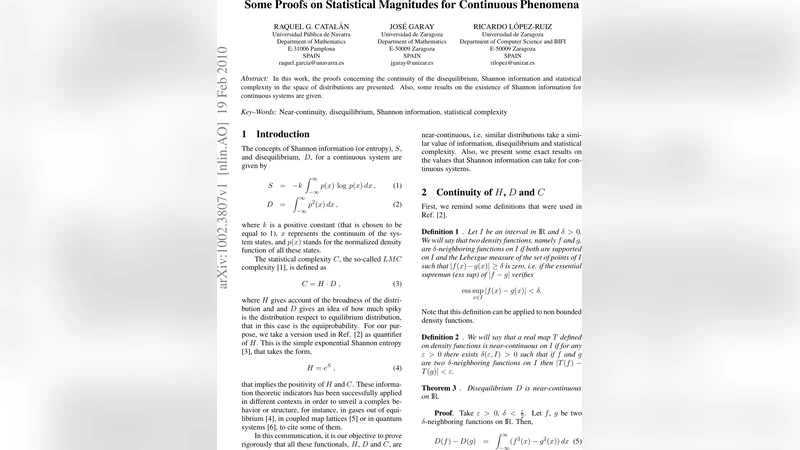
In this work, the proofs concerning the continuity of the disequilibrium, Shannon information and statistical complexity in the space of distributions are presented. Also, some results on the existence of Shannon information for continuous systems are given.
💡 Research Summary
The paper “Some Proofs on Statistical Magnitudes for Continuous Phenomena” addresses a fundamental gap in the theoretical treatment of information‑theoretic quantities for continuous random variables. While the concepts of disequilibrium, Shannon information (more precisely, differential entropy), and statistical complexity are well‑established for discrete distributions, their behavior in the space of continuous probability density functions (pdfs) has received comparatively little rigorous attention. The authors set out to prove that these three quantities are continuous functionals on appropriate spaces of pdfs and to clarify under which conditions the Shannon information is even well‑defined for continuous systems.
The first major contribution is a formal proof of the continuity of the disequilibrium functional. Disequilibrium is defined here as a distance‑like measure between a given pdf and a reference distribution, typically expressed through an L²‑norm of the difference or a symmetrized Kullback‑Leibler divergence. By embedding the set of admissible pdfs in the Banach space (L^{1}\cap L^{2}) and using the fact that the mapping (f\mapsto|f-g|_{2}^{2}) is a continuous quadratic form, the authors demonstrate that any sequence of pdfs converging uniformly (or in the (L^{2}) sense) to a limit pdf yields a convergent sequence of disequilibrium values. The proof relies on standard tools such as the dominated convergence theorem and the uniform boundedness principle, ensuring that the disequilibrium functional is not only continuous but also uniformly bounded on compact subsets of the pdf space.
The second contribution concerns the differential Shannon information (H
Comments & Academic Discussion
Loading comments...
Leave a Comment