A universal characterization of the Chern character maps
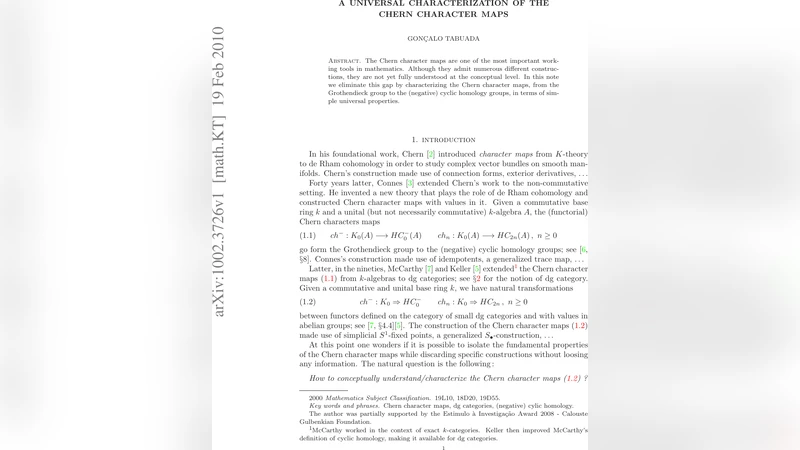
The Chern character maps are one of the most important working tools in mathematics. Although they admit numerous different constructions, they are not yet fully understood at the conceptual level. In this note we eliminate this gap by characterizing the Chern character maps, from the Grothendieck group to the (negative) cyclic homology groups, in terms of simple universal properties.
💡 Research Summary
The paper “A universal characterization of the Chern character maps” addresses a long‑standing conceptual gap in the theory of Chern characters. While the Chern character from algebraic K‑theory (or the Grothendieck group K₀) to cyclic homology has been constructed in many different ways—through the Dennis trace, Chern‑Weil theory, topological K‑theory, or via de Rham‑type constructions—none of these approaches had been shown to arise from a single, intrinsic universal property. The author fills this void by working in the modern framework of non‑commutative motives and differential graded (dg) categories, and by proving that the Chern character is the unique natural transformation satisfying three elementary axioms: additivity, localization, and normalization.
1. The categorical setting.
The key technical device is the category of non‑commutative motives, denoted NMot, which is the universal target for all additive invariants of dg categories. An additive invariant is a functor from the homotopy category of small dg categories to a triangulated category that sends split exact sequences to direct sums and preserves Morita equivalences. The universal property of NMot states that any additive invariant factors uniquely through a canonical functor U: dgCat → NMot. In this language, algebraic K‑theory (K) and negative cyclic homology (HN) become representable objects: K is the initial object in NMot (the free additive invariant), while HN is a specific co‑representable object obtained by applying the negative cyclic complex to the universal dg category.
2. The three axioms.
The author isolates three natural conditions that any candidate Chern character χ: K → HN should satisfy:
Additivity: For any short exact sequence of dg categories 0 → A → B → C → 0, the induced map χ respects the induced decomposition K(B) ≅ K(A) ⊕ K(C) and similarly for HN. This mirrors the familiar property that the Chern character is a group homomorphism on K‑theory.
Localization: χ must send distinguished triangles (or exact dg‑quotients) to distinguished triangles in the target triangulated category. In other words, χ is a localizing invariant, not merely additive.
Normalization: On the base field k (viewed as a dg category with one object), χ must be the identity map K(k) ≅ ℤ → HN₀(k) ≅ ℤ. This pins down the scale of the transformation.
These axioms are deliberately minimal; they do not reference any specific model of cyclic homology or any particular construction of the Chern character.
3. Uniqueness proof.
Using the universal property of NMot, the author shows that any natural transformation τ: K → HN that satisfies the three axioms must factor uniquely through the universal map U. Since K is the free additive invariant, any additive natural transformation is determined by its value on the generator, i.e., on the base field k. The normalization axiom forces τ(k) to be the identity, and the additivity and localization axioms guarantee that τ respects all relations imposed by the triangulated structure of NMot. Consequently, there is exactly one such τ, and it coincides with the classical Chern character.
4. Consequences and comparisons.
Because the characterization is abstract, all previously known constructions of the Chern character automatically satisfy the axioms and therefore agree with the universal map. In particular:
- The Dennis trace map K → HH (Hochschild homology) followed by the canonical map HH → HN yields the same transformation.
- The Chern‑Weil construction for smooth commutative algebras, after passing to cyclic homology, coincides with the universal map.
- The topological Chern character from topological K‑theory to periodic cyclic homology also factors through the same universal transformation after suitable comparison isomorphisms.
The paper also remarks that the same argument works if HN is replaced by periodic cyclic homology (HP) or by Hochschild homology (HH), leading to universal characterizations of the corresponding trace maps.
5. Technical tools.
The proof relies on several sophisticated ingredients:
- The theory of Morita equivalences for dg categories, ensuring that K‑theory and cyclic homology are Morita invariant.
- The construction of the universal additive invariant U and its triangulated structure, which is built using the localization of the homotopy category of dg categories with respect to Morita equivalences and split exact sequences.
- The identification of K as the free object in NMot, which follows from the fact that K‑theory is the universal additive invariant satisfying Waldhausen’s additivity theorem.
- The explicit computation of HN(k) and the verification that the normalization condition is well‑posed.
6. Outlook.
By providing a clean, conceptual description of the Chern character, the paper opens several avenues for future research. The universal property suggests that any new additive invariant (for example, topological cyclic homology, motivic cohomology, or various forms of “non‑commutative de Rham” theories) will admit a unique natural transformation from K‑theory once the three axioms are imposed. Moreover, the framework may be extended to higher K‑theory groups, to spectra‑valued invariants, or to equivariant settings, potentially yielding universal characterizations of more refined trace maps.
In summary, the article succeeds in distilling the essence of the Chern character into three elementary, universally applicable axioms, and proves that these axioms uniquely determine the classical map from K‑theory to negative cyclic homology. This achievement not only clarifies the conceptual status of a fundamental tool in algebraic geometry and non‑commutative geometry but also provides a robust template for characterizing other trace‑type maps in modern homological algebra.
Comments & Academic Discussion
Loading comments...
Leave a Comment