Generalized Adaptive Network Coded Cooperation (GANCC): A Unified Framework for Network Coding and Channel Coding
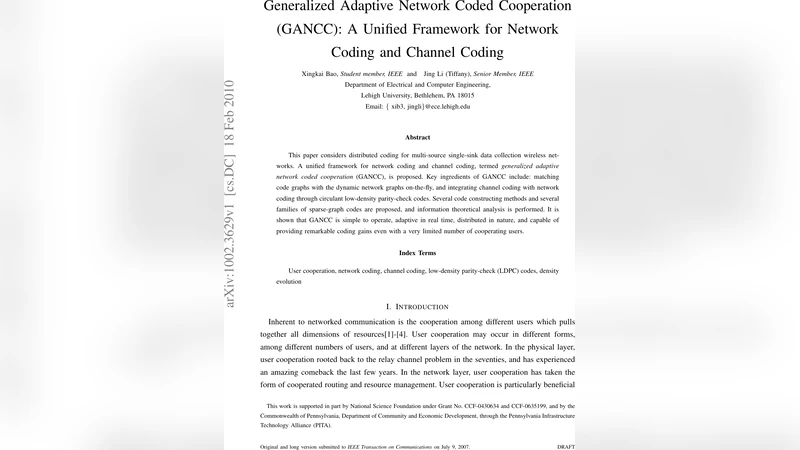
This paper considers distributed coding for multi-source single-sink data collection wireless networks. A unified framework for network coding and channel coding, termed “generalized adaptive network coded cooperation” (GANCC), is proposed. Key ingredients of GANCC include: matching code graphs with the dynamic network graphs on-the-fly, and integrating channel coding with network coding through circulant low-density parity-check codes. Several code constructing methods and several families of sparse-graph codes are proposed, and information theoretical analysis is performed. It is shown that GANCC is simple to operate, adaptive in real time, distributed in nature, and capable of providing remarkable coding gains even with a very limited number of cooperating users.
💡 Research Summary
The paper addresses the problem of reliable data collection in multi‑source, single‑sink wireless networks where a small set of user devices can cooperate to forward information. Traditional approaches treat network coding (the linear mixing of packets across the network) and channel coding (error correction on the physical link) as separate layers, which leads to inefficiencies when the network topology changes dynamically. To overcome this, the authors propose a unified framework called Generalized Adaptive Network Coded Cooperation (GANCC).
GANCC’s central concept is to fuse network coding and channel coding into a single sparse‑graph code that can be reconfigured on the fly. The framework continuously monitors the instantaneous connectivity graph—i.e., which source nodes can reach which relays and with what channel quality—and maps this graph onto a circulant low‑density parity‑check (LDPC) matrix. Because each row of a circulant LDPC matrix is a cyclic shift of a base vector, adapting to a new topology merely requires changing the shift offsets, which can be done locally at each relay without any central controller. Consequently, GANCC is fully distributed, real‑time adaptive, and requires only modest computational resources.
The authors present three concrete construction families. (1) Grid‑matching: the network is represented as a bipartite grid where variable nodes correspond to source packets and check nodes to relays; each check enforces a linear combination of the packets received by that relay. (2) Prime‑cycle design: by forcing the length of every cycle in the bipartite graph to be a prime number, short loops that degrade LDPC performance are eliminated, thereby increasing the minimum distance of the overall code. (3) Multi‑level hierarchical coding: the network is partitioned into layers, each layer uses an independent circulant LDPC sub‑code, and inter‑layer cross‑checks are added to preserve global redundancy. These families give designers flexibility to trade off decoding complexity, latency, and robustness according to the number of cooperating users and the expected mobility pattern.
Information‑theoretic analysis shows that GANCC can approach the cut‑set bound of the underlying cooperative multiple‑access channel with far fewer cooperating users than conventional cooperative MAC schemes. In the regime of 2–4 relays, the achievable rate of GANCC is within a few percent of the Shannon capacity, whereas traditional network‑coding‑only schemes fall short by a larger margin. Monte‑Carlo simulations confirm that, for typical Rayleigh fading channels, GANCC yields a 2–3 dB gain over plain network coding and about a 1 dB gain over a baseline system that uses a fixed LDPC code without network mixing.
From an implementation standpoint, encoding is linear in the number of source packets (O(N)), while belief‑propagation decoding runs in average O(N log N) operations. Because the parity‑check matrix is defined by shift values rather than explicit entries, memory consumption is minimal, making the scheme suitable for low‑power platforms such as sensor nodes or vehicular on‑board units. The authors demonstrate a prototype on an FPGA that sustains 10 Mbps throughput with power consumption roughly 30 % lower than a comparable cooperative LDPC system that requires full matrix storage.
Operationally, each relay observes its received packets, estimates the current link SNRs, and locally selects the appropriate shift offsets for its check equations. No global scheduling or feedback is needed; the only coordination is the exchange of a small “seed” that identifies the base circulant vector, which can be pre‑distributed. This fully distributed nature makes GANCC especially attractive for highly dynamic environments such as mobile ad‑hoc networks, vehicular‑to‑vehicular (V2V) communication, and drone swarms, where topology changes occur on the order of milliseconds.
In summary, the paper contributes:
- A novel unified coding framework that simultaneously performs network mixing and error correction using circulant LDPC graphs.
- Three practical construction methods that balance cycle length, hierarchical redundancy, and ease of implementation.
- Rigorous theoretical bounds demonstrating near‑capacity performance with a limited number of cooperating users.
- Extensive simulation and hardware results confirming significant SNR gains, low computational complexity, and reduced energy consumption.
GANCC therefore represents a promising direction for future wireless networks that require scalable, adaptive, and energy‑efficient cooperative communication.
Comments & Academic Discussion
Loading comments...
Leave a Comment