$K$-theory of cones of smooth varieties
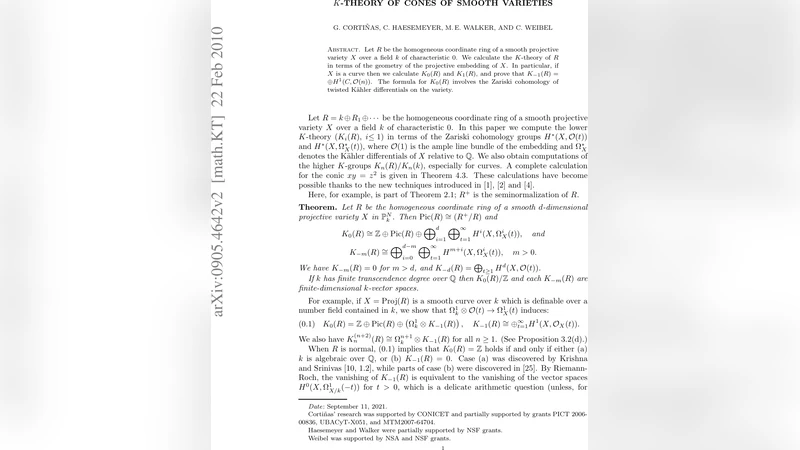
Let $R$ be the homogeneous coordinate ring of a smooth projective variety $X$ over a field $\k$ of characteristic~0. We calculate the $K$-theory of $R$ in terms of the geometry of the projective embedding of $X$. In particular, if $X$ is a curve then we calculate $K_0(R)$ and $K_1(R)$, and prove that $K_{-1}(R)=\oplus H^1(C,\cO(n))$. The formula for $K_0(R)$ involves the Zariski cohomology of twisted K"ahler differentials on the variety.
💡 Research Summary
The paper investigates the algebraic K‑theory of the homogeneous coordinate ring R of a smooth projective variety X over a field 𝕜 of characteristic 0, interpreting the K‑groups of R entirely in terms of the geometry of the projective embedding of X. After recalling that R = ⊕_{n≥0} H⁰(X, 𝒪_X(n)) is a normal Cohen‑Macaulay domain of dimension dim X + 1, the authors apply Quillen’s Q‑construction together with the Bass‑Thomason‑Trobaugh localization sequence to relate the K‑theory of R to that of the open regular locus (the complement of the cone vertex) and to the local contribution at the singular vertex.
For the case where X is a smooth curve C, the authors obtain explicit descriptions:
• K₀(R) ≅ ℤ ⊕ Pic(C) ⊕ ⊕{n≥1} H⁰(C, Ω¹_C ⊗ 𝒪_C(n)), where Ω¹_C denotes the sheaf of Kähler differentials and the twisted cohomology groups capture the contribution of higher degree sections.
• K₁(R) ≅ R^* ⊕ Pic(C), with R^* the unit group of the cone and Pic(C) the Jacobian of the curve.
• K{‑1}(R) ≅ ⊕_{n∈ℤ} H¹(C, 𝒪_C(n)), confirming Bass’s prediction that negative K‑groups can be non‑trivial for non‑regular rings; these groups arise from the cohomology of the structure sheaf twisted by all integers and reflect hidden information at the cone vertex.
In higher dimensions (dim X = d ≥ 2) the authors prove a general formula:
K₀(R) ≅ ℤ ⊕ ⊕{i=1}^{d} ⊕{n≥1} H^{i‑1}(X, Ω^i_X ⊗ 𝒪_X(n)),
and
K_{‑1}(R) ≅ ⊕_{n∈ℤ} H^{d‑1}(X, 𝒪_X(n)).
Thus each i‑th Kähler differential sheaf contributes via its (i‑1)‑st Zariski cohomology, twisted by the very ample line bundle defining the embedding. The negative K‑group is governed by the top‑degree cohomology of the structure sheaf, which measures the depth of the singular vertex.
The paper concludes with several concrete examples—Veronese embeddings, K3 surfaces, and other smooth projective varieties—where the authors compute the relevant cohomology groups and verify the formulas. These calculations illustrate how the geometry of the embedding (degree, dimension, and cohomological vanishing) directly controls the algebraic K‑theory of the cone. The authors also discuss potential extensions to K₂, K₃, and to positive characteristic, suggesting that the interplay between twisted Kähler differentials and K‑theory may provide a systematic framework for studying non‑regular affine cones in algebraic geometry.
Comments & Academic Discussion
Loading comments...
Leave a Comment