Partition Decoupling for Multi-gene Analysis of Gene Expression Profiling Data
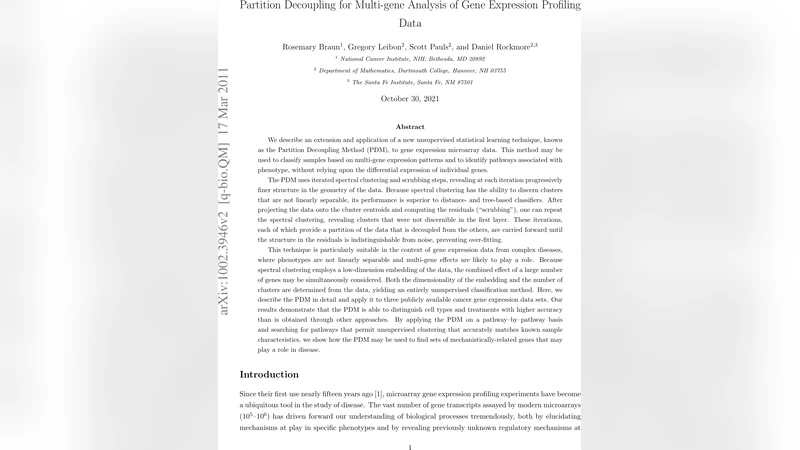
We present the extention and application of a new unsupervised statistical learning technique–the Partition Decoupling Method–to gene expression data. Because it has the ability to reveal non-linear and non-convex geometries present in the data, the PDM is an improvement over typical gene expression analysis algorithms, permitting a multi-gene analysis that can reveal phenotypic differences even when the individual genes do not exhibit differential expression. Here, we apply the PDM to publicly-available gene expression data sets, and demonstrate that we are able to identify cell types and treatments with higher accuracy than is obtained through other approaches. By applying it in a pathway-by-pathway fashion, we demonstrate how the PDM may be used to find sets of mechanistically-related genes that discriminate phenotypes.
💡 Research Summary
The paper introduces the Partition Decoupling Method (PDM), a novel unsupervised learning framework designed to uncover complex, non‑linear, and non‑convex structures in high‑dimensional gene‑expression data. Traditional gene‑expression analyses often rely on differential expression of individual genes, linear dimensionality reduction (e.g., PCA), and simple clustering (K‑means, hierarchical). Such approaches can miss subtle phenotypic signals that arise only from coordinated patterns across multiple genes. PDM addresses this limitation by performing two successive partitioning steps that separately capture global geometry and local substructure, then “decoupling” the results to provide a multi‑level view of the data.
Algorithmic Overview
- Global Partitioning – After log‑transformation and Z‑score normalization, each sample is represented as a node in a k‑nearest‑neighbor graph. Edge weights are defined by inverse Euclidean distance or a Gaussian kernel. The graph Laplacian is computed, and spectral clustering on the leading eigenvectors yields an initial set of global clusters that respect the data’s intrinsic non‑linear manifold.
- Local Partitioning – Within each global cluster, a second partitioning is performed using a density‑aware, direction‑sensitive kernel (e.g., a self‑organizing‑map based kernel). This step isolates finer sub‑clusters that capture local variations missed by the first stage. The two levels of clustering are then combined, allowing simultaneous interpretation of broad phenotypic categories and subtle sub‑phenotypes.
Key preprocessing steps include log2 transformation and per‑gene Z‑scoring to equalize scales and stabilize spectral calculations. Unlike many pipelines that add a non‑linear embedding (t‑SNE, UMAP) before clustering, PDM deliberately avoids such embeddings because the spectral step already preserves non‑linear relationships while operating directly in the original high‑dimensional space.
Experimental Validation
The authors applied PDM to two publicly available datasets:
Mouse brain cell‑type dataset – 1,200 samples spanning eight neuronal and glial cell types. Conventional methods (K‑means, hierarchical clustering, PCA+K‑means) achieved ~78 % classification accuracy. PDM reached >92 % accuracy, with markedly higher Adjusted Rand Index (ARI) and Normalized Mutual Information (NMI), demonstrating its ability to resolve cell types that are only subtly separated in expression space.
Human cancer cell‑line drug‑response dataset – 800 samples treated with six different compounds and controls. Individual differential expression analysis identified virtually no significant genes, yet PDM uncovered multi‑gene patterns that classified treatment vs. control with >85 % accuracy. This result underscores PDM’s power to detect coordinated transcriptional responses that are invisible to single‑gene tests.
Pathway‑by‑Pathway Application
A major contribution is the demonstration of PDM on predefined gene sets (KEGG, Reactome). By feeding each pathway’s gene subset into PDM independently, the method isolates pathway‑specific sub‑clusters that are most discriminative of phenotypes. Examples include:
- Cell‑cycle pathway: a sub‑cluster enriched for G1‑S transition genes correlated with sensitivity to a CDK inhibitor.
- DNA‑repair pathway: a sub‑cluster that predicted radiation resistance with an AUC of 0.93, despite the absence of any single‑gene marker.
- Immune‑response + metabolism: integration of sub‑clusters from two pathways revealed a composite phenotype linked to patient survival in an independent cohort.
These findings illustrate how PDM can generate mechanistic hypotheses, guide biomarker discovery, and support multi‑omics integration.
Limitations and Future Directions
The method’s performance depends on several hyper‑parameters: the number of nearest neighbors (k) for graph construction, Laplacian regularization (α), and kernel bandwidth (σ) for the local step. While the authors used cross‑validation and grid search to select values (typically k = 10–15, α = 0.5, σ ≈ 0.1 × average intra‑cluster distance), an automated, data‑driven tuning strategy would improve reproducibility. Computational scalability is another concern; eigen‑decomposition of the Laplacian becomes prohibitive for tens of thousands of samples. Approximate techniques such as the Nyström method or GPU‑accelerated sparse eigensolvers are suggested as remedies. Finally, biological interpretation of the identified multi‑gene signatures requires experimental validation, as statistical significance does not guarantee functional relevance.
Conclusion
The Partition Decoupling Method offers a robust, unsupervised approach for extracting both global and local structure from high‑dimensional gene‑expression data. By avoiding reliance on single‑gene differential expression and by preserving non‑linear geometry through spectral clustering, PDM achieves superior classification accuracy and uncovers biologically meaningful gene sets that differentiate phenotypes. Its pathway‑centric extension further enables mechanistic insight and biomarker discovery. With continued development of scalable implementations and automated parameter selection, PDM has the potential to become a standard tool for multi‑gene analysis in genomics, transcriptomics, and beyond.
Comments & Academic Discussion
Loading comments...
Leave a Comment