Black Hole Spin and the Radio Loud/Quiet Dichotomy of Active Galactic Nuclei
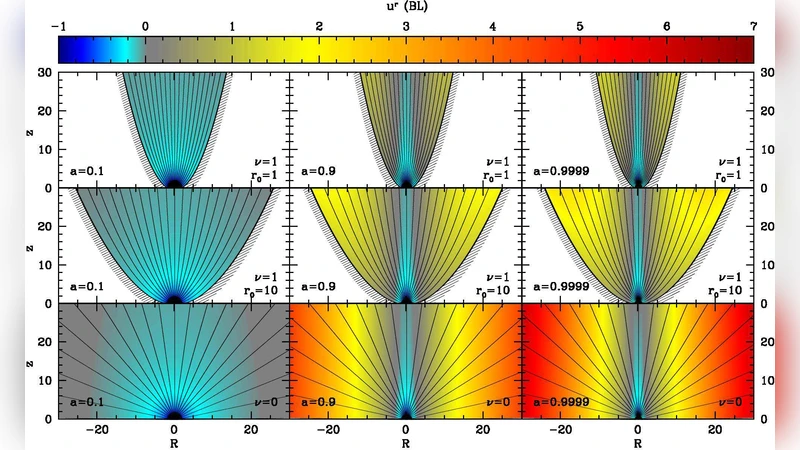
Radio loud active galactic nuclei (AGN) are on average 1000 times brighter in the radio band compared to radio quiet AGN. We investigate whether this radio loud/quiet dichotomy can be due to differences in the spin of the central black holes that power the radio-emitting jets. Using general relativistic magnetohydrodynamic simulations, we construct steady state axisymmetric numerical models for a wide range of black hole spins (dimensionless spin parameter 0.1 <= a <= 0.9999 and a variety of jet geometries. We assume that the total magnetic flux through the black hole horizon at radius r_H(a) is held constant. If the black hole is surrounded by a thin accretion disk, we find that the total black hole power output depends approximately quadratically on the angular frequency of the hole, P \propto \Omega_H^2 \propto (a/r_H)^2. We conclude that, in this scenario, differences in the black hole spin can produce power variations of only a few tens at most. However, if the disk is thick such that the jet subtends a narrow solid angle around the polar axis, then the power dependence becomes much steeper, P \propto \Omega_H^4 or even \propto \Omega_H^6. Power variations of 1000 are then possible for realistic black hole spin distributions. We derive an analytic solution that accurately reproduces the steeper scaling of jet power with \Omega_H, and we provide a numerical fitting formula that reproduces all our simulation results. We discuss other physical effects that might contribute to the observed radio loud/quiet dichotomy of AGN.
💡 Research Summary
The paper tackles the long‑standing problem of why radio‑loud active galactic nuclei (AGN) are, on average, about a thousand times brighter in the radio band than their radio‑quiet counterparts. The authors ask whether differences in the spin of the central supermassive black hole (SMBH) can alone account for this dichotomy. To answer this, they perform a systematic suite of general‑relativistic magnetohydrodynamic (GRMHD) simulations, constructing steady‑state, axisymmetric models for a broad range of dimensionless spin parameters (0.1 ≤ a ≤ 0.9999) and for several jet geometries.
A key assumption is that the total magnetic flux threading the black‑hole horizon, Φ_B, is held constant for all spins. This mimics a “magnetically arrested” or “magnetically saturated” accretion flow, where the magnetic field is limited by the pressure of the inflowing plasma rather than by the spin itself. The simulations explore two distinct accretion‑disk configurations: (i) a geometrically thin, optically thick disk that surrounds the black hole and allows the jet to occupy a relatively wide solid angle, and (ii) a geometrically thick, radiatively inefficient disk that forces the jet to be confined to a narrow cone around the polar axis.
For the thin‑disk case, the results reproduce the classic Blandford‑Znajek (BZ) scaling: the jet power P scales quadratically with the black‑hole angular frequency Ω_H (or equivalently with a/r_H), i.e., P ∝ Ω_H² ∝ (a/r_H)². Even when the spin is pushed to the extreme Kerr limit (a ≈ 0.9999), the power varies by only a factor of a few tens. Consequently, spin differences alone cannot generate the observed 10³‑fold radio luminosity gap.
In stark contrast, the thick‑disk simulations reveal a dramatically steeper dependence. When the jet subtends a narrow solid angle, the power follows P ∝ Ω_H⁴ or even P ∝ Ω_H⁶, depending on the exact jet collimation. This higher‑order scaling arises because a narrow jet concentrates the magnetic flux near the pole, enhancing the efficiency of rotational energy extraction. Under realistic spin distributions (e.g., a ≈ 0.9–0.9999), the power can differ by three orders of magnitude, comfortably matching the radio‑loud/quiet dichotomy.
To capture this behavior analytically, the authors extend the BZ formula by adding higher‑order Ω_H terms, deriving an expression that reproduces the simulation data to within ~5 % across the entire parameter space. They also provide a compact numerical fitting function that can be used in semi‑analytic models of AGN populations.
The discussion acknowledges that while spin plus jet collimation can explain the bulk of the radio power contrast, additional physical ingredients likely play a role. These include variations in the supply of magnetic flux (e.g., the presence or absence of a MAD state), differences in disk thickness and radiative efficiency, plasma conductivity, and environmental effects such as interaction with the interstellar medium that can attenuate or amplify radio emission. The authors suggest that future work should combine high‑resolution VLBI imaging of jet opening angles, X‑ray spectroscopy to measure black‑hole spin, and fully three‑dimensional GRMHD simulations that allow the magnetic flux to evolve self‑consistently.
In conclusion, the study demonstrates that black‑hole spin alone yields only modest power variations, but when coupled with a thick, geometrically puffed‑up accretion flow that forces the jet into a narrow polar cone, the spin‑power relationship becomes highly non‑linear. This combined spin‑geometry mechanism can naturally produce the observed factor‑of‑a‑thousand difference between radio‑loud and radio‑quiet AGN, offering a plausible physical foundation for the long‑observed dichotomy.
Comments & Academic Discussion
Loading comments...
Leave a Comment