Categories without structures
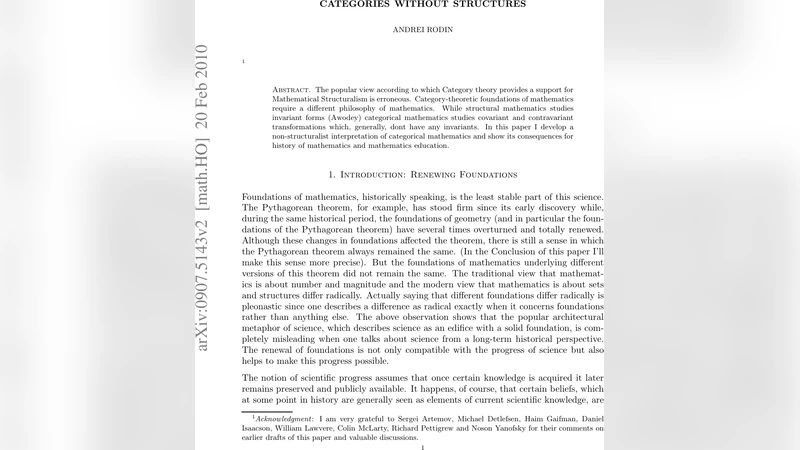
The popular view according to which Category theory provides a support for Mathematical Structuralism is erroneous. Category-theoretic foundations of mathematics require a different philosophy of mathematics. While structural mathematics studies invariant forms (Awodey) categorical mathematics studies covariant transformations which, generally, don t have any invariants. In this paper I develop a non-structuralist interpretation of categorical mathematics and show its consequences for history of mathematics and mathematics education.
💡 Research Summary
The paper opens by outlining the dominant view that Category Theory (CT) supplies a natural foundation for Mathematical Structuralism, a philosophy that treats mathematics as the study of invariant forms. Citing Awodey, the author sketches structuralism’s emphasis on objects whose essential properties remain unchanged under isomorphisms. From this starting point the author argues that this interpretation is fundamentally mistaken. The core claim is that CT does not prioritize invariants at all; instead it foregrounds covariant transformations—arrows, functors, natural transformations—whose meaning is generated precisely by the way they compose and relate, not by any fixed internal structure of the objects they connect.
The first substantive section critiques the “structuralist reading” of CT. The author shows that when one tries to identify categorical objects with structural entities, one inevitably collapses the distinction between objects and the morphisms that bind them. For example, in group theory the traditional structuralist approach treats a group as a self‑contained algebraic structure. In CT, however, a group is more naturally understood as a one‑object category whose morphisms are the group elements, and the group operation is simply composition of arrows. The “structure” of the group is thus not an intrinsic invariant but a pattern of compositional relationships. Similar analysis is applied to topology: open sets and inclusion maps are not static carriers of topological form; the essential content lies in continuous maps and their preservation of structure, which is itself a relational property.
Historical context follows. The author traces the emergence of CT in the 1940s (Eilenberg–Mac Lane) and notes that early proponents already envisioned a foundation that transcended set‑theoretic structuralism. Yet the mathematical community, influenced by the prevailing structuralist paradigm, re‑interpreted CT through the lens of invariance, leading to a persistent conflation. The paper argues that this conflation has shaped both research directions and pedagogical practices, often obscuring the genuinely novel philosophical stance that CT brings.
The educational implications are explored in depth. Current mathematics curricula emphasize definitions, theorems, and proofs about fixed objects, reflecting a structuralist mindset. Introducing a “covariant” perspective would shift focus to the behavior of transformations: students would first encounter functions, functors, and naturality conditions before abstracting objects themselves. This reordering is argued to develop a deeper intuition for abstraction, promote flexibility in moving between mathematical domains, and better reflect the practice of contemporary research, where categorical language is increasingly standard.
In the concluding section the author proposes a new philosophical stance—“transformation‑centric” or “relation‑centric” mathematics. This stance accepts that mathematics can be studied both as a science of invariant forms (structuralism) and as a science of coherent transformation patterns (category theory), but insists that the latter cannot be reduced to the former. The paper calls for a clear conceptual separation in future foundational work, historical scholarship, and curriculum design, urging scholars to recognize that CT demands a philosophy that embraces change, composition, and covariance rather than static invariance.
Comments & Academic Discussion
Loading comments...
Leave a Comment