$varkappa$-metrizable compacta and superextensions
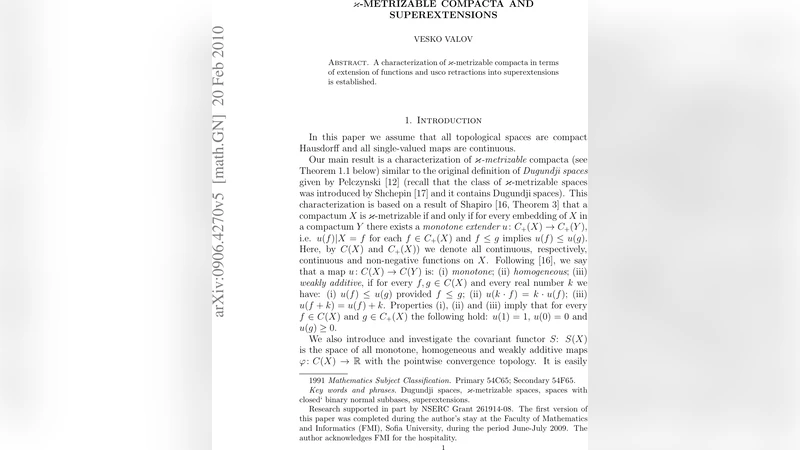
A characterization of $\varkappa$-metrizable compacta in terms of extension of functions and usco retractions into superextensions is established.
💡 Research Summary
**
The paper establishes a new characterization of κ‑metrizable compact spaces by linking three seemingly disparate concepts: the ability to extend continuous real‑valued functions to the superextension λX, the existence of upper‑semicontinuous (usco) retractions from any ambient compact space Y onto X, and the classical definition of κ‑metrizable spaces via a κ‑distance. After a concise review of κ‑metrizable compacta—spaces that admit a κ‑distance d satisfying axioms (K1)–(K4)—the author recalls the construction of the superextension λX, the compact Hausdorff space consisting of all maximal linked systems of closed subsets of X, equipped with the standard topology generated by sets of the form U⁺ (U open in X).
The first major technical result shows that every continuous function f∈C(X) admits a natural extension (\tilde f) to λX defined by (\tilde f(A)=\sup{f(F):F∈A}) for a linked system A. This extension is continuous, and its restriction to X coincides with f, demonstrating that λX is “C‑extension complete”.
The second key theorem proves that if X is a closed subspace of a compact space Y and there exists a usco retraction r:Y→X (i.e., r is upper‑semicontinuous, r(x)={x} for x∈X, and r(y) is a non‑empty closed subset of X for each y∈Y), then r lifts uniquely to a continuous map (\hat r:λY→λX) given by (\hat r(A)={B∈λX:B⊂r(A)}). Consequently, the superextension functor preserves the retraction structure.
The central equivalence theorem (Theorem 4.1) states that for a compact space X the following are equivalent:
- X is κ‑metrizable.
- For every compact Y containing X as a subspace, there exists a usco retraction r:Y→X.
- Every f∈C(X) extends continuously to λX.
The proof proceeds by constructing a κ‑distance from the usco retraction data and by showing that the existence of such extensions forces the superextension λX to carry a compatible κ‑metric, which in turn yields a κ‑distance on X. The argument uses the interplay between the linked‑system topology of λX and the upper‑semicontinuity of r, together with standard selection theorems.
Beyond the main equivalence, the paper derives several corollaries: κ‑metrizable compacta are closed under taking closed subspaces, continuous images, and finite products; the superextension λX of a κ‑metrizable compactum is itself a limit space (lim‑space) and inherits many of the nice topological properties of X. Moreover, the author points out that the new characterization provides a functional‑analytic viewpoint on κ‑metrizable spaces, opening potential applications to the theory of function spaces C(X), selection principles, and measure‑theoretic extensions.
In the concluding section, the author emphasizes that the result bridges the gap between classical κ‑metrizable theory and modern superextension techniques, offering a unified framework that can be extended to non‑compact settings, to other hyperspace constructions, and possibly to interactions with set‑theoretic axioms such as the Axiom of Choice. Future work is suggested on exploring λ‑structures in the context of probability measures, on developing analogous characterizations for κ‑metrizable non‑Hausdorff spaces, and on investigating the role of usco retractions in the categorical treatment of compactifications.
Comments & Academic Discussion
Loading comments...
Leave a Comment