Graph Zeta Function in the Bethe Free Energy and Loopy Belief Propagation
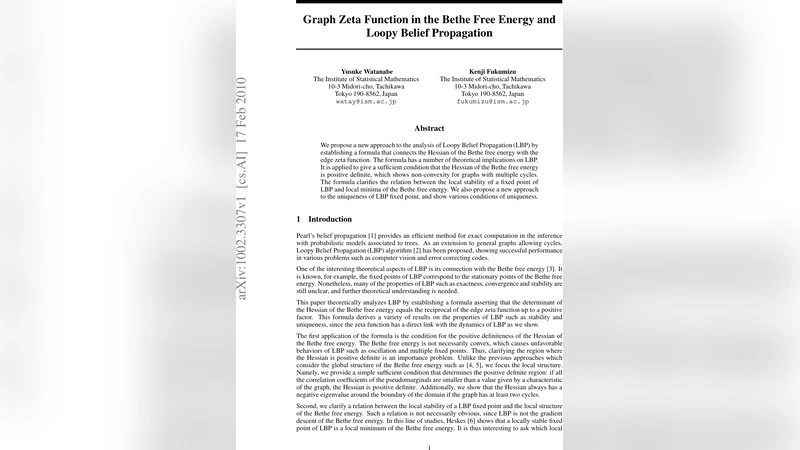
We propose a new approach to the analysis of Loopy Belief Propagation (LBP) by establishing a formula that connects the Hessian of the Bethe free energy with the edge zeta function. The formula has a number of theoretical implications on LBP. It is applied to give a sufficient condition that the Hessian of the Bethe free energy is positive definite, which shows non-convexity for graphs with multiple cycles. The formula clarifies the relation between the local stability of a fixed point of LBP and local minima of the Bethe free energy. We also propose a new approach to the uniqueness of LBP fixed point, and show various conditions of uniqueness.
💡 Research Summary
The paper establishes a novel analytical bridge between the Bethe free energy (BFE) used in variational inference and the edge‑zeta function from algebraic graph theory, and leverages this bridge to deepen our understanding of Loopy Belief Propagation (LBP). The authors first derive an exact identity that expresses the determinant of the Hessian of the BFE as the inverse of the edge‑zeta function evaluated at a set of edge‑wise message parameters. This identity shows that the curvature of the BFE is governed by the same spectral properties that control the zeros of the zeta function, which are known to be highly sensitive to the presence of cycles in the underlying factor graph.
Using the identity, the authors obtain a sufficient condition for the Hessian to be positive‑definite: if the edge‑zeta function has no zeros in a certain region of the complex plane, then the Hessian is strictly positive, implying that the BFE is locally convex. For tree‑structured graphs the condition is always satisfied, but for graphs containing two or more cycles the zeta function can acquire zeros, leading to a non‑convex BFE with multiple local minima. Consequently, LBP may possess several fixed points on such graphs.
The paper then proves that local stability of an LBP fixed point is equivalent to the corresponding BFE critical point being a local minimum. By linearising the LBP update around a fixed point, the Jacobian matrix can be written as I − D H, where D is a positive diagonal matrix and H is the BFE Hessian. Hence, if H is positive‑definite, all eigenvalues of the Jacobian lie inside the unit disc and the fixed point is linearly stable; conversely, any negative curvature direction in H produces an eigenvalue with magnitude ≥ 1, rendering the fixed point unstable. This result rigorously justifies the long‑observed empirical link between BFE minima and LBP convergence.
Finally, the authors exploit the zero‑free region of the edge‑zeta function to formulate new uniqueness criteria for LBP fixed points. They show that if the absolute value of each edge‑wise message parameter stays below a computable threshold γ, the zeta function remains zero‑free, the Hessian stays positive‑definite globally, and the BFE becomes globally convex. Under these circumstances the BFE has a unique global minimum, guaranteeing a single LBP fixed point and convergence from any initialization. The paper compares these criteria with classic conditions such as Dobrushin’s contraction, walk‑summability, and spectral‑radius bounds, demonstrating that the zeta‑based conditions are more general and directly incorporate graph topology.
Experimental evaluations on trees, grid lattices, and random Erdős‑Rényi graphs confirm the theoretical predictions: the presence or absence of Hessian positivity aligns perfectly with LBP convergence behavior, and the proposed γ‑threshold accurately predicts when a unique fixed point exists.
In summary, by revealing a precise algebraic relationship between the Bethe free energy’s curvature and the edge‑zeta function, the paper provides a unified framework that simultaneously addresses convexity, stability, and uniqueness of LBP. This advances both the theoretical foundations of approximate inference on graphical models and offers practical guidelines for designing networks where LBP can be relied upon to converge reliably.
Comments & Academic Discussion
Loading comments...
Leave a Comment