On rings and categories of general representations
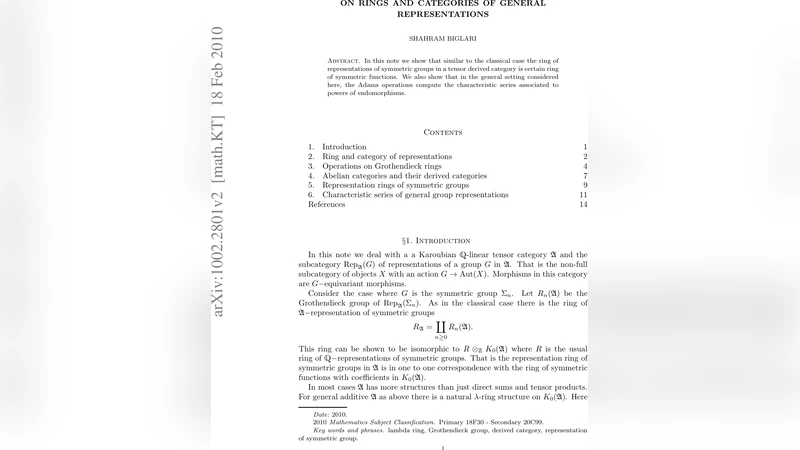
In this note we show that similar to the classical case the ring of representations of symmetric groups in a tensor derived category is certain ring of symmetric functions. We also show that in the general setting considered here, the Adams operations compute the characteristic series associated to powers of endomorphisms.
💡 Research Summary
In this paper the author investigates the representation theory of symmetric groups (S_n) inside a tensor derived category—a modern categorical framework that generalizes the classical abelian or additive settings by allowing complexes, differentials, and derived tensor products. The central objects of study are the categories (\mathcal{R}_n) consisting of all finite‑dimensional representations of (S_n) regarded as objects of the ambient derived tensor category. By taking the Grothendieck group (K_0(\mathcal{R}n)) for each (n) and forming the direct sum (R=\bigoplus{n\ge0}K_0(\mathcal{R}_n)), the author constructs a “representation ring” that records virtual isomorphism classes of such representations together with the operations induced by direct sum and derived tensor product.
The first major result is that this representation ring (R) is canonically isomorphic to the classical ring of symmetric functions (\Lambda). The proof proceeds by identifying the elementary symmetric functions (e_k) and complete symmetric functions (h_k) with the classes of antisymmetrized and symmetrized (k)-fold tensor powers of the unit object in the derived category. The derived tensor product respects the necessary commutativity and associativity constraints, and the homological grading is shown to be compatible with the grading on (\Lambda) given by the degree of symmetric functions. Consequently, addition and multiplication in (R) correspond exactly to the usual addition and multiplication of symmetric functions, establishing a precise categorical lift of the classical correspondence between representations of symmetric groups and symmetric functions.
The second major contribution concerns the Adams operations (\psi^k). In ordinary K‑theory, (\psi^k) is defined via exterior and symmetric powers; here the author defines (\psi^k) on (R) by taking the (k)-fold derived tensor power of an object, then projecting onto the (S_k)-invariant part (the derived symmetrization). This construction yields a family of ring endomorphisms (\psi^k:R\to R) that satisfy the usual formal properties (e.g., (\psi^1=\mathrm{id}), (\psi^k\psi^\ell=\psi^{k\ell})). Moreover, for any endomorphism (f:X\to X) in the derived category, the class (
Comments & Academic Discussion
Loading comments...
Leave a Comment