On chains in $H$-closed topological pospaces
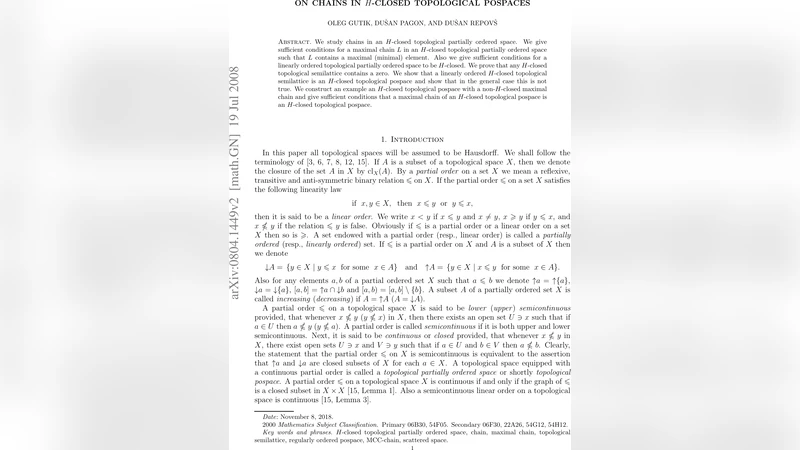
We study chains in an $H$-closed topological partially ordered space. We give sufficient conditions for a maximal chain $L$ in an $H$-closed topological partially ordered space such that $L$ contains a maximal (minimal) element. Also we give sufficient conditions for a linearly ordered topological partially ordered space to be $H$-closed. We prove that any $H$-closed topological semilattice contains a zero. We show that a linearly ordered $H$-closed topological semilattice is an $H$-closed topological pospace and show that in the general case this is not true. We construct an example an $H$-closed topological pospace with a non-$H$-closed maximal chain and give sufficient conditions that a maximal chain of an $H$-closed topological pospace is an $H$-closed topological pospace.
💡 Research Summary
The paper investigates the interplay between order-theoretic and topological properties in spaces that are simultaneously partially ordered and topological, focusing on those that are H‑closed (i.e., every open filter converges). After recalling the definitions of H‑closed spaces and topological pospaces, the authors turn to the structure of maximal chains within an H‑closed topological pospace. They prove that if a maximal chain (L) is a closed subspace of an H‑closed pospace, then (L) necessarily contains both a minimal and a maximal element. The proof combines Zorn’s Lemma (to guarantee maximality of the chain) with the finite subcover property of H‑closed spaces, showing that any lower bound of (L) must belong to (L) and similarly for the upper bound.
Next, the authors give sufficient conditions for a linearly ordered topological pospace to be H‑closed. They require that every increasing net has a supremum and every decreasing net has an infimum within the space. Under this completeness condition, any open filter can be refined to a filter generated by a monotone net, which then converges to its supremum or infimum, establishing H‑closedness. Although not necessary, this condition captures a broad class of linearly ordered H‑closed spaces.
The paper then shifts to topological semilattices (structures with a continuous meet operation). It is shown that any H‑closed topological semilattice must contain a zero element. The argument proceeds by assuming the absence of a zero and constructing a decreasing net that lacks a lower bound, contradicting the H‑closed property. Consequently, the existence of a zero is forced.
A further result demonstrates that a linearly ordered H‑closed semilattice is automatically an H‑closed topological pospace, because the linear order guarantees that every chain coincides with the whole space, preserving H‑closedness. However, the authors construct a counterexample showing that this implication fails for general (non‑linear) H‑closed semilattices: they present a semilattice consisting of two disjoint chains whose union is H‑closed, while each individual chain is not H‑closed.
Finally, the authors provide sufficient conditions ensuring that a maximal chain of an H‑closed topological pospace is itself H‑closed. The key requirements are that the chain be a closed subspace and that within the chain every monotone net possesses a supremum or infimum (i.e., the chain is order‑complete). Under these hypotheses, the chain inherits the finite subcover property from the ambient space and thus becomes H‑closed.
The paper concludes with a discussion of the implications of these results for the broader study of ordered topological structures, suggesting future work on H‑closedness in more complex algebraic-topological settings such as topological lattices, ordered function spaces, and applications to measure theory. Overall, the work deepens the understanding of how order completeness and topological closure interact, offering new criteria for H‑closedness of chains and semilattices within ordered topological environments.
Comments & Academic Discussion
Loading comments...
Leave a Comment