Central Extensions of Gerbes
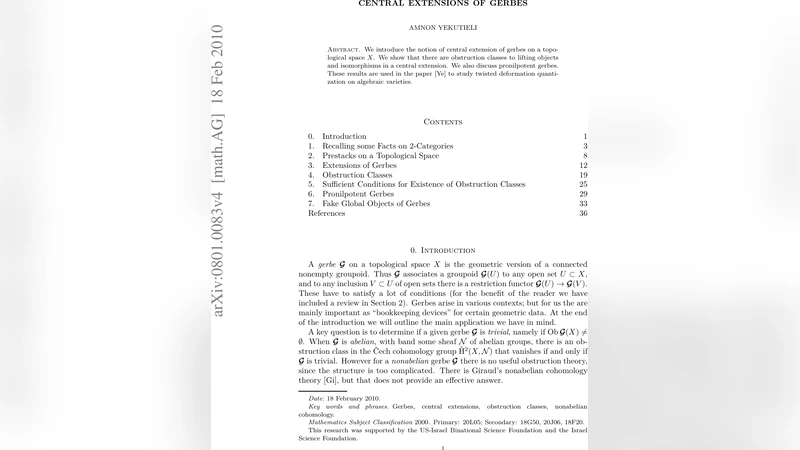
We introduce the notion of central extension of gerbes on a topological space. We then show that there are obstruction classes to lifting objects and isomorphisms in a central extension. We also discuss pronilpotent gerbes. These results are used in a subsequent paper to study twisted deformation quantization on algebraic varieties.
💡 Research Summary
The paper introduces a systematic theory of central extensions of gerbes on a topological space X. After reviewing the classical notion of gerbes as 2‑stacks (or 2‑groupoids) and recalling the role of central extensions in ordinary group theory, the author defines a central extension of gerbes to be a short exact sequence of 2‑stacks
1 → 𝔾 → ℍ → 𝔽 → 1,
where 𝔾 is an abelian group‑stack sitting in the centre of ℍ. This definition is deliberately made in the language of 2‑categorical cohomology so that the extension data can be expressed by higher‑cocycle conditions.
The first major result identifies the cohomological obstructions to the existence of such an extension. Using the non‑abelian 2‑Cech complex, the author shows that the class of a central extension lives in H³(X,𝔾) and that a necessary and sufficient condition for a given pair (ℍ,𝔽) to admit a central extension with kernel 𝔾 is the vanishing of a specific 3‑cocycle. When 𝔾 is non‑abelian, an additional H⁴‑class appears, reflecting the higher‑order non‑commutativity of the gerbe.
Having established existence criteria, the paper turns to the lifting problem. Given an object F in the base gerbe 𝔽, one asks whether there exists an object H in ℍ mapping to F. The obstruction to such a lift is a class in H²(X,𝔾). If this class vanishes, the set of possible lifts forms a torsor under H¹(X,𝔾). A second, finer obstruction concerns the lifting of morphisms (or 1‑isomorphisms) between objects of 𝔽; this lives in H¹(X,𝔾) and, when trivial, yields a torsor under H⁰(X,𝔾). The author packages these results into an “obstruction tower” that mirrors the familiar Postnikov tower for spaces but operates entirely within the 2‑stack context.
The next section is devoted to pronilpotent gerbes, i.e., gerbes obtained as inverse limits of a tower of central extensions whose kernels form a descending central series of abelian group‑stacks. By iterating the obstruction analysis at each finite stage, the author shows that the inverse limit gerbe inherits a natural filtration and that all higher obstruction classes eventually vanish. Consequently, pronilpotent gerbes admit a canonical “nilpotent” structure that can be described by a formal exponential map from the Lie algebra of the kernel to the gerbe itself. This construction is reminiscent of the Malcev completion for groups but lives in the realm of 2‑stacks.
Finally, the paper outlines how these abstract results feed into the study of twisted deformation quantization on algebraic varieties, a topic the author will develop in a subsequent work. In that setting, one starts with the Hochschild cochain complex of a sheaf of algebras and interprets its Gerstenhaber bracket as a 2‑stack structure. Central extensions then encode the “twist” needed to deform the algebra in a way compatible with a given gerbe of line bundles. The obstruction classes identified earlier become precisely the cohomological conditions that guarantee the existence of a global twisted star‑product. Thus, the central‑extension theory provides both a conceptual framework and concrete computational tools for handling non‑trivial background gerbes in deformation quantization.
In summary, the paper makes three original contributions: (1) a precise definition of central extensions of gerbes and a cohomological classification; (2) a detailed obstruction theory for lifting objects and morphisms, organized into a hierarchical tower; and (3) the introduction of pronilpotent gerbes as inverse limits of such extensions, together with an application blueprint for twisted deformation quantization. The results deepen the interplay between higher‑categorical geometry and deformation theory, opening new avenues for research in both pure mathematics and mathematical physics.
Comments & Academic Discussion
Loading comments...
Leave a Comment