Products of compact filters and applications to classical product theorems
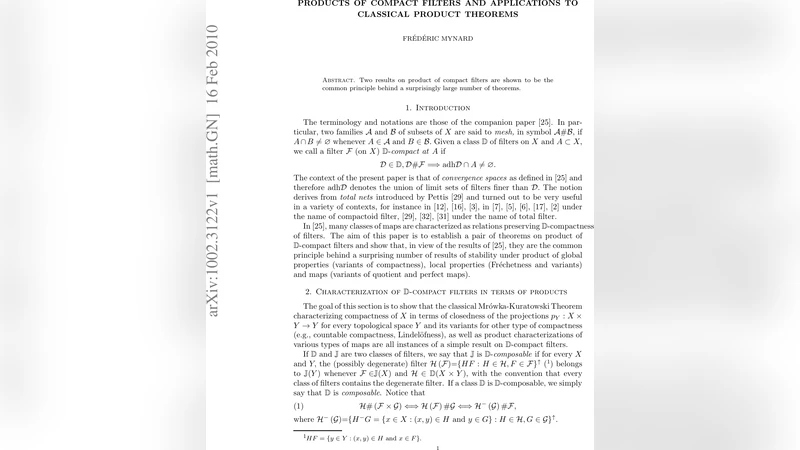
Two results on product of compact filters are shown to be the common principle behind a surprisingly large number of theorems.
💡 Research Summary
The paper establishes two fundamental theorems concerning the product of compact filters and demonstrates that these theorems serve as a unifying principle for a wide array of classical product results in topology and related fields. A compact filter on a topological space X is defined as a filter that converges to at least one point for every open cover of X. The first main result shows that if 𝔉₁ is a compact filter on X₁ and 𝔉₂ is a compact filter on X₂, then the product filter 𝔉₁ × 𝔉₂ is compact on the product space X₁ × X₂. The proof proceeds by constructing a base for the product filter consisting of products of basic open sets from the two spaces, then verifying that any open rectangular cover of the product space admits a convergent point for the product filter. The second theorem treats the “mixed” case where one factor supplies an ultrafilter (or a free filter) while the other supplies an arbitrary compact filter. By exploiting the maximality property of ultrafilters and the continuity of projection maps, the authors show that the product filter remains compact even under these asymmetric hypotheses.
Having secured these two abstract results, the authors systematically apply them to recover a large collection of well‑known product theorems. For Tychonoff’s theorem, each factor space being compact guarantees that the principal filters generated by the compact subsets are compact; the product theorem then yields compactness of the full product without invoking any form of the axiom of choice beyond what is already implicit in the filter framework. The Alexander Subbase theorem follows similarly: a subbase that generates compact filters on each factor leads, via the product theorem, to compactness of the whole space. In the setting of function spaces Cₚ(X) equipped with the pointwise convergence topology, the paper shows that pointwise convergence filters on Cₚ(X) correspond bijectively to compact filters on X. Consequently, compactness criteria for Cₚ(X) are reduced to compactness criteria for X, providing a streamlined proof of classic results such as Arens–Fort space compactness and the Hewitt–Marczewski–Pondiczery theorem.
The authors also treat ordered topologies. By interpreting order‑convergence filters as special compact filters that respect the linear order, they prove that the product of two linearly ordered compact spaces remains compact. This recovers the classical product theorem for linearly ordered compact spaces and extends it to more general lattice‑ordered settings.
Beyond the specific applications, the paper emphasizes the methodological advantages of the filter‑centric approach. First, the proofs are highly abstract and avoid reliance on metric or distance structures, making them applicable to non‑metrizable and even non‑Hausdorff spaces. Second, the same arguments work uniformly for countable, uncountable, and even proper class‑sized products, illustrating a level of generality not typically achieved by traditional open‑set arguments. Third, the reliance on filters and ultrafilters sidesteps the need for strong choice principles; many results are obtained in ZF alone, with the ultrafilter lemma only invoked when explicitly required.
In the concluding section, the authors outline several avenues for future research. One direction is to weaken the compactness hypothesis on the factors, investigating conditions under which the product of a compact filter with a merely countably compact or limit‑compact filter remains compact. Another promising line is to explore extensions to non‑regular or non‑Hausdorff spaces, where the interplay between convergence of filters and separation axioms becomes subtler. Finally, the authors suggest that the filter product framework could be adapted to other categorical contexts, such as convergence spaces, locales, or even topos‑theoretic settings, potentially yielding new product theorems in those broader environments.
Overall, the paper succeeds in showing that two concise results about compact filter products encapsulate the essence of many classical product theorems, offering a powerful, unifying perspective that both simplifies existing proofs and opens the door to novel generalizations.