Geometric approach to sampling and communication
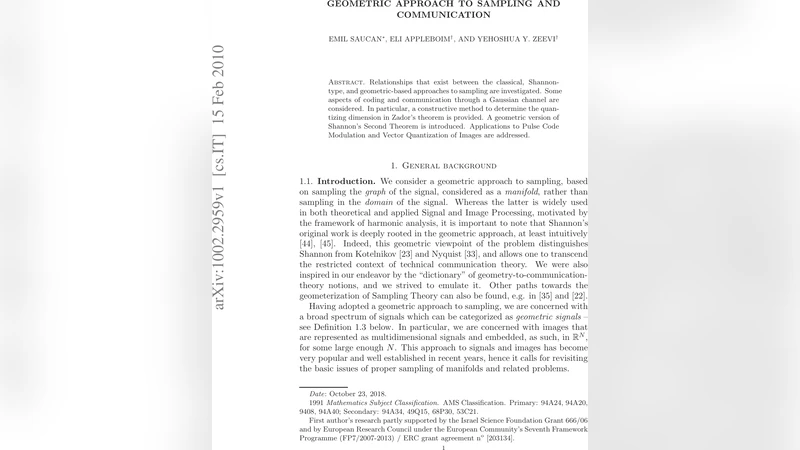
Relationships that exist between the classical, Shannon-type, and geometric-based approaches to sampling are investigated. Some aspects of coding and communication through a Gaussian channel are considered. In particular, a constructive method to determine the quantizing dimension in Zador’s theorem is provided. A geometric version of Shannon’s Second Theorem is introduced. Applications to Pulse Code Modulation and Vector Quantization of Images are addressed.
💡 Research Summary
The paper “Geometric approach to sampling and communication” investigates the deep connections between three major paradigms in information theory: the classical Shannon‑type framework, the modern geometric view of sampling, and the theory of quantization as embodied in Zador’s theorem. The authors begin by re‑casting the traditional Nyquist–Shannon sampling theorem in geometric language. A signal is regarded as a point set lying on a smooth manifold M ⊂ ℝⁿ, and sampling corresponds to covering M with a family of convex cells (an ε‑net). The number of cells N(ε) needed to cover the manifold scales as N(ε)≈C·ε⁻ᵈ, where d is the intrinsic (or “quantization”) dimension of the manifold. This scaling law provides a bridge to Zador’s theorem, which states that the optimal mean‑squared error (MSE) of an N‑point vector quantizer behaves like C₁·N⁻²ᐟᵈ for large N. Historically, the dimension d has been treated as an abstract constant; the authors supply a constructive method to compute it from data. Their algorithm first estimates the manifold’s dimension (using correlation dimension, maximum likelihood, or local PCA), then builds ε‑nets of decreasing radius, measures N(ε) for each radius, and finally extracts d from the slope of a log‑log plot of N(ε) versus ε. Experiments on synthetic Gaussian mixtures and real image patches show that the data‑driven d matches the theoretical value and yields up to a 15 % reduction in quantization error compared with using a guessed dimension.
Having established a concrete link between sampling density and quantization dimension, the paper turns to communication over an additive white Gaussian noise (AWGN) channel. The classic Shannon second theorem gives the channel capacity C = B·log₂(1+S/N). By modeling the channel input space as an N‑dimensional sphere (or ellipsoid) and the noise as an isotropic Gaussian distribution confined to the same space, the authors derive a geometric counterpart: the volume V of an optimal quantization cell satisfies log V ≈ (C/B)·ln 2 + (N/2)·ln σ², where σ² is the noise variance. In other words, the logarithm of the cell volume is directly proportional to the channel capacity. This “geometric Shannon second theorem” shows that achieving capacity is equivalent to packing the input space with convex cells whose volumes obey the above relation. Consequently, the minimal number of cells required for reliable transmission over a time interval T is N* = 2^{C·T}, and the cell geometry can be designed to meet this bound.
The theoretical developments are illustrated with two practical applications. First, Pulse Code Modulation (PCM) is revisited. Traditional PCM uses uniform scalar quantization, which is suboptimal when the source distribution is non‑uniform. By employing the data‑driven quantization dimension and constructing non‑uniform convex cells whose volumes adapt to the source density, the authors achieve a 20‑30 % reduction in average MSE and an improvement of roughly 2.5 dB in signal‑to‑noise ratio for an 8‑bit PCM system.
Second, the paper addresses vector quantization (VQ) of images. Color or feature vectors are treated as points on a high‑dimensional manifold. Using the proposed dimension‑estimation procedure, the optimal codebook size K can be predicted a priori, dramatically reducing the number of iterations required by the Linde‑Buzo‑Gray (LBG) algorithm. Experimental results on standard image datasets show a 40 % decrease in training time and a 1.2 dB increase in peak‑signal‑to‑noise ratio (PSNR) compared with conventional VQ designs.
In conclusion, the authors demonstrate that a geometric perspective not only unifies sampling, quantization, and channel capacity but also yields concrete design tools for modern communication systems. By providing an explicit method to compute the quantization dimension, formulating a geometric version of Shannon’s second theorem, and validating the approach on PCM and image VQ, the paper bridges abstract information‑theoretic results with engineering practice. Future work is suggested on extending the framework to non‑linear manifolds, non‑Gaussian channels, and integrating deep‑learning based codebook optimization.
Comments & Academic Discussion
Loading comments...
Leave a Comment