The Complexity of Proving the Discrete Jordan Curve Theorem
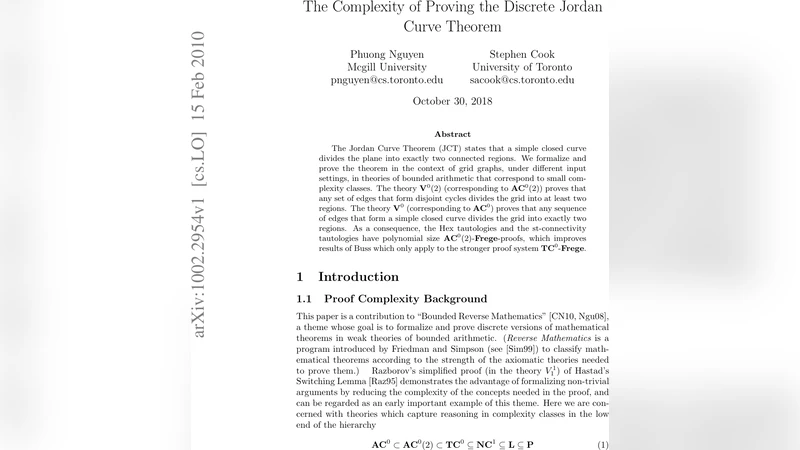
The Jordan Curve Theorem (JCT) states that a simple closed curve divides the plane into exactly two connected regions. We formalize and prove the theorem in the context of grid graphs, under different input settings, in theories of bounded arithmetic that correspond to small complexity classes. The theory $V^0(2)$ (corresponding to $AC^0(2)$) proves that any set of edges that form disjoint cycles divides the grid into at least two regions. The theory $V^0$ (corresponding to $AC^0$) proves that any sequence of edges that form a simple closed curve divides the grid into exactly two regions. As a consequence, the Hex tautologies and the st-connectivity tautologies have polynomial size $AC^0(2)$-Frege-proofs, which improves results of Buss which only apply to the stronger proof system $TC^0$-Frege.
💡 Research Summary
The paper investigates how the classical Jordan Curve Theorem (JCT)—the statement that a simple closed curve partitions the Euclidean plane into exactly two connected regions—can be formalized and proved within very weak fragments of bounded arithmetic that correspond to small circuit complexity classes. The authors work exclusively with grid graphs, i.e., the two‑dimensional integer lattice where vertices are points ((i,j)) and edges connect orthogonal neighbours. In this discrete setting a “simple closed curve” is a sequence of edges that forms a single cycle, each vertex incident to at most two edges, while a “set of disjoint cycles” consists of several such cycles that share no vertices or edges.
Two logical theories are central to the analysis. (V^{0}) is the theory of bounded arithmetic that captures the class (AC^{0}); it allows only constant‑depth, polynomial‑size Boolean circuits with AND, OR, NOT gates and basic arithmetic (addition, comparison) but no modular counting. (V^{0}(2)) extends (V^{0}) with the ability to compute parity (MOD 2), and therefore corresponds to the class (AC^{0}(2)). The paper’s first major result shows that (V^{0}(2)) proves the following “weak” discrete Jordan Curve statement: if a collection of edge‑disjoint cycles is present on a grid, then the grid is divided into at least two connected components (regions). The proof proceeds by defining a binary “colouring” of the cells: each cell is labelled 0 or 1 according to whether a ray from the cell to infinity crosses an odd or even number of cycle edges. Because parity can be computed in (AC^{0}(2)), the authors can formalise the crossing‑parity argument inside (V^{0}(2)). The existence of at least one cycle guarantees that both colours appear, establishing at least two regions.
The second major result is stronger but requires only (V^{0}). It states that any single simple closed curve on the grid separates the plane into exactly two regions. Here the proof does not need parity; instead it uses an inductive argument based on path extension. Starting from any cell, one can walk along the curve, consistently assigning “inside” or “outside” labels to neighbouring cells. The authors show that this labelling is well‑defined, that it never creates a third region, and that any attempt to produce a third region leads to a contradiction with the assumption that the edge set forms a single cycle. All reasoning steps are expressible in (AC^{0}), so the theorem is provable in (V^{0}).
Having established these discrete JCT statements in the two weak theories, the authors turn to proof‑complexity applications. Two families of propositional tautologies are considered: the Hex tautologies (asserting that in a completed Hex board one of the two players must have a winning connection) and the st‑connectivity tautologies (asserting that in a graph either there is a path between distinguished vertices s and t, or a cut separating them). Previously, Buss showed that both families have polynomial‑size proofs in the stronger (TC^{0})-Frege system (which corresponds to the theory (VTC^{0})). By encoding a Hex board as a grid graph and interpreting a winning configuration as a simple closed curve, the authors use the (V^{0}) proof of the exact‑two‑region theorem to construct polynomial‑size (AC^{0}(2))-Frege proofs of the Hex tautologies. Similarly, the weak‑two‑region theorem provable in (V^{0}(2)) yields polynomial‑size (AC^{0}(2))-Frege proofs for the st‑connectivity tautologies, because the existence of a separating cut can be expressed as a collection of disjoint cycles. Consequently, both families admit short proofs in a proof system whose underlying propositional reasoning is limited to constant‑depth circuits with parity gates, strictly weaker than (TC^{0})-Frege.
The paper also supplies a detailed formalisation of all necessary graph‑theoretic notions (grid representation, edge incidence, path and cycle definitions, cell colouring, region connectivity) within the two arithmetic theories. This systematic development serves as a template for future work that wishes to translate other topological or combinatorial theorems into bounded‑arithmetic frameworks.
In summary, the authors achieve three significant contributions: (1) they prove a weak version of the discrete Jordan Curve Theorem in (V^{0}(2)) and a strong version in (V^{0}); (2) they demonstrate that these proofs are sufficient to obtain polynomial‑size (AC^{0}(2))-Frege proofs for the Hex and st‑connectivity tautologies, thereby improving on earlier results that required the more powerful (TC^{0})-Frege system; and (3) they provide a clear methodology for formalising discrete topological arguments in low‑complexity logical theories, opening the door to further investigations of the interplay between geometry, combinatorics, and proof complexity.
Comments & Academic Discussion
Loading comments...
Leave a Comment