As compared to load demand, frequent wind energy intermittencies produce large short-term (sub 1-hr to 3-hr) deficits (and surpluses) in the energy supply. These intermittent deficits pose systemic and structural risks that will likely lead to energy deficits that have significant reliability implications for energy system operators and consumers. This work provides a toolset to help policy makers quantify these first-order risks. The thinking methodology / framework shows that increasing wind energy penetration significantly increases the risk of loss in California. In addition, the work presents holistic risk tables as a general innovation to help decision makers quickly grasp the full impact of risk.
Deep Dive into Risk Quantification Associated with Wind Energy Intermittency in California.
As compared to load demand, frequent wind energy intermittencies produce large short-term (sub 1-hr to 3-hr) deficits (and surpluses) in the energy supply. These intermittent deficits pose systemic and structural risks that will likely lead to energy deficits that have significant reliability implications for energy system operators and consumers. This work provides a toolset to help policy makers quantify these first-order risks. The thinking methodology / framework shows that increasing wind energy penetration significantly increases the risk of loss in California. In addition, the work presents holistic risk tables as a general innovation to help decision makers quickly grasp the full impact of risk.
HIS work is presented as a companion to our paper submitted for publication [1]. Two important outputs in that report are: (1) If the components in California's Renewable Portfolio Standard (RPS) grow at current rates, wind energy will constitute 15% of the state's energy generation by 2016; 1 (2) The state has energy reserve capacity between 2 and 5 GWh (5 to 10% of total 2009 energy demand) consisting of spinning (and other) reserves. For the wind component of the RPS (wRPS) greater than 5%, the current reserve capacity is too low and not correctly configured to mitigate the risks associated with wind intermittency.
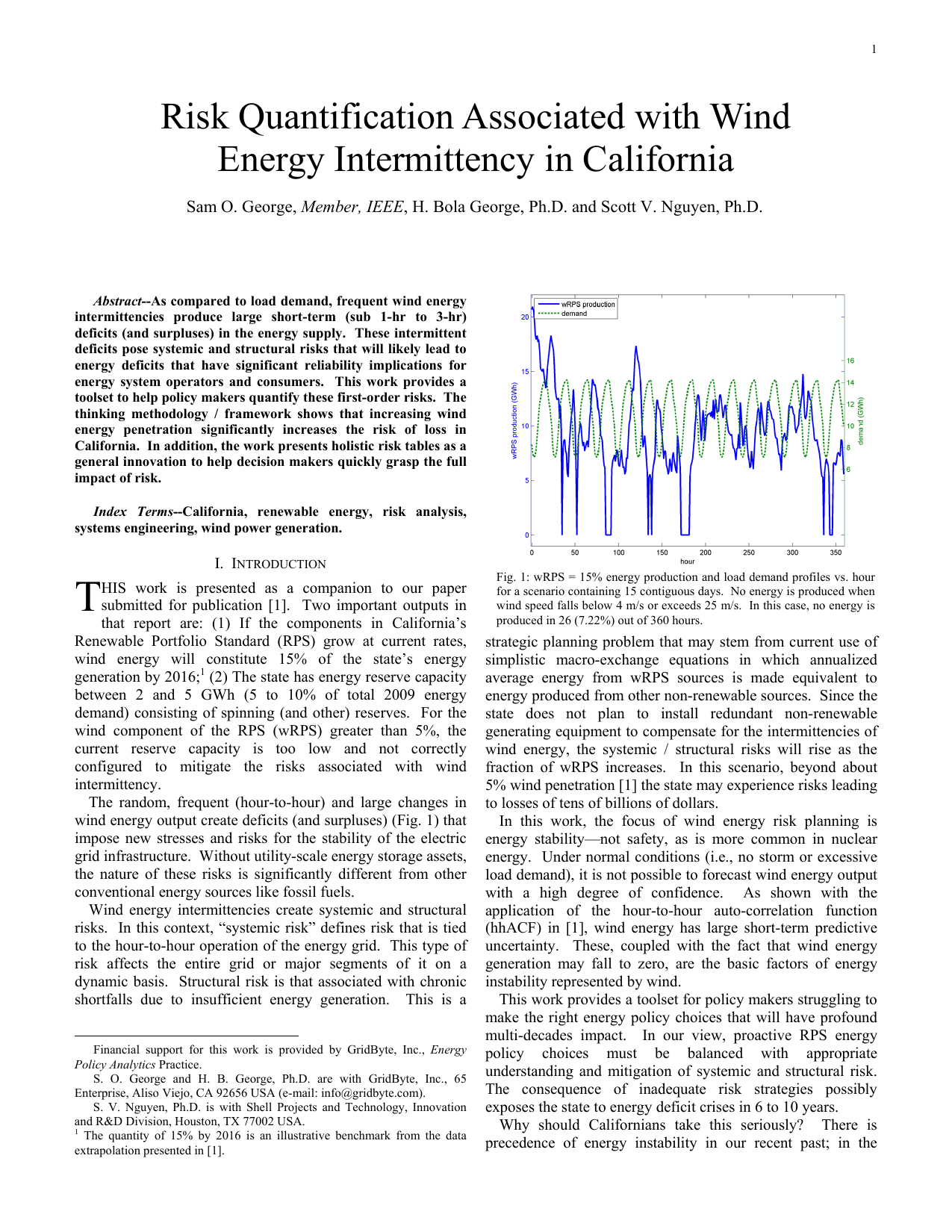
The random, frequent (hour-to-hour) and large changes in wind energy output create deficits (and surpluses) (Fig. 1) that impose new stresses and risks for the stability of the electric grid infrastructure. Without utility-scale energy storage assets, the nature of these risks is significantly different from other conventional energy sources like fossil fuels.
Wind energy intermittencies create systemic and structural risks. In this context, “systemic risk” defines risk that is tied to the hour-to-hour operation of the energy grid. This type of risk affects the entire grid or major segments of it on a dynamic basis. Structural risk is that associated with chronic shortfalls due to insufficient energy generation. This is a Financial support for this work is provided by GridByte, Inc., Energy Policy Analytics Practice. S. O. George and H. B. George, Ph.D. are with GridByte, Inc., 65 Enterprise, Aliso Viejo, CA 92656 USA (e-mail: info@gridbyte.com).
S. V. Nguyen, Ph.D. is with Shell Projects and Technology, Innovation and R&D Division, Houston, TX 77002 USA. 1 The quantity of 15% by 2016 is an illustrative benchmark from the data extrapolation presented in [1]. strategic planning problem that may stem from current use of simplistic macro-exchange equations in which annualized average energy from wRPS sources is made equivalent to energy produced from other non-renewable sources. Since the state does not plan to install redundant non-renewable generating equipment to compensate for the intermittencies of wind energy, the systemic / structural risks will rise as the fraction of wRPS increases. In this scenario, beyond about 5% wind penetration [1] the state may experience risks leading to losses of tens of billions of dollars.
In this work, the focus of wind energy risk planning is energy stability-not safety, as is more common in nuclear energy. Under normal conditions (i.e., no storm or excessive load demand), it is not possible to forecast wind energy output with a high degree of confidence. As shown with the application of the hour-to-hour auto-correlation function (hhACF) in [1], wind energy has large short-term predictive uncertainty. These, coupled with the fact that wind energy generation may fall to zero, are the basic factors of energy instability represented by wind.
This work provides a toolset for policy makers struggling to make the right energy policy choices that will have profound multi-decades impact. In our view, proactive RPS energy policy choices must be balanced with appropriate understanding and mitigation of systemic and structural risk. The consequence of inadequate risk strategies possibly exposes the state to energy deficit crises in 6 to 10 years.
Why should Californians take this seriously? There is precedence of energy instability in our recent past; in the structural energy crises of 2000-2001, it is estimated that California lost $40 to $45 billion (about 3.5% of Gross State Product (GSP)) [2]. During this period, the state experienced rolling blackouts (load shedding) over 38 days [3] as energy demand exceeded supply by an average of 600 MW. In some cases, electricity customers lost power for up to 16 hours. 2Again, as cited in [1], notable recent precedents exist in Denmark and Texas. A note about reading this document: The purpose is to provide an analytics framework for energy risk quantification. Of course, it is possible that businesses and government will not stand by and allow wRPS risks to become chronic. The reality is that we are operating under mandates codified in California law (CA AB 32 / Governor’s executive order) to achieve 33% RPS (RPS33) by 2030. The logical action is that risk mitigation infrastructure will be added to cope with the inherent intermittencies of wind energy. One essential component of risk mitigation infrastructure may include utility-scale storage.
Without significant utility-scale storage, wind energy should not be equated with energy from conventional sources (e.g., fossil-based). The underlying risk is that wind energy has large random short-term (sub 1-hr to 3-hr) intermittencies, as shown in Fig. 1, that necessitate constant compensation [1]. The energy-exchange macro equations equate the statistical average energy from wRPS generator sites to the absolute energy produced from conventional sources. Moreover, the statis
…(Full text truncated)…
This content is AI-processed based on ArXiv data.