Invariant formulation of surfaces associated with $CP^{N-1}$ models
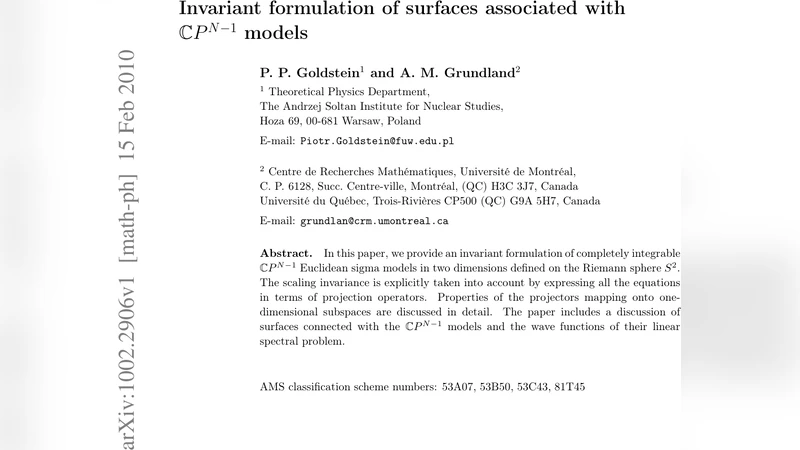
In this paper, we provide an invariant formulation of completely integrable $CP^{N-1}$ Euclidean sigma models in two dimensions defined on the Riemann sphere $S^2$. The scaling invariance is explicitly taken into account by expressing all the equations in terms of projection operators. Properties of the projectors mapping onto one-dimensional subspaces are discussed in detail. The paper includes a discussion of surfaces connected with the $CP^{N-1}$ models and the wave functions of their linear spectral problem.
💡 Research Summary
The paper presents a fully invariant formulation of the two‑dimensional Euclidean CP^{N‑1} sigma model defined on the Riemann sphere S², by recasting the theory entirely in terms of rank‑one projection operators. Traditional descriptions employ a normalized complex vector z (‖z‖=1) together with a gauge connection derived from z. While this representation is convenient for many analytical purposes, it obscures the model’s scale invariance because the vector itself transforms under a global rescaling z → λz. The authors circumvent this issue by introducing the Hermitian projector P = zz†, which satisfies P² = P, Tr P = 1, and, crucially, is invariant under any non‑zero scalar multiplication of z. Consequently, all dynamical quantities—Lagrangian density, equations of motion, conserved currents—can be expressed solely through P, guaranteeing that scale symmetry is built into the formalism from the outset.
The Lagrangian is rewritten as L = Tr(∂_μP ∂^μP). Varying this functional yields the compact Euler‑Lagrange equation
Comments & Academic Discussion
Loading comments...
Leave a Comment